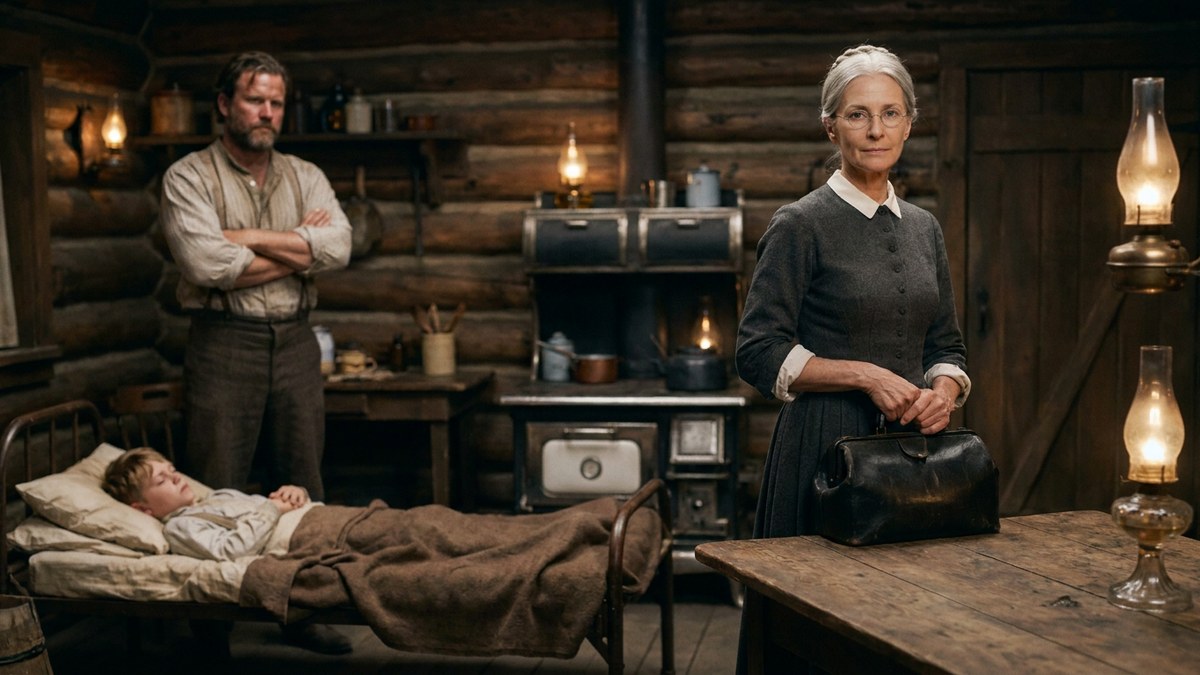
"I'm not going to cut him, Mr. Dillard," Harriet said. "I'm going to set his leg. Dr. Reeves didn't."
"Reeves is a surgeon. He was in the war."
"He was. And he tied up a broken thigh the way it lay, and it's been grinding on itself for eight hours, and if nobody puts it right tonight, he'll come back in the morning and take it off." She kept her voice level. "You saw his hands this afternoon, Mr. Dillard. Would you let him take your son's leg off with those hands?"
Dillard's jaw worked.
"I'll fetch a doctor from Denver."
"That's two days there and two days back. Look at the swelling. Look at his color." She did not move toward the cot. She stood where she was, with her coat over her arm. "I won't touch him without your leave. It's your house and your son. But you need to know what you're choosing."
Cass Dillard did not move.
On the cot, Tommy turned his head.
"Pa," he said, in that thin, high voice. "Please."
Dillard looked down at his son. Something went out of his shoulders. When he spoke, it was to the floor.
"My wife died in that room," he said. "Tommy was three days old. She took a fever, and the nearest doctor was forty miles, and by the time I got him here, she was gone. I swore that boy would never be sick a day without a real doctor in reach. I've paid Reeves for twelve years to be that doctor."
"I know," said Harriet. "And tonight, Mr. Dillard, I'm the real doctor in reach."
He looked up at her. A long, hard look.
Then he unfolded his arms and stepped aside.
"What do you need?" he said.
"You," said Harriet. "At the head of the table. Holding his shoulders. Whatever happens, you don't let go."
They moved Tommy to the kitchen table, on folded quilts, under every lamp in the house.
Harriet put a few drops of chloroform on a folded cloth and held it a little above the boy's face, and talked to him, and counted with him, until his eyes closed and his breathing went long and slow. She watched his breathing the whole time after that, and his lips, and the pulse in his throat.
She cut away Reeves's boards and bedsheet.
Then she took hold of the boy's ankle with both hands, and leaned back, slowly, with her whole weight, the way the professor in Philadelphia had shown them on a skeleton, and pulled.
It took a very long time. The muscles of a boy's thigh are stronger than anyone would think. Harriet pulled until her arms shook and her back burned, steady, never jerking, while Cass Dillard held his son's shoulders at the other end of the table with his eyes shut. She felt the broken ends of the bone slide, and catch, and slide again.
Then she felt them come into line. She knew it by the way the thigh suddenly changed shape under her hand. The leg was the same length as the other one.
"Hold him," she said through her teeth. "Don't let go yet."
The next part was the method she had come for.
She ran strips of sticking plaster down both sides of the boy's leg, from above the knee to below the ankle, and bound them on smooth with muslin, and left a loop of plaster hanging below the foot. Mrs. Ortiz's husband nailed a wooden spool to the foot of Tommy's bed for a pulley. Harriet tied a cord to the loop, ran it over the spool, and hung on it a bag with two of Mrs. Ortiz's flatirons inside.
The weight hung there and pulled, gently and steadily, all the time, so the thigh muscles could not drag the bone ends past each other again.
"Six weeks," she told Dillard. "He doesn't get up. He doesn't get out of this. You raise the foot of the bed on blocks, so his own weight pulls against it. If the leg swells or turns cold or he gets a fever, you send for me at once. Not Reeves. Me."
Cass Dillard stood by his son's bed and looked at the flatirons hanging from the spool.
"That's all it is?" he said. "Flatirons?"
"A doctor in New York named Buck worked it out before the war," Harriet said. "They used it on thousands of soldiers. Flatirons do just as well as anything."
She rode out to the Dillard place twice a week for six weeks.
Tommy's fever broke on the third day. The swelling went down in the second week. He complained bitterly in the third week about being bored, which Harriet said was the best sign of all. She brought him books from her own shelf and taught him to play chess on a board balanced on his chest.
On the first of December, she took the weights off. In January, he walked across the kitchen on crutches. In March, he walked without them, with both legs the same length and no limp at all, and Cass Dillard came into town and stood in Harriet's little front room behind the general store with his hat in his hands.
"I owe you more than money," he said.
"You owe me twenty-two dollars," said Harriet. "And I'd take it kindly if you'd stop calling me the hen doctor."
"I never called you that." He paused. "Not out loud."
He paid the twenty-two dollars. He also did something else.
That summer, when Dillard's foreman broke his collarbone, Dillard sent for Harriet Lowell. When one of his riders was kicked by a horse, he sent for Harriet Lowell. And when men in the valley asked him why in the world he'd send for a woman, Cass Dillard told them about the flatirons, every time, at length, until they stopped asking.
By 1887, she was the only doctor in the valley. Amos Reeves went to Denver to dry out, and Harriet wrote him a letter of introduction to a hospital there, and never told anyone she had.
Tommy Dillard became a doctor himself. He studied at the University of Colorado, and when he hung out his shingle in Denver in 1898, the first thing he hung up beside his diploma, in a little glass case, was a flatiron.
> What really happened: A small number of women doctors practiced in the West in the 1880s, most trained at women's medical colleges such as the Woman's Medical College of Pennsylvania, founded in 1850, and many faced open hostility from male colleagues and patients. In 1861 Dr. Gurdon Buck of New York Hospital described a simple traction method for broken thighbones, using adhesive strips on the leg, a cord over a pulley and a hanging weight. It was used widely in Union army hospitals during the Civil War and soon around the world. Sources: Clinical Orthopaedics and Related Research; Wellcome Collection.