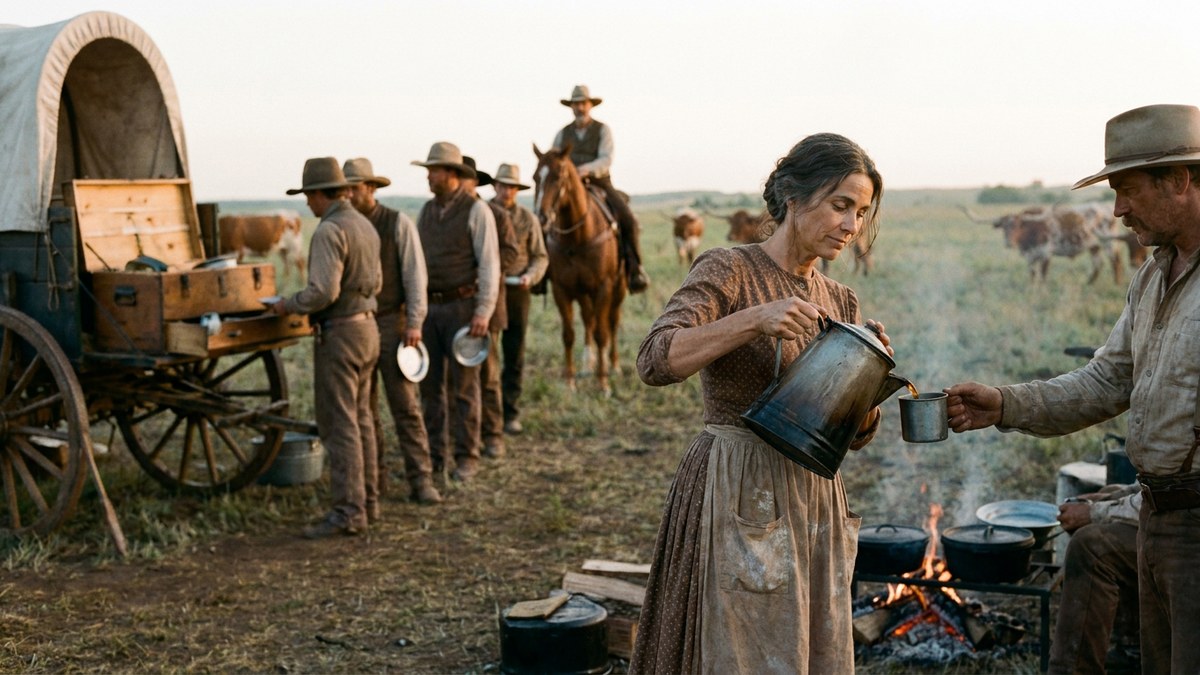
On the third morning out from the Guadalupe River, Pap Maddox climbed down off the chuck wagon in the dark, missed the wheel spoke with his boot, and broke his left arm in two places.
His daughter heard the bone go from twenty feet away. She had been a nurse's helper in the war. She knew the sound.
"Well," said Pap, sitting in the dirt by the wagon tongue with his face white. "Josie, I believe that's done it."
It was April 1874, on the Chisholm Trail, a hundred miles north of San Antonio. The herd was twenty-six hundred longhorn steers bound for the railroad at Wichita, Kansas. There were eleven men with it, and a remuda of seventy horses, and a wrangler, and a trail boss, and one cook.
The cook was Henry Maddox, called Pap. He was seventy years old. He had cooked for trail herds since 1866, and he was the best trail cook in South Texas, and every man in the outfit knew it.
His daughter, Josephine Clay, was forty-four, a widow, and had no business being there at all.
She had driven her father to the herd's starting camp in her buggy, because he was seventy and stubborn and she did not like him making the trip alone. She had meant to turn around after the first day and go home. On the second day it had rained, and the creeks were up. On the third morning, Pap broke his arm.
The trail boss was Warren Tate.
He was fifty-six, gray and narrow and tough as harness leather, and he had been taking herds up the trail for eight years. He had a few rules, which every hand in South Texas could recite. No liquor. No cards on the trail. No racing the horses.
And no women.
He had said it to Josie on the first morning, politely, with his hat in his hand. "Ma'am, I'm obliged to you for bringing your father. But you'll be heading home today. The trail's no place for a lady."
"I'm not much of a lady, Mr. Tate," she had said. "But I'll be heading home."
Now it was the third morning, and the cook was sitting in the dirt with a broken arm.
Josie set the arm with two splints from a broken wagon slat and her own petticoat, while Pap swore at her in two languages and Warren Tate held his shoulders.
Then Tate stood up and looked north, up the trail, and then south, back down it.
"Nearest town big enough to hire a cook in is San Antonio," he said. "Two days back. Find a cook there, if there's one to be had in April, which there won't be. Bring him up. That's four, five days lost." He rubbed his jaw. "I can't hold twenty-six hundred steers on this grass five days. They'll walk off the weight we're driving them to sell."
"Then don't hold them," said Josie.
He looked at her.
"I can drive that wagon," she said. "I can cook. I've cooked for my father's whole family and half the county at every barbecue since I was twelve. He taught me everything he knows, and the parts he forgot, I made up myself. And somebody has to take care of his arm."
"Ma'am," said Warren Tate. "I said no women."
"You did," Josie agreed. "And you need a cook by noon."
From the dirt by the wagon tongue, Pap Maddox laughed until he had to stop and hold his arm.
Warren Tate looked at his men.
Eleven trail hands stood around the cold fire in the gray light, holding their empty tin cups, looking at the chuck wagon. Nobody had had coffee. Nobody had had breakfast. They had a two-month drive ahead of them across Indian Territory and three big rivers.
"To the Red River," Tate said finally. "Just to the Red. We'll find a cook at the crossing. Then you'll go home."
"To the Red," said Josie.
She took off her bonnet and rolled up her sleeves.
Breakfast was forty minutes late. Nobody said a word about it. By the second day, it was on time.
Josie was up at three every morning, before anyone, building the fire. She made sourdough biscuits from the crock Pap had kept alive for eight years. She made coffee strong enough, the hands said, to float a horseshoe. She made beans, and sowbelly, and son-of-a-gun stew when they butchered a lame steer, and a vinegar pie on Sundays.
She drove the wagon herself every day, ahead of the herd, with Pap on the seat beside her giving orders she ignored. At noon and at night she had the fire going and the food ready before the herd came up.
She also lanced a boil, pulled a tooth, and sewed up a cut on the wrangler's head with Pap's needle and thread.
On the eighth night, a hand named Billy Dunn told her it was the best grub he'd had on any trail. Then he looked at Warren Tate quickly, as if he expected to be fired.
Warren Tate ate his stew and said nothing.
They reached the Red River on the nineteenth day, in the afternoon.
It was in flood. It was wide and red and fast, full of whole trees turning slowly in the current, and the far bank was a quarter mile off. Herds were stacked up along the south bank waiting to cross. There was no cook to be had at the crossing, or anywhere.
Tate rode up and down the bank all evening. In the morning, he said they'd cross.
The herd went first, swimming, with the men on both sides yelling and swinging their ropes. They got across with two steers lost.
Then it was the wagon's turn.
Josie drove the mules down the bank into the water with Pap on the seat beside her and the wagon box caulked as tight as they could make it. The mules swam. The wagon floated, rocking. For the first two hundred yards it went well.
Then, in the middle of the river, a drifting cottonwood came down on them, roots first, and hit the wagon broadside.
The wagon swung around. The near mule went under. And Pap Maddox, with his one good arm, went over the side into the red water.