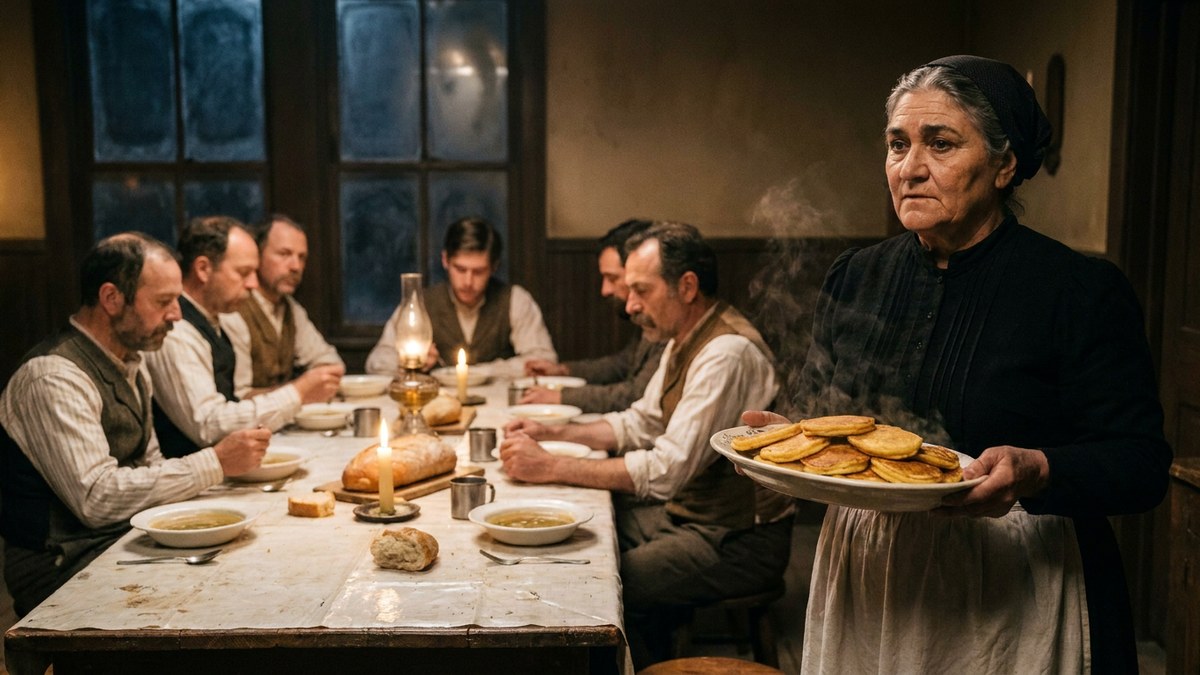
Josefa Aldazabal had cooked Christmas Eve supper for twelve sheepherders every year for nine years, and in all that time she had never once heard Mikel Etxeberri speak.
It was December 1899, in Winnemucca, Nevada. Snow lay on the desert all the way to the mountains, and the sheep were in the winter range, and the herders who were not out with them had come down into town to the boardinghouse on Bridge Street, the way they did every winter.
Josefa was sixty-one. She ran the house with her husband, Pello, who kept the bar and the books. She did everything else.
They came from the Basque Country, on both sides of the mountains between Spain and France. They had come to Nevada young and alone, to herd other men's sheep in the desert for two years or five or ten, and send their wages home, and someday go back and buy a farm.
Most of them never went back.
In the summer they lived alone with the flocks for months, in the high country, with a dog and a tent and a burro, and saw no one but the camp tender once a week. In the winter they came down to the boardinghouses in Winnemucca and Elko and Battle Mountain, to sleep in a bed and eat at a table and speak their own language, which almost no one else in America understood.
Josefa's boardinghouse was their mail drop and their bank and their translator and their church. Pello said she was their mother. She told Pello not to be foolish. But she knew every one of their villages.
That was the plan she had made for this Christmas Eve, and she had been making it since October.
Every dish on the table would come from one of their villages.
For Joanes and the two Arrieta brothers from Bizkaia, salt cod in garlic and oil, the way their mothers made it. For old Fermin from Navarre, the red peppers and the lamb. For the three boys from the French side, from Baigorri and Garazi, the thick bean and cabbage soup they called garbure. For Ander, who was from Gipuzkoa and homesick enough to cry when he was drinking, the walnut cream that was eaten there on Christmas Eve and nowhere else. And corn cakes, talo, hot off the griddle, for everyone, because everyone's grandmother had made those.
She had written to San Francisco for the salt cod in October, and for the walnuts and the dried peppers. She had saved for it all fall out of the house money.
It would be the best Christmas Eve any of them had had since they left home. She had decided that.
On the twenty-second, the freight came in on the railroad. The walnuts were there, and the peppers.
The salt cod was not.
"Next week," said the freight agent, looking at his papers. "Maybe after New Year's. Snow on the Sierra."
Josefa stood on the platform in the cold with her shawl around her and did not say anything for a moment. Salt cod was Christmas Eve, for half her men. Without it, the supper had a hole in it.
Then she went to the butcher and bought every pound of fresh trout he had, which was not much, and went home and started thinking.
On the twenty-third, the fight started.
It was about nothing, the way those things always were. Fermin from Navarre said something about the French Basques and their soup, and one of the Baigorri boys said something about Navarre and its pigs, and in the bar that night it came to shoving, and then to a broken chair.
Pello threw both of them out into the snow for an hour to cool off.
Josefa swept up the chair. She did not say a word. But she sat up late that night in the kitchen with her hands around a cup of coffee, thinking that Christmas Eve might be a very long supper indeed.
And there was Mikel.
He had come to the house nine years ago, at sixteen, from a mountain village on the French side so small it was not on any map Josefa owned. He came with his uncle, who herded with him in the Santa Rosa range.
That first winter, the two of them sat at the end of the long table and the uncle talked for both of them. Mikel laughed at his jokes. He had a laugh you could hear in the street.
The next winter, Mikel came down from the mountains alone.
His uncle had died at sheep camp in a February blizzard, in the tent, with only Mikel there. Mikel had buried him in frozen ground with a shovel and an axe, and stayed with the flock until spring because there was no one else to stay.
He had not spoken a word since. Not one, in eight years. He ate. He worked. He nodded. He wrote his letters home in a careful hand and gave them to Josefa to mail. Sometimes she thought he did not write anything in them at all.
On Christmas Eve, at seven o'clock, she rang the bell, and they came in from the bar and sat down at the long table under the lamps. Twelve men in clean shirts, with their hair combed wet.
The fish was trout, not cod. Joanes from Bizkaia tasted it and looked at her across the table, and she saw him understand what had happened, and decide to say nothing.
The French boys had their garbure. Fermin had his lamb. Ander saw the bowl of walnut cream and had to get up and go stand in the hall for a minute.
Fermin and the Baigorri boy did not look at each other. They sat at opposite ends of the table with their jaws set, and nobody asked either of them to pass anything.
Mikel sat at the far end where he always sat, alone, and ate, and looked at his plate.
Josefa came out of the kitchen with the last platter of talo, and looked at her twelve men, all of them homesick and stubborn and lonely and pretending not to be. The supper she had planned since October was on the table, and somehow it was not enough.
Then Mikel Etxeberri put down his fork, pushed back his chair, and stood up.