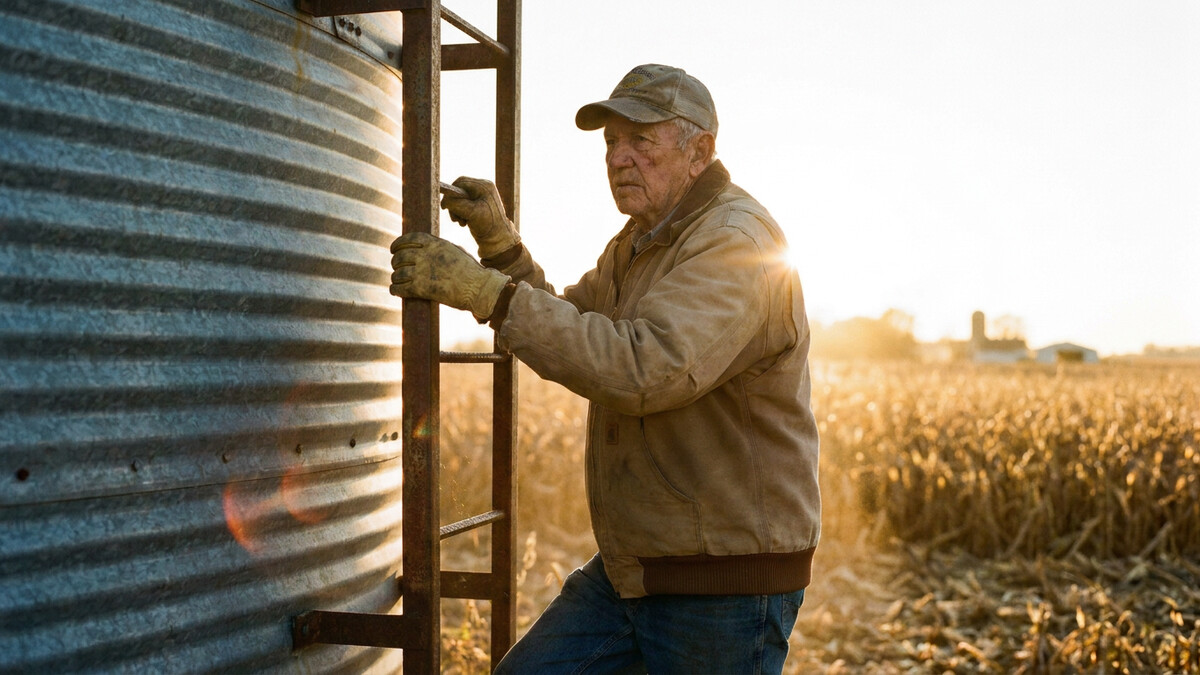
"Austin," Lyle said. "Stop moving."
His voice came out of the hatch flat and hard, like a slammed door. It was the voice his father had used on him when he was a boy. He had not used it on anyone in thirty years.
The boy kept clawing.
"Austin. Look at me. Stop moving right now."
Austin looked up.
"Every time you move, the corn settles tighter around you," Lyle said. "You pull one leg up, and the corn fills in under it, and you go down two inches. You can't climb out. Not even a strong young man can. That's how it gets you." He held the boy's eyes. "Put your arms down on top of the corn. Flat. Like you're floating. And hold still."
"I can't. I'll sink."
"You won't sink if you're still," Lyle said. "The auger's off. It's locked. Nothing's pulling you down anymore. The only thing pulling you down now is you."
Austin stopped.
It took him a while. He was shaking all over. But he put his arms out flat on the corn, and he stopped kicking, and he stopped clawing.
The corn was at his chest. It stayed at his chest.
"Good," Lyle said. "That's good. Now breathe. Slow."
"It's squeezing me," Austin said. "I can't get a deep breath."
"I know. It's the weight. Take little breaths. Little ones. You've got plenty of room. Your head's high. Your arms are free." Lyle kept his voice low and steady. "The fire department's coming. They've got a rescue tube made for exactly this. Twenty minutes. You can hold still for twenty minutes. I've seen men do it."
"You're not going to pull me out?"
"No," Lyle said. "I'm not."
He told him why. Lying there on the cold steel roof, with his chin on the edge of the hatch, he told him.
"In 1966, my little brother was right where you are," he said. "Sixteen years old. In a bin on this farm. I went in after him and grabbed his arms and pulled with everything I had." He paused. "When corn's got you to the chest, it's holding on with hundreds of pounds. A man pulling on your arms can't beat that. He just hurts you. He can tear your shoulders. He can hurt you inside." He stopped. "I didn't know. I was twenty-one. I thought I was saving him."
Austin was quiet. He was looking up at the old man in the hatch.
"I've read everything since," Lyle said. "Every bulletin. Every safety class at the extension office, for sixty years. I've taught it to every man who ever worked here. Shut it off. Lock it out. Don't go in. And if somebody's in, don't pull." He breathed. "I'm not going to make the same mistake twice, son. Not with you."
Mark's pickup came tearing into the bin yard four minutes later, with Nate right behind him on the tractor.
Lyle shouted down to them from the roof before they could start up the ladder.
"Don't come up. Don't come in. Get the plywood from the machine shed. The big sheets. And the battery saw."
Mark stared up at his father on the roof of Bin 4.
"Dad, what are you doing up there?"
"Keeping him calm," Lyle said. "Get the plywood."
They brought it. Lyle had them hand two sheets up the ladder, one at a time. He slid them through the hatch, carefully, and down onto the corn, flat, near the boy but not touching him, so a man could kneel on them without sinking.
He did not go down onto them himself. He was not that kind of fool. He just wanted them there, ready, for the firemen.
Then he had Mark cut a row of holes low on the outside of the bin wall, on the far side from the boy, the way the extension man had shown them in a class in 2009. Corn began to run out of the holes onto the ground in thin yellow streams, slowly lowering the level inside, away from Austin.
"Is it working?" Austin said from inside.
"It's working," Lyle said. "It's coming down. Hold still."
The fire department arrived in nineteen minutes. Two trucks from Mackinaw Bend and a rescue unit from Eureka, with sirens, and eleven volunteers.
The captain was a woman in her forties named Becky Haas. She climbed the ladder in about thirty seconds, looked down through the hatch at the boy lying still in the corn with his arms out flat, and the plywood laid beside him, and the streams of grain running out the side of the bin. Then she looked at the old man lying on the roof.
"Who set this up?" she said.
"I did," Lyle said.
"Sir, you did everything exactly right."
"Not the first time," Lyle said quietly. "This time."
They lowered two firefighters onto the plywood on harnesses. They brought down the curved panels of the rescue tube and fitted them together around Austin, one by one, until he was standing inside a steel ring in the corn. Then they scooped the grain out from inside the ring with buckets, a little at a time, until the weight came off his chest and his stomach and his legs.
It took fifty minutes.
At eleven-forty, they raised Austin Reyes out of the top hatch of Bin 4 in a harness, pale and shaking, with corn dust in his hair, and lowered him down the outside of the bin to the ambulance.
He was bruised. He was exhausted. He had a cracked rib from the weight of the corn.
He was fine.
It took Lyle twelve minutes to come down the ladder. Becky Haas came down beside him the whole way, one rung below, with her hand near his back.
At the bottom, his son was waiting. Mark did not say anything about promises. He just put his arms around his father in the bin yard, in front of eleven firefighters, and held on for a long time.
Austin came back to the farm in December, when his rib had healed.
He did not come for work. Harvest was over. He came with his mother, and she brought a pie, and she cried in Lyle's kitchen and could not say anything.
Before he left, Austin asked if he could see the bins.
Lyle walked him out to Bin 4. It was empty now, swept clean, the hatch closed. On the steel wall beside the ladder, at eye level, there was a sign. A new one. Mark had made it.
NEVER ENTER WHEN THE AUGER IS RUNNING. LOCK IT OUT. DON'T PULL. CALL 911.
And below it, a smaller line, in white paint.
In memory of Dean Ebersole, 1950 to 1966.
Austin read it twice. Then he turned to the old man beside him.
"Mr. Ebersole," he said. "Next fall. Can I work for you again?"
Lyle looked at the sign for a long time.
"First day," he said, "I'll tell you the same thing I tell all of them."