Richard Haskell didn't take the microphone at first. He looked at it like it might bite him.
"Mrs. DiNapoli, I don't think that's appropriate."
"Why not?" Connie asked pleasantly. "You don't trust the caller. So be the caller. You can spin the cage, pull the balls, read them out. I won't touch a thing." She held it a little closer. "I'll be at the second table, right in front of the stage. Where you can see me."
Two hundred people were watching. Somebody at the Holy Name Society table laughed out loud.
Richard Haskell's ears went red. He stood up, and took the microphone, and walked up to the stage with his leather notebook under his arm.
Connie walked to the second table and sat down next to Rosemarie.
Rosemarie looked at her with wet eyes. "Con, what are you doing?"
"Playing bingo," Connie said. She picked up a purple dauber. "Give me a few of your cards. I haven't played in thirty-one years."
Richard Haskell was a terrible bingo caller.
He spun the cage too slowly, and then too fast, and a ball shot out the side and rolled under the stage, and two altar boys had to crawl after it. He read the numbers like a man reading a tax form. "G. Forty-seven. G, forty-seven."
"Slow down, honey," called Mrs. Pagliaro from the Altar Society table. "Some of us are eighty-nine."
"Sorry. Sorry. N, thirty-one."
By the third game, the hall had decided to help him. When he called B-nine, two hundred people called back, "Like my blood pressure." When he called O-sixty-six, the Holy Name men sang, "Get your kicks." Richard Haskell turned red and then, slowly, against his will, he started to smile.
Connie dabbed her cards and didn't say a word.
The early games went to other people. Mrs. Pagliaro won the coverall and had to be helped up to collect it.
Then came the jackpot game, the last of the night.
Richard spun the cage. He called the numbers carefully, one at a time, in his tax-form voice. The hall went quiet, the way it always did for the jackpot, nothing but the click of the balls and the soft tap of two hundred daubers.
Rosemarie's purple dauber moved across her thirty cards so fast it was hard to follow.
"I, twenty-two," Richard said.
Rosemarie stopped dabbing. She sat very still for a second.
Then she raised her hand, slowly, like a schoolgirl who wasn't sure she had the right answer.
"Bingo," she said, very softly.
The hall was silent.
Richard Haskell stood on the stage with the microphone in his hand and the last ball still in his fingers. Connie hadn't touched the cage.
Connie hadn't touched the microphone. Connie had been sitting at the second table for two hours in full view of two hundred people.
The floor checker read Rosemarie's numbers back to the stage. Richard checked each one against the board twice.
"That's a bingo," he said into the microphone. His voice sounded strange.
Somebody started to clap. Then the whole hall did.
Richard set the ball down on the table next to the cage. He came down off the stage and walked the length of the hall to the second table, in front of the whole hall, with his leather notebook in his hand.
"Mrs. Ferraro," he said. "Mrs. DiNapoli." He cleared his throat. "I owe you both an apology. In front of the people I made the accusation in front of." He looked down at Rosemarie's thirty cards spread out across the table. "You play thirty cards. Most people here play six. I counted that the first week and wrote it down, and then I didn't think about what it meant." He shook his head. "Five times the cards, five times the chances. I was an accountant for thirty-eight years. I should have done the math."
"Yes, you should have," Connie said, but she said it kindly.
He held out his hand. Rosemarie looked at it. Then she shook it.
Afterward, when the hall had emptied out and the Holy Name men were stacking chairs, Connie went into the kitchen to help with the coffeepots. Through the pass-through window, she saw Rosemarie standing by the back door with her pocketbook.
Rosemarie glanced over her shoulder, the way a person does when she thinks she's alone. Then she opened her pocketbook and took out the jackpot envelope, still sealed, and slipped it through the slot of the big gray lockbox on the wall by the door.
The lockbox that said St. Lucy's Food Pantry. Thank you and God bless.
Connie stood in the kitchen with a coffeepot in her hand and watched her do it.
She caught up with her in the parking lot.
"Rosemarie Ferraro," she said. "What did you just do?"
Rosemarie jumped about a foot. Then she sighed, and leaned against her old blue Buick, and looked up at the streetlight.
"You weren't supposed to see that."
"How long?"
Rosemarie didn't answer right away.
"Since Tony died," she said finally. "Six years." She shrugged, a little embarrassed. "He left me some money. Not a lot. A little account at the credit union, and a note in his own handwriting. For Friday fun, Rosie. Don't save it. Spend it on yourself." She laughed softly. "So I do. Thirty cards, every Friday. That's my fun. Tony always said I had fast hands."
"And when you win?"
"I don't need it, Con. The house is paid for. My kids are fine." Rosemarie looked toward the dark church. "But Sister Pat told me in the spring there were forty families coming to the pantry on Saturdays. Forty. In this parish." She shook her head. "So when I win, it goes in the box. Tony's having his fun. Somebody's kids are having supper. That's the whole story."
Connie stood there under the streetlight for a long time.
"Three weeks in a row," she said. "You gave away three jackpots, and that man called us crooks in front of the whole parish, and you never said a word."
"What was I going to say?" Rosemarie asked. "It's no business but mine and Tony's. And yours, now, I guess." She smiled a little. Rosemarie reached out and squeezed her hand. "Thank you for sitting with me instead."
Somehow the story got out anyway. In a parish like St. Lucy's, a story always gets out.
Sister Pat swore she never told a soul. Connie believed her, mostly.
But by the second Friday in July, the gray lockbox by the back door was too full to close. There were envelopes in it from the Altar Society and the Holy Name men, and twenty-dollar bills folded into squares, and a jar of quarters from the altar boys. Mrs. Pagliaro put her whole coverall prize in it.
And in the front, sticking out of the slot, there was a thick white envelope with a note paper-clipped to the outside, in very neat accountant's handwriting.
For the pantry. With apologies.
R. Haskell.
He still came on Fridays. He played six cards and never won a thing, and he didn't seem to mind.
Connie went back to the microphone. Rosemarie went back to her seat at the second table, right in front of the stage, with her thirty cards in three neat rows.
"B-nine," Connie called, quick as a card dealer.
"Like my blood pressure," two hundred people called back. Richard Haskell's voice was in there too, a little behind the others.
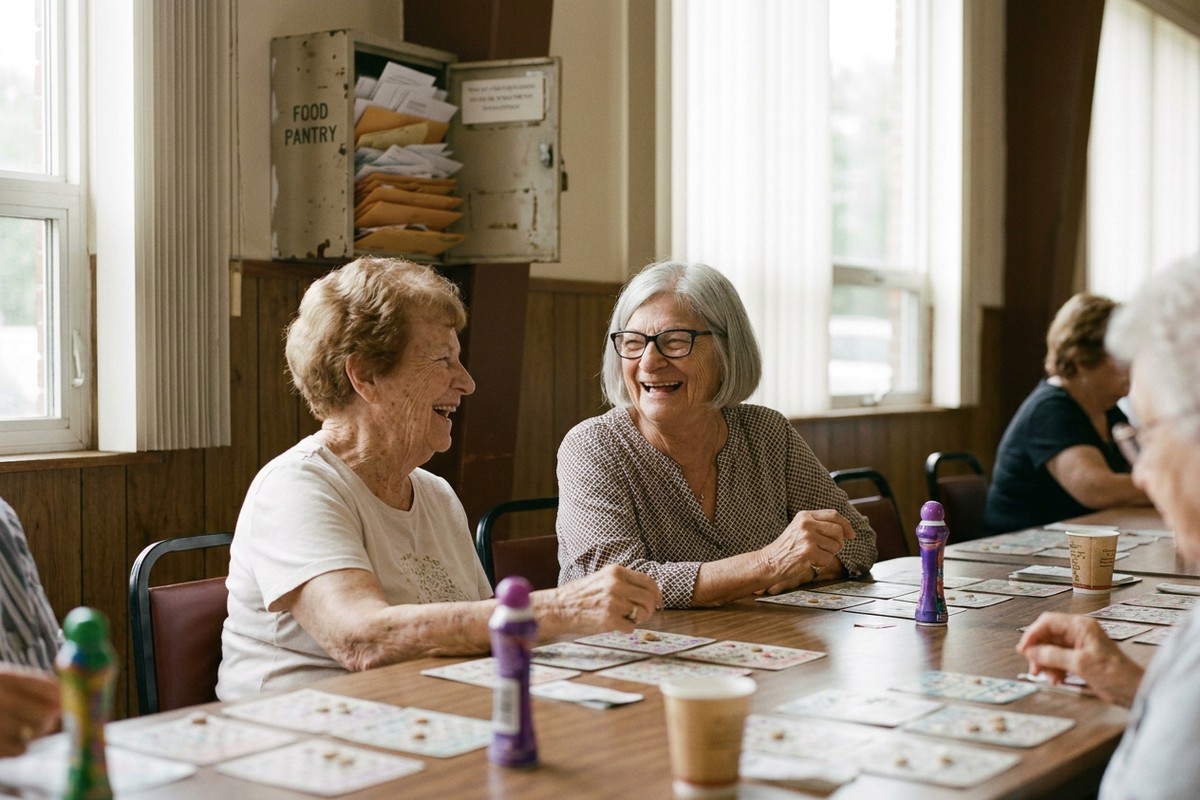
And at the second table, two old women who had been friends since the first grade looked at each other over a pile of purple daubers, and laughed until they had to take off their glasses.