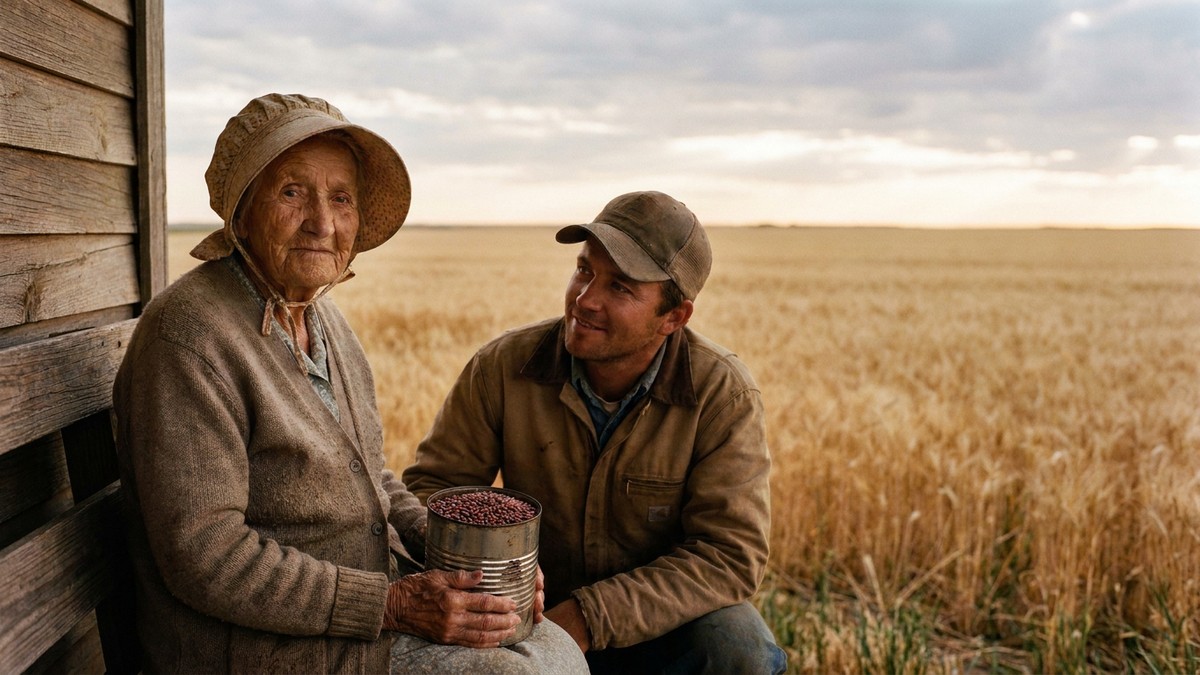
Velma Quick was five years old when the black wall came over the horizon on Palm Sunday, 1935, and her father ran for the seed wheat instead of the house.
She remembered the sky first. It had been the most beautiful morning in weeks. Blue and still and warm, after a winter of dust storms so bad that her mother had stuffed wet rags under every door and still swept dirt off the kitchen table three times a day.
That Sunday, the wind had finally quit. The neighbors had hung out their laundry. The church in Hollis Flat had been full for Palm Sunday, every pew, and afterward the men stood around in the sunshine in their good hats and talked about rain.
Then, a little after four in the afternoon, the birds started flying south. Thousands of them, ducks and geese and little brown sparrows, all going the same way, fast and low and silent. Velma's father stood in the farmyard and watched them, and his face changed.
She turned around to look where he was looking.
To the north, a wall was coming. It was black. Not gray, like the other dust storms.
Black, like the inside of a stove. It stood up from the ground to the sky as high as she could see, and it rolled toward them across the flat Texas Panhandle like a mountain range that had come loose.
"Velma," her father said, very quietly. "Go in the house with your mother. Now."
She ran. At the door, she looked back.
Her father wasn't following her. He was running the other way. Toward the barn.
When he came into the house, the storm hit right behind him.
It was so dark that Velma couldn't see her own hand in front of her face. The kerosene lamp on the table was a little brown smudge of light. The dust came in through the walls, through the window frames, through the keyholes.
It filled her mouth and her nose. It sounded like the end of the world.
Her mother held her and her baby brother under the kitchen table with wet dish towels over their faces. Her father sat beside them on the floor in the dark, holding something against his chest with both arms.
He held it the whole four hours. He didn't let go once.
When the storm finally passed, and the lamp came back, Velma saw what it was.
A big tin coffee can, with the lid pounded tight and wrapped in his Sunday shirt. Inside it was the last of their seed wheat. Turkey Red, the hard red winter wheat his grandfather had brought down from Kansas in 1901, and his grandfather's people had carried over the ocean from Russia in 1874, sewn into the hems of their clothes.
The rest of the seed in the barn was buried under three feet of dust. The rest of the wheat in the fields was gone. But her father had saved the coffee can.
"As long as we've got the seed," he told her that night, coughing, wiping the dust out of her eyes with his thumb, "we've still got a farm. You remember that, Velma. Whatever happens. You always plant the seed."
She was five. She remembered.
That was ninety-two years ago.
Velma Quick was ninety-seven now. She still lived on the same farm outside Hollis Flat, Texas, in the same house, though it had a new roof and electricity and air conditioning now. She'd buried her father in 1968, and her husband, Walter, in 2003, and her only son in 2019.
And every single fall for ninety-two years, someone in her family had planted the Turkey Red.
Not much of it. Her family had switched to modern wheat varieties a long time ago, like nearly every farm in the Panhandle. Bigger yields, shorter stalks, better disease resistance.
But on the north edge of the home quarter, beside the old windbreak, there was always one small patch. Two acres. Planted from the seed saved off the year before, which was planted from the seed saved off the year before that, all the way back to a coffee can on a kitchen floor in 1935.
Velma had planted it herself until she was eighty-five. Then her son had planted it. Then, after her son died, her great-grandson had planted it.
His name was Wade. He was twenty-nine, a big, quiet, sunburned young man who had come home from Texas Tech to run the farm when his grandfather died.
He'd done his best for eight years. Velma knew how hard he'd tried.
It had not been enough.
The drought had come back in 2022, and it had never really left. Three bad years out of four. The aquifer under the farm was dropping every year.
Wheat prices were down. Fertilizer and diesel prices were up. Wade had borrowed against the land twice.
He came to see her on a Tuesday evening in July, after supper, and sat down across from her at the kitchen table with his cap in his hands.
Velma knew before he said anything. She'd seen that look on her father's face in 1935.
"Grandma Velma," he said. "I'm sorry. I'm so sorry."
"Tell me, honey."
"There's a company out of Amarillo. They've been buying up farms all over the county. Putting in solar panels, mostly. They've made an offer." He swallowed hard. "It's a good offer. It'd pay off everything we owe, and there'd be some left. Enough for you to live on, and for me to start over somewhere."
Velma folded her hands on the table.
"What about the Turkey Red?" she asked.
Wade looked down at his cap. He couldn't look at her.
"They'd plow it under, Grandma. With everything else." His voice cracked. "I can't keep the farm alive another year. I tried. I'm signing on Friday."