Velma didn't argue with him. She'd never been an arguer.
She sat at the kitchen table for a long time after he'd gone, in the yellow light of the lamp, with her hands folded. Out the window, the sun was going down red over the dry fields, the way it had gone down over this farm every evening of her life.
She thought about her father on the floor in the dark, with the coffee can held against his chest.
You always plant the seed.
Then she got up, slowly, and went to the bedroom, and took her Bible off the nightstand. Tucked inside the back cover, where she kept things she meant to think about, was a newspaper clipping her granddaughter had mailed her from Fort Worth back in March.
She'd read it once and put it away. She'd thought it was a nice story about city people.
She put on her reading glasses and read it again.
The clipping was from a Dallas paper. It was about a bakery in Austin.
The bakery was run by a young couple who baked bread only from old American wheat. Heritage grain, the article called it. Wheat varieties from before the 1950s, before the big modern breeding programs.
Red Fife and Sonora and Turkey Red. They said the old wheats had more flavor.
They said people with sensitive stomachs could sometimes eat them better. They said the old wheats had deep roots, and could stand drought and hard winters, because they'd been bred for exactly that by farmers who had nothing else.
They milled their own flour. They paid farmers three and four times the regular price, under contract, for real heritage wheat.
The hard part, the baker said near the end of the article, was finding it. Most of the old varieties had been lost. The seed banks had samples.
But a living farm line, grown out and saved by the same family, year after year, for generations, without ever being crossed or mixed? That was almost impossible to find.
"If somebody's out there with a coffee can of their great-grandfather's wheat," the baker said, "I'd drive anywhere to meet them."
Velma took off her reading glasses. She sat on the edge of her bed in the dark for a long time.
Then she picked up the telephone.
It was Wednesday before she reached the bakery. Thursday before the baker called back.
His name was Diego Arrieta. He was thirty-four.
He listened to Velma for twenty minutes without interrupting. Then he asked her to repeat the part about 1935.
"Mrs. Quick," he said. His voice had gone careful, the way people's voices go when they don't want to hope too hard. "How many years has your family saved that seed?"
"Every fall since 1935," Velma said. "And my grandfather brought it from Kansas in 1901. And his people brought it from Russia before that."
There was a long silence on the line.
"Don't let anybody plow that field," Diego Arrieta said. "I'm getting in my truck."
He drove eight hours from Austin overnight and pulled into Velma's farmyard at six on Friday morning, in a dusty Toyota pickup with a bakery logo on the door. Wade was supposed to drive to Amarillo at nine to sign the papers. He'd come by to take his great-grandmother to breakfast first.
He found her sitting on the front porch in her sunbonnet and cardigan, with a stranger in a flour-dusted cap kneeling beside her rocking chair, holding a handful of red wheat up to the morning light like it was gold.
Velma had last year's seed in a cloth sack in her lap. Two hundred pounds of it, saved off the two-acre patch, the way it was saved every year.
Diego looked up at Wade. He was grinning like a man who'd found buried treasure.
"Look at this," he said. "Look at the color. Look at the shape of the kernel. This is Turkey Red, the real thing. I've seen the seed bank samples. This is better." He shook his head. "You've been sitting on this for ninety years."
"Ninety-two," said Velma.
The tests came back from the grain lab at Kansas State University two weeks later. True Turkey Red. As pure a line as the lab had seen in years.
Wade never drove to Amarillo. He called the solar company that Friday morning, standing in the farmyard with his cap in his hand, and told them he needed more time.
They gave him thirty days. He didn't need them.
Diego's contract was for two hundred acres of dryland Turkey Red, starting that fall. At three and a half times the regular price. He'd buy every bushel Wade could grow, for five years, and he'd already called two other heritage bakeries, in Dallas and Santa Fe, that wanted to buy what he couldn't use.
It wasn't going to make anybody rich. But with old wheat that could stand a dry year, and a price that paid the bills, and a reason to keep going, it was enough to keep the Quick farm a farm.
Wade planted the two hundred acres in October, from the seed in Velma's two-acre patch, which had come from the patch before that, all the way back to a coffee can on a kitchen floor.
The next July, Velma was ninety-eight.
Wade drove her out to the north edge of the home quarter in the pickup on a hot, still evening, and helped her out, and held her arm. The Turkey Red stood all around them, two hundred acres of it, tall and gold and heavy, with that faint red cast in the late light that no modern wheat ever had. It moved in long slow waves in the little bit of wind.
They'd harvest in a week. Diego was coming up from Austin to watch.
Wade had brought a cloth sack of last year's seed. He held it open in front of her.
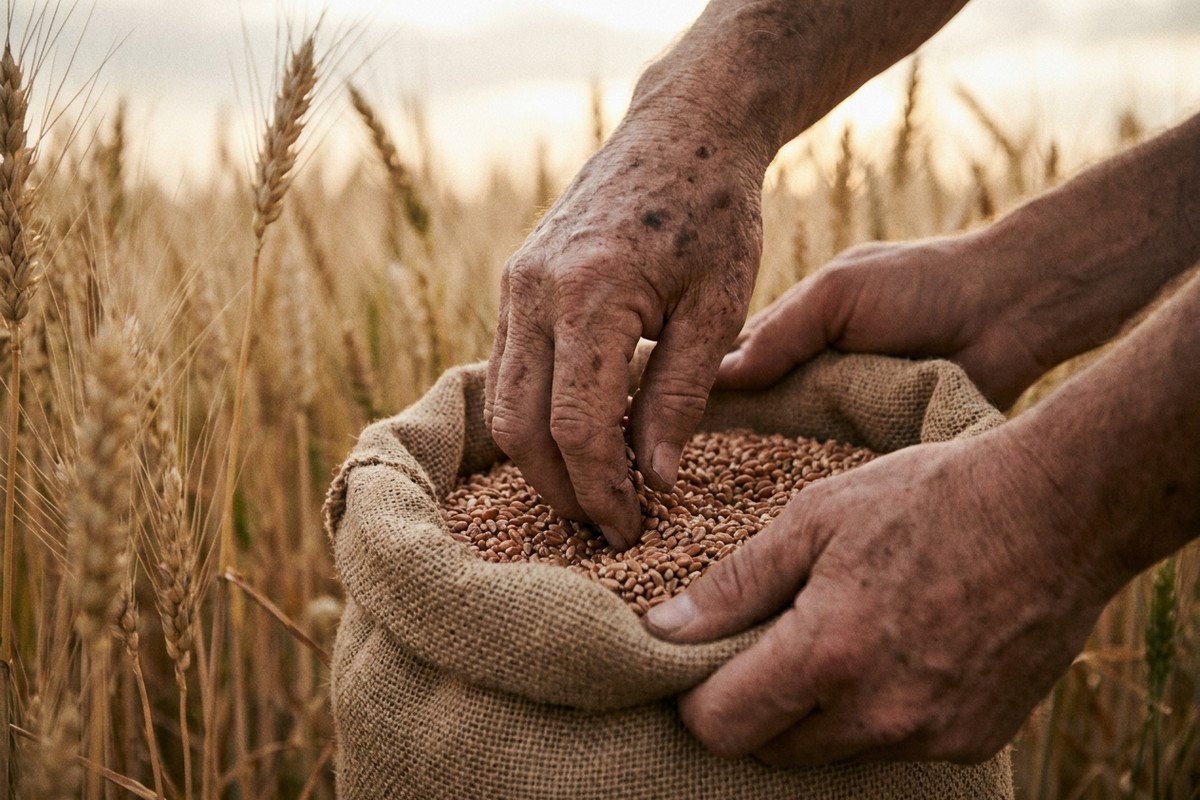
Velma Quick reached into it with her old, spotted hand, and ran her fingers through the red wheat, slowly, the way her father had done on the kitchen floor in 1935, and let it pour back through her fingers into the sack.
"You always plant the seed," she said.
"Yes, ma'am," said Wade. "I always will."