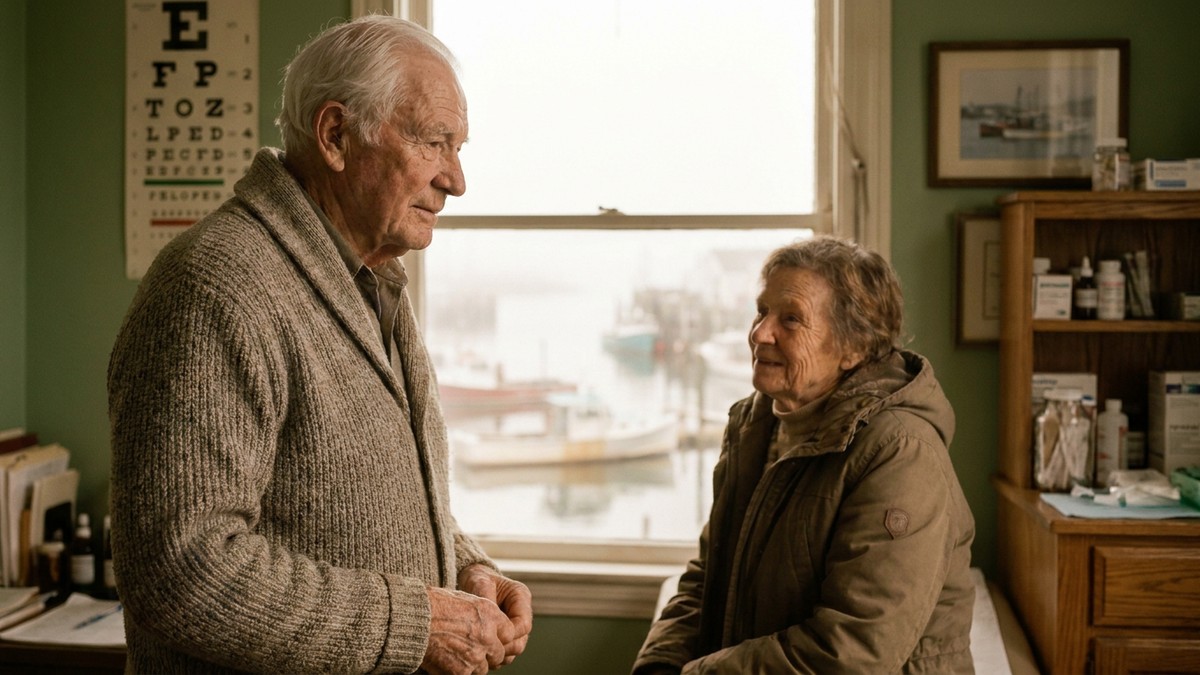
Dr. Everett Lowe had delivered his first baby in a snowstorm in 1970, on a kitchen table, with a flashlight in his teeth.
He'd been twenty-seven years old and three weeks into his first job, as the junior partner of old Dr. Bickford in Port Ellery, Maine. It was February. A nor'easter had come in off the Gulf of Maine and buried the coast in three feet of snow, and the power was out from Rockland to Bar Harbor, and the road to the hospital was closed.
At two in the morning, a lobsterman named Paul Gagnon had pounded on the door of the little apartment over the office.
"It's Marie," he'd said. "The baby's coming. Now."
Everett had grabbed his bag and his flashlight and followed Paul through the snow on foot, half a mile down Water Street, with the wind screaming off the harbor. He'd found Marie Gagnon on the kitchen table, because it was the only place in the house that was the right height, with her mother holding a kerosene lamp and the snow piling up against the windows.
He'd never delivered a baby by himself. He'd watched six of them in medical school.
He held the flashlight in his teeth because he needed both hands. At 4:12 a.m., by the kitchen clock, he lifted a small, furious, slippery baby girl into the lamplight, and she opened her mouth and screamed louder than the storm.
"Annie," Marie had said, crying, reaching for her. "Her name is Annie."
Everett had sat down on a kitchen chair, with his flashlight still in his mouth, and laughed and cried at the same time.
That was fifty-seven years ago.
Dr. Everett Lowe was eighty-four now. He'd been the family doctor in Port Ellery for fifty-seven years, the last thirty-one of them by himself, after old Dr. Bickford retired. He'd delivered more than seven hundred babies before the hospital in Rockport took over all the deliveries in 1994.
He'd set broken arms and stitched up lobstermen's hands and sat up all night with old women dying of pneumonia. He'd made house calls until 2015, when his wife, Lorraine, made him stop.
He'd taken care of three generations of some families. Four, in a few.
And he was closing his practice on Friday.
He'd been trying to find a replacement for six years. He'd put ads in the medical journals.
He'd called every medical school in New England. He'd offered the practice for free, the building and the patients and the old oak desk and all, to any young doctor who'd come.
None of them came. Young doctors didn't want to live in a town of eleven hundred people at the end of a peninsula, with no hospital, where it got dark at four in the winter and you got paid in lobsters half the time.
The nearest doctor after Friday would be forty minutes away, in Rockport. For the old people who didn't drive, it might as well be the moon.
Everett hadn't slept well in months. His hands had started shaking, too, a little, just in the mornings. He told himself it was the coffee.
The last week was hard.
His patients came in to say goodbye. Most of them weren't even sick. They came in and sat on his exam table and talked about their grandchildren and cried a little.
Old men he'd known for fifty years shook his hand and couldn't say anything at all. Mrs. Pelletier brought him a blueberry pie. Three different lobstermen brought him lobsters, which he gave to his nurse, Joanne, because Lorraine was allergic.
Joanne had worked with him for thirty-three years. She cried every day that week. She said it was her allergies.
On Friday afternoon, she brought in the last chart of the day and set it on his desk.
"Last one," she said. Her voice was wobbly. "Four-thirty. She called on Monday. Wouldn't say what it was for. Just said she had to be your last patient." Joanne raised her eyebrows. "Wouldn't take any other time."
Everett picked up the chart. There wasn't much in it. A name, and a birth date.
Anne Gagnon Ross. Born February 9, 1970.
He looked at the birth date for a long time.
At 4:30, she walked in.
She was fifty-seven, tall and strong, with short gray hair and her father's square jaw and her mother's dark eyes. She was wearing a parka and jeans and boots.
She looked like a lot of women in Port Ellery. She looked like a woman who'd grown up on the water.
Everett hadn't seen her in more than thirty years. She'd moved away after high school. He'd heard she'd become a nurse.
He'd heard she married, and had children, and lived somewhere near Boston. Her mother had told him all of it, every Christmas, until Marie died in 2016.
"Annie," he said. He stood up from behind his desk, a little stiffly. "Annie Gagnon."
"Dr. Lowe." She smiled. She had her mother's smile, too. "It's been a long time."
"What can I do for you?" he asked.
She didn't answer right away. She looked around the little exam room. The old green paint.
The eye chart that hadn't changed since 1970. The jar of lollipops on the counter. The window with the view of the harbor and the lobster boats.
Then she hopped up onto the exam table, the way she must have done a hundred times as a child, and the paper crinkled under her.
"I'm not here for me, Doctor," she said. "I'm here for you."