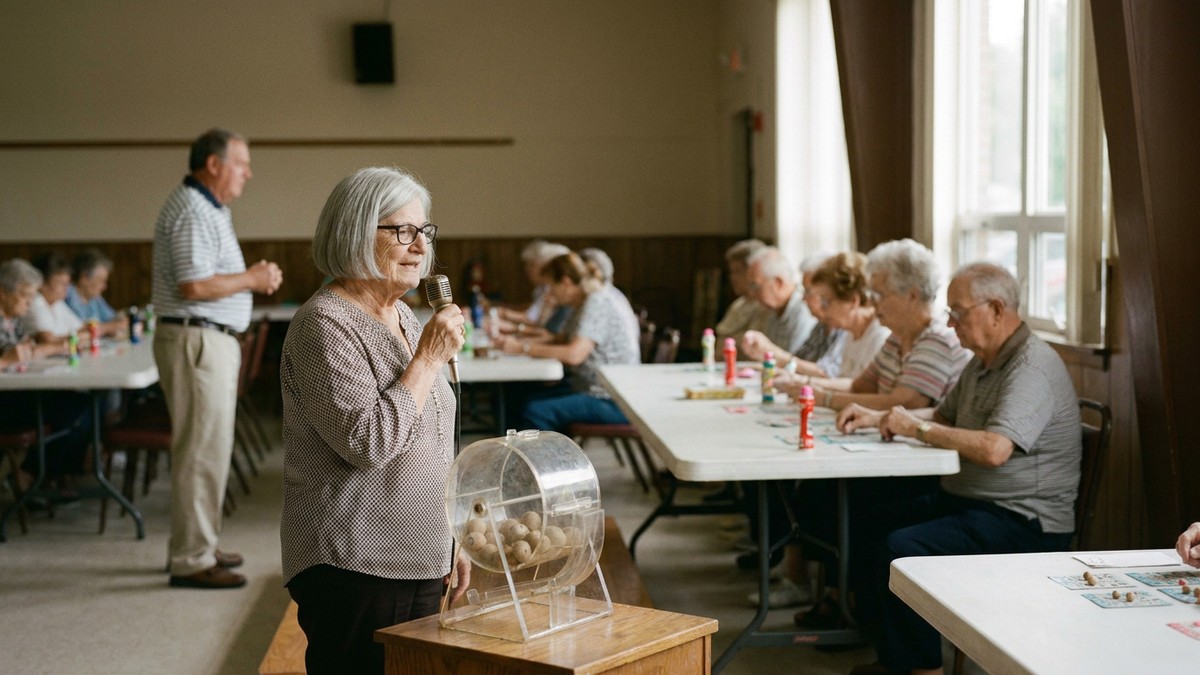
Connie DiNapoli had called bingo every Friday night since 1996, and in thirty-one years, she'd never been accused of anything worse than talking too fast.
"B-nine," she'd say into the microphone, quick as a card dealer. "B-nine, like my blood pressure. B-nine."
The players at the long tables would laugh, and dab, and wait for the next one. Connie would reach into the clear plastic cage, give it a spin with her wrist, and pull out the next ball without looking.
"O-sixty-six. O-sixty-six, get your kicks. O-sixty-six."
She'd been doing it so long, she could call a full game and carry on a conversation with the kitchen at the same time. The players said Friday bingo at St. Lucy's in Cranston, Rhode Island, was the best show in the state, and cheaper than Foxwoods.
Connie was seventy-nine. She'd been a hairdresser on Atwells Avenue in Providence for forty years. She had dark-rimmed glasses, a silver bob she still cut herself, and a voice that could carry over a parish hall full of two hundred people and a broken air conditioner.
Her husband, Carmine, had started the Friday bingo with Father Mike in 1996, to raise money for the parish roof. When Carmine died in 2009, Connie took over the microphone.
The roof had been paid for a long time ago. Now the money went to the school, and the food pantry, and the heating bill.
And every Friday night, in the same seat at the second table, right in front of the stage, sat her best friend.
Rosemarie Ferraro was eighty. She and Connie had been friends since the first grade at St. Lucy's school, in 1953. They'd been bridesmaids at each other's weddings.
They'd held each other's hands at their husbands' funerals. Rosemarie played thirty cards every Friday, spread out across the table in front of her in three neat rows, and she dabbed them so fast with her purple dauber that the young people at the next table sometimes stopped playing just to watch.
On the second Friday in June, Rosemarie won the jackpot.
That happened. It was bingo. Somebody had to win, and Rosemarie played thirty cards.
On the third Friday in June, Rosemarie won the jackpot again.
People clapped, a little slower. A few of them raised their eyebrows.
On the fourth Friday in June, Rosemarie won the jackpot for the third week in a row.
This time, the hall didn't clap at all.
Rosemarie stood up at the second table and held up her card and said, "Bingo," the way she always did, a little shy, like she was apologizing. And in the silence that followed, a man's voice came from the back of the hall.
"Well, isn't that convenient."
His name was Richard Haskell. He was sixty-six, a retired accountant from Connecticut who'd moved to Cranston to be near his grandchildren.
He'd joined the parish in the spring, and by May, he'd gotten himself elected to the parish council. He wore a golf shirt tucked into pressed khakis, and he carried a little leather notebook everywhere.
He'd been coming to Friday bingo for six weeks. He'd been writing in the notebook every Friday.
"Three weeks in a row," he said, standing up from his chair at the back table. "Same woman. Same seat, right in front of the stage. And the caller is her best friend." He held up the notebook. "I'm an accountant, Mrs. DiNapoli. I know what the odds are. I'm not saying anything. I'm just saying it looks very convenient."
Two hundred heads turned toward the stage.
Connie stood there with a bingo ball in her hand. Her face went hot all the way up to her silver bob.
"Mr. Haskell," she said into the microphone, very evenly. "Are you saying I'm cheating?"
"I'm saying I'd like to see the books," he said. "And I'd like to know how a ball cage gets so lucky."
Rosemarie sat down very slowly in her chair. She looked like somebody had slapped her.
Connie called the rest of the night in a voice that wasn't hers. Quiet. No jokes.
No blood pressure. When she got home to her little house on Pontiac Avenue, she sat at the kitchen table in the dark with a cup of chamomile tea and didn't drink it.
Thirty-one years. Thirty-one years of Friday nights.
She'd called through blizzards and power outages. She'd called the night after Carmine's funeral, because he would have wanted her to, with Rosemarie sitting in the front row holding up a sign that said, You've got this, Con.
And a man with a leather notebook had stood up in front of two hundred people and said she was a crook.
The next morning, Father Mike called.
"Connie," he said. He sounded tired. "Richard filed a complaint with the parish council. He wants an audit of the bingo books. And he wants you off the microphone until it's done."
"Do you think I'm cheating, Father?"
"Connie, I've known you for thirty years. I think you'd sooner rob a bank than cheat at bingo." He sighed. "But he's on the council. And people are talking. Rosemarie's son called me last night, upset. I've got to do something, or it gets worse."
Connie looked out the kitchen window at her tomato plants for a long time.
"Then let me do something," she said.
She could have fought him. She knew exactly how.
She could have stood up at the council meeting and shouted. She could have called her nephew, who was a lawyer in Warwick. She could have brought thirty-one years of handwritten books into the hall in a laundry basket and thrown them on Richard Haskell's pressed khakis.
But Connie had cut hair on Atwells Avenue for forty years, and she'd learned one thing standing behind that chair. You can argue with a woman about her hair all day long, and she'll never believe you. Or you can turn the chair around, and hand her the mirror, and let her see it for herself.
So the next Friday night, she came to bingo early.
The hall filled up the way it always did. The ladies from the Altar Society. The old men from the Holy Name Society.
The young mothers who came for the cheap night out. Rosemarie came, though Connie had half expected her not to, and sat in her seat at the second table with her thirty cards in three neat rows, very pale.
Richard Haskell came too. He sat at the back table with his leather notebook open.
At seven o'clock, Connie walked up onto the stage. She didn't go to the microphone. She went to the ball cage, and she picked up the microphone stand, and she carried it down the steps and all the way to the back of the hall, while two hundred people turned in their chairs to watch her.
She stopped in front of Richard Haskell's table.
"Mr. Haskell," she said. She held out the microphone. "You call it tonight. All of it. Every ball."
He stared up at her.
"I'll just go sit with my friend," Connie said.