On the night of January 26, 1978, in the worst blizzard Indiana had seen in a hundred years, a baby girl was born on the kitchen floor of Lois Fenstermaker's farmhouse, delivered by Lois and a truck driver whose last name she never learned, and forty-eight years later, on a cold Saturday in November, that baby knocked on her door.
Lois was ninety-two. She did not answer the door much anymore. Her grandson usually did.
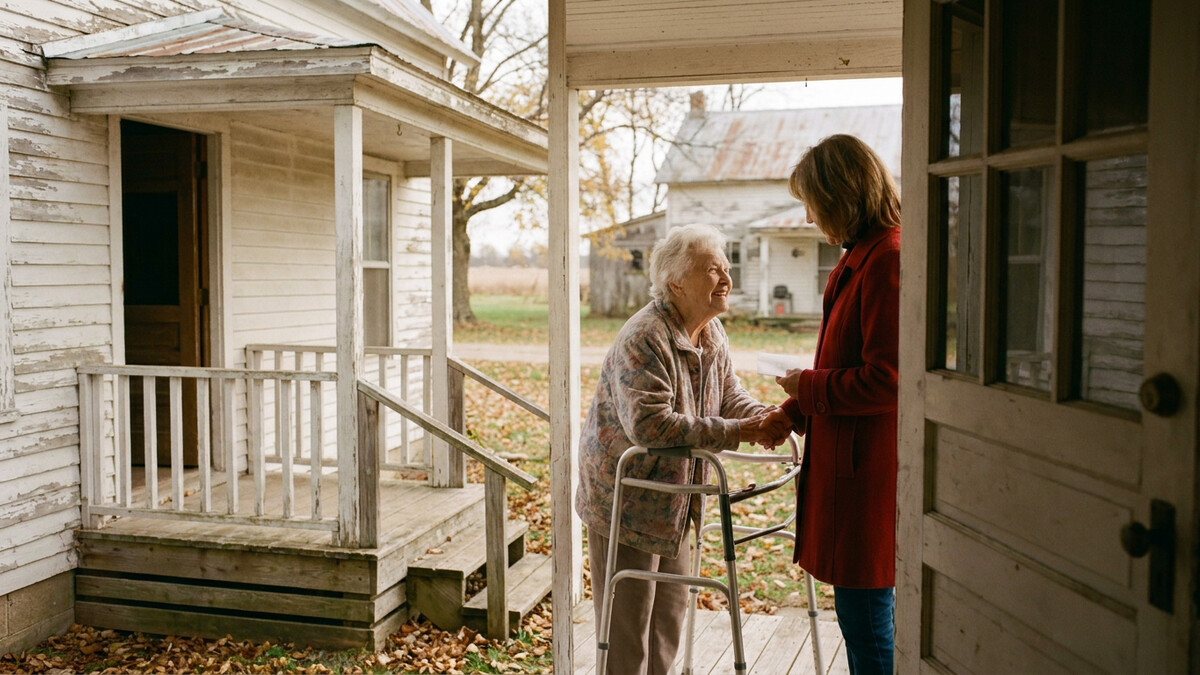
But he was in the barn, and the knocking would not stop, so she got up from her chair by the window with her walker and made her way down the hall.
The woman on the porch was in her late forties, in a red wool coat, holding a small white envelope in both hands. She looked nervous.
"Mrs. Fenstermaker?" she said. "Lois Fenstermaker?"
"That's me."
The woman swallowed.
"My name is Lois too," she said. "I think I was named after you."
Lois Fenstermaker had lived on the same farm outside Wabash Corners, Indiana, since 1955. A hundred and sixty acres of corn and soybeans and a white farmhouse with a big kitchen. She had raised four children there. She had buried a husband there, Walter, in 2009.
And she had lived through the Blizzard of 1978 there, which in that part of Indiana people still talked about the way they talked about wars.
It had started on the evening of January 25. Rain at first, then sleet, then snow. By midnight, the wind was blowing fifty miles an hour, and the snow was coming sideways. By morning, the drifts were higher than the fence posts. The roads were gone. The power was gone. The telephone lines were down. The whole county was buried.
Lois was forty-four that winter. Walter was in bed with pneumonia. The kids were grown and gone except the youngest, Gary, who was sixteen.
She had a woodstove in the kitchen, a pantry full of canned goods, and a lot of blankets. She figured they would wait it out.
On the night of the twenty-sixth, at about nine o'clock, somebody pounded on the kitchen door.
Lois nearly did not hear it over the wind. When she opened the door, the snow blew in so hard she could not see. Then a big shape came through it, covered in white, carrying something.
It was a man. A huge man, six foot four at least, in a sheepskin coat with ice in his beard. And in his arms, wrapped in a blanket, was a young woman.
"Ma'am," the man said. "I'm sorry. I need help. My rig's stuck on the county road half a mile back. I found her car in a ditch. She's having a baby."
Lois looked at the young woman in his arms. She was maybe twenty. Her face was white. Her eyes were wide with fear.
"Bring her in," Lois said. "By the stove."
The young woman's name was Debbie. She was twenty years old and nine months pregnant with her first baby. She had been trying to drive to her mother's house in Peru when the storm caught her. Her car had gone into the ditch, and she had sat there for six hours with the engine running until the gas ran out.
Her water had broken in the car.
The truck driver had seen her headlights in the ditch from the cab of his semi, stuck in a drift. He had waded through the snow to her, put her over his shoulder, and walked half a mile in a whiteout toward the only light he could see.
It was Lois's kerosene lamp, in the kitchen window.
There was no calling a doctor. There was no driving to a hospital. There was no road.
There was Lois, who had had four babies of her own and helped deliver more calves than she could count. And there was a truck driver named Jim, who said he had been a medic in the Army, in Korea, a long time ago.
"Never done a baby," he said. "But I've seen worse."
Lois boiled water on the woodstove. She sent Gary for every clean sheet and towel in the house. She spread blankets on the kitchen floor in front of the stove, because it was the only warm room. She tore up an old flannel nightgown.
At ten o'clock, the labor started in earnest.
It lasted five hours.
Lois remembered all of it. Forty-eight years later, she still remembered.
The roar of the wind. The kerosene lamp flickering on the kitchen table. Debbie screaming and gripping her hand so hard Lois's fingers were bruised for a week. Jim kneeling on the floor beside her with his sleeves rolled up, talking low and calm, the way she imagined he had talked to soldiers.
At ten after three in the morning, the baby came.
A girl. Small and blue and not breathing.
Jim picked her up. He turned her over in his huge hands. He rubbed her back, hard, and cleared her mouth with his finger, and rubbed again.
Nothing.
Lois stood frozen by the stove. Debbie was screaming.
Jim bent his big shaggy head down over the tiny baby, and put his mouth over her nose and mouth, and breathed, very gently, three little puffs.
Then the baby coughed. And cried. A thin, angry, beautiful cry.
Jim sat back on his heels on Lois's kitchen floor with the baby in his hands and started to cry too.
The roads opened three days later. A National Guard truck came for Debbie and the baby. Jim dug out his rig with Gary and a borrowed tractor and drove away south.
He never told Lois his last name. She never asked. It had not seemed important in the middle of it.
Debbie had hugged her at the door of the Guard truck.
"I'm going to name her after you," she had said. "Lois. I promise."
And then she was gone. Lois never saw her again. She did not know Debbie's last name either.
For forty-eight years, every January, she had wondered.
Now the woman in the red wool coat stood on her porch in the cold November wind.
"My mother died in September," she said. "Debbie. I was cleaning out her things, and I found this."
She held out the white envelope.
Inside was a photograph, small and square, with a white border, the kind from the seventies. It showed a kitchen. A woodstove. A kerosene lamp on a table. And a huge, bearded man in a sheepskin coat, sitting on a kitchen floor, holding a tiny newborn baby against his chest.
On the back, in faded ballpoint pen, it said: Lois's kitchen, Jan. 27, 1978. Jim and Baby Lois.
"Mrs. Fenstermaker," the woman said. Her voice was shaking. "Do you know who this man is? Because I've spent two months looking. And I think I found him." She took a breath. "But I need you to tell me if it's really him."