Part 2
Never forget the warm.
Lucinda stood in the laughter and heard Thomas say it as plain as if he were standing at her elbow. The sun was down. The wind off the mountains had dropped the air twenty degrees since supper. She had poured a cold spoonful onto a cold saucer, in the cool of the evening, and expected it to burn like a barrel tested by lamplight.
She had been wrong. She had been wrong in front of the whole town.
She did not leave.
"Dr. Quill," she said, when the laughing let her be heard. "Would you lend me your lamp?"
He hesitated. The crowd was watching him now too.
"Certainly, ma'am."
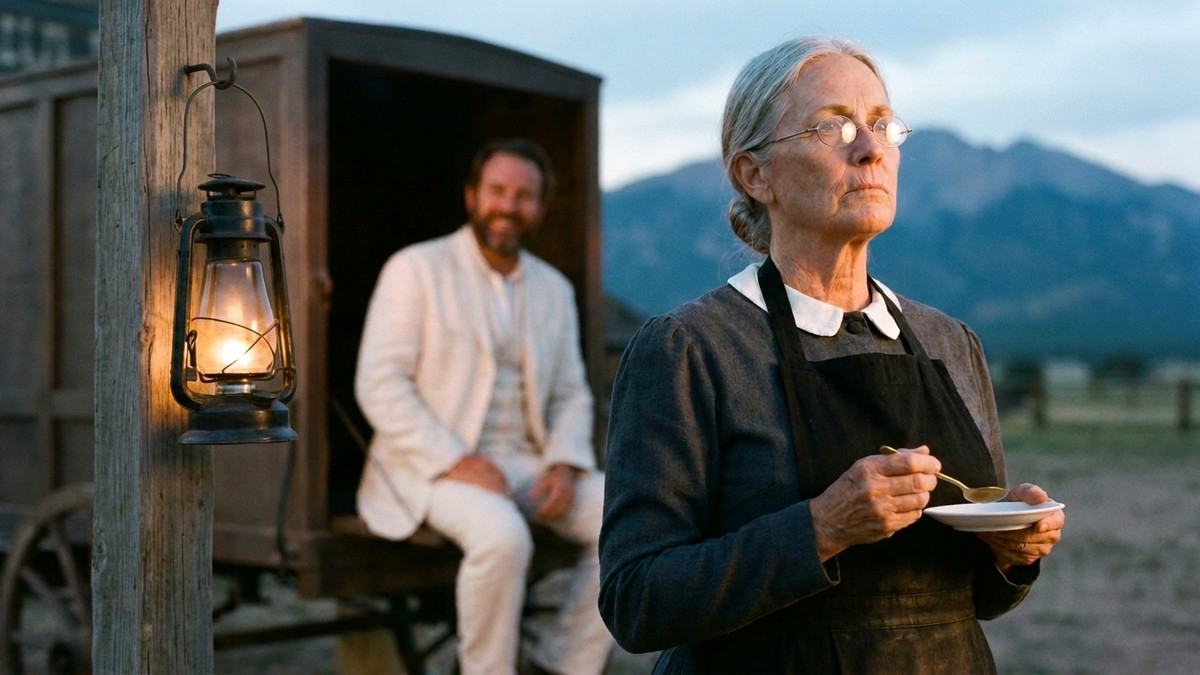
The boy handed down the brass lantern from its hook. Lucinda set it on the edge of the tailboard and lifted the glass chimney off. The heat came up against her face. She filled Thomas's spoon from the bottle and held it above the flame, not in it, and counted under her breath.
"Now, that's not fair," Dr. Quill said. "She's cooking it."
"Then I'll cook water too," Lucinda said. "Somebody bring me a dipper from the pump."
A boy ran. He came back with the dipper sloshing. Lucinda emptied the spoon onto the ground, filled it with water, and held it over the lamp for the same count. Then she struck a match and touched it to the water.
The match went out with a small wet sound.
"Water," she said. She looked at Ned Farley, who kept the saloon across the street and was standing in his apron at the edge of the crowd. "Ned. A spoonful of your whiskey, please."
Ned looked at the Temperance ladies, and then at Lucinda, and went to get it.
She warmed the whiskey over the lamp. She struck a match. A soft blue flame rose out of the spoon, hardly bigger than a thumbnail, wavering in the dusk.
Someone said, "Huh."
Lucinda blew it out. She wiped the spoon on her apron, filled it from Dr. Quill's bottle of Golden Miracle Tonic, and held it over the lamp for the same count as the others.
She struck the match.
The flame came up blue and steady and burned longer than the whiskey had.
No one in the street made a sound.
The flame burned down to nothing. Lucinda tipped the empty spoon so they could all see it.
"Spirits," she said. "Close to half spirits, I would guess. As strong as the whiskey Ned sells, and he doesn't sell his to babies."
Mrs. Purdy had both hands over her purse. One of the Temperance ladies sat down on the edge of the boardwalk as if her knees had decided it for her.
Lucinda looked up at the tailboard.
"Last night the wind blew your torch toward that crate," she said, "and you moved the crate yourself. Why would a man move a crate of vegetable tonic away from a flame?"
Dr. Quill did not answer that. He looked down at his white trousers, at the brown smudges where he had wiped his hands.
Then he sat down on the tailboard, which surprised everyone, and took off his hat.
"Folks out here work fourteen hours a day for a dollar and a half," he said. He did not sound like a showman now. He sounded tired, and from somewhere in Missouri. "The doctor's forty miles off and charges five dollars to tell them to rest. I sell them one good night's sleep and a little hope, for a dollar. You tell me who's robbing whom."
"You told them it was safe for babies," Lucinda said.
He looked at Annie Kroll in the crowd, and Annie looked back at him, holding Grace.
He did not answer that either.
Somebody said something about the river. Then somebody else said it louder, and three men started toward the wagon.
"No," Lucinda said.
She did not say it loudly. She said it the way she told boys to put back the licorice, and the men stopped.
"He'll give back every dollar to any woman who brings back a bottle," she said. "Tonight. Here. Then he'll be on the noon train with his wagon and his banjo, and that's the end of it." She looked at Dr. Quill. "Isn't that so?"
He looked at the men, and at the lantern, and at the brass spoon in her hand.
"That's so," he said.
It took until ten o'clock. The women came back one at a time, some with full bottles and some with half, and the boy counted dollars out of a tin box by lantern light. Mrs. Purdy brought back six. Annie Kroll came last.
Her bottle was nearly a third gone.
Annie set it on the tailboard. She took her dollar. She did not look at anyone.
The wagon left on the noon train. The banjo boy waved from the flatcar, and two small boys ran beside the tracks until the train outran them.
That night, someone knocked on the back door of the drugstore.
It was Annie Kroll, with Grace screaming on her shoulder. The baby's face was red and wet and furious. Annie's eyes were swollen.
"I'm sorry," Annie said. "I didn't know where else."
Lucinda took the baby. Grace was heavy and hot and smelled of milk and soap. She screamed directly into Lucinda's ear.
"Go home and sleep," Lucinda said. "I'll walk her."
"All night?"
"I walked Thomas through three winters of a bad chest. I can walk one baby."
Annie went. Lucinda put the kettle on and began to walk, up and down between the counter and the shelves of brown glass, past the drawer where the brass spoon lay.
Toward two in the morning the screaming wore down to hiccups, and then to breathing.
Lucinda kept walking anyway. The floorboards creaked under her in the same three places they always had.