Part 1
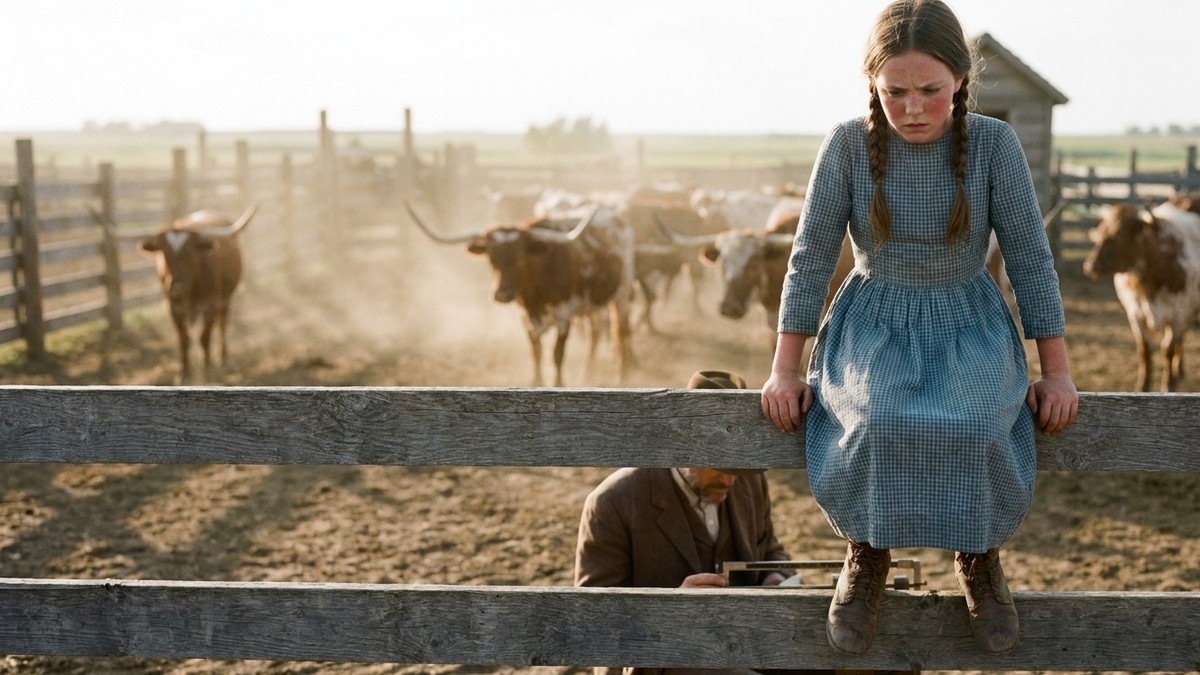
Lizzie Tate sat on the top rail of the Ellsworth stockyard fence and added the weight of other people's cattle in her head.
It was October 1872, in Ellsworth, Kansas, and the Texas herds were mostly gone for the year. The pens smelled of trampled manure and dust and the coal smoke from the Kansas Pacific engines waiting on the siding. Down below, the cattle buyer from Kansas City stood at the scale house door and called out weights.
"Eight head. Seven thousand eight hundred and forty."
His clerk wrote it in a long tally book. Lizzie added it to the others. She did not try to. It just happened, the way some people hum.
She was twelve. Her grandmother said she had a head for figures, and her grandmother had taught school in Ohio for forty-one years, so Lizzie supposed it must be so.
Gran was sitting in the wagon by the gate, wrapped in a shawl, because her hip would not let her climb fences anymore. She had a slate on her knee. She always had a slate on her knee.
That morning, on the drive in, she had made Lizzie check the egg money.
"Thirty-seven dozen at eleven cents," Gran said. "What's that?"
"Four dollars and seven cents."
"Check it."
Lizzie had sighed and done it the old way, the way Gran had drilled her since she was seven. You added up the digits of each number, over and over, until only one digit was left, and you threw out the nines as you went. Then you did the same to the answer. If the leftovers did not agree, the sum was wrong. No need to do the whole thing over.
"Checks," Lizzie said.
"Every time," Gran said. "Figures will lie to you the minute you stop looking at them."
Pa had sixty-four head of steers in the far pen. They were Kansas cattle, not Texas, wintered on the creek and fattened on prairie hay, and they were the whole of the year's work.
There was one buyer left in Ellsworth. His name was Royce Kimball, and he wore a brown suit with chalk dust on the knees from the scale beam. He bought for a commission house in Kansas City, and he had a car order for the four o'clock train east.
"Two and a quarter cents a pound," he told Pa. "On the scale. That's the price."
"It was two and three-quarters in August," Pa said.
"It was August in August." Kimball shrugged. "That's the last train I can fill this fall, Mr. Tate. Take it or keep them through the winter."
Pa looked at the far pen a long time and said yes.
Before them came the Haneys, who had forty head and a note at the bank. Lizzie sat on the rail and added their drafts while she watched a brindle cow try to climb out of the alley.
When the clerk read Mr. Haney his total, something in it snagged her, like a sleeve on a nail. She frowned. Then the brindle cow went over the fence and two men went after her, yelling, and Lizzie laughed and forgot it.
Mr. Haney took his money, and shook Kimball's hand, and drove off toward home.
At two o'clock they weighed Pa's steers.
Eight to a draft. Eight drafts. The platform creaked under the weight, and the iron poise slid along the beam with a little scraping sound, and Kimball called the numbers.
"Seven thousand nine hundred and twenty."
"Eight thousand and sixty."
"Seven thousand seven hundred and eighty."
Lizzie added. She did not have to try.
When the last draft was weighed, the clerk drew a line under the column and totaled it. He was a young man with ink on his cuff and a cowlick that would not lie down. He turned the book around for Pa to see.
"Sixty-two thousand, five hundred and forty pounds," he said.
Lizzie's mouth opened before she could stop it.
"That's not right," she said.
Every man at the scale house turned around and looked up at the fence.
"Lizzie," Pa said.
"It's sixty-three thousand, five hundred and forty. It's a thousand short."
Royce Kimball laughed. It was not a mean laugh. It was the laugh a man uses for a dog that has learned a trick.
"Elmer," he said to the clerk. "The young lady says you can't add."
The clerk ran his pencil down the column. He did it fast, his lips moving, and at the bottom he tapped the total.
"Sixty-two five forty," he said. "It's right, Mr. Kimball."
"There you are." Kimball smiled up at her. "Fine head for figures, miss. Just a little quick."
The men laughed. Somebody said something about schoolgirls.
Lizzie felt her face burn all the way to her ears. Last spring, at the school exhibition, she had stood up in front of the whole district and gotten a long division wrong, and cried, and had to sit down. She felt exactly like that now.
"Lizzie," Pa said quietly. "Hush."
She hushed.
Kimball took a roll of bills from his inside pocket and began counting them out on the clerk's table. A thousand pounds at two and a quarter cents was twenty-two dollars and a half. It was more than Pa paid the hired man in a month.
It was more than that. Lizzie suddenly remembered the snag. Mr. Haney's total. It had been short too.
Pa picked up the clerk's pen to sign the receipt.
Lizzie looked back toward the gate.
Gran was climbing down out of the wagon, one slow step at a time, with the slate under her arm.