Part 2
It took Gran a full minute to cross the yard. Nobody hurried her. Even the cattle seemed to wait.
She was seventy-one and small and leaned on her cane at every third step. When she reached the scale house, she nodded to Royce Kimball as if he were a school board member who had come to visit her classroom.
"Mr. Kimball," she said. "Margaret Tate. I taught school in Licking County, Ohio, for forty-one years. I wonder if I might see your tally book."
Kimball's smile slipped a little at one corner.
"Ma'am, the boy's already checked it twice."
"Then a third time will cost you nothing." She held out her hand.
Elmer the clerk looked at his employer. Kimball shrugged, as if it were all very amusing, and Elmer gave her the book.
Gran set her slate on the clerk's table and wiped it clean with the heel of her hand. Chalk dust drifted up in the sunlight.
"Elizabeth," she said, "come down off that fence and read me the drafts. Slowly."
Lizzie came. Her legs did not feel like her own. She stood beside her grandmother and read from the book, one line at a time, and her voice shook on the first number and steadied by the third.
"Seven thousand nine hundred and twenty."
Gran wrote it on the slate. Next to it she wrote a single small figure, and circled it.
"Eight thousand and sixty."
Another number. Another small figure, circled.
Lizzie read all eight. Gran wrote all eight, and beside each one her chalk made a little circled digit. Some of the men had drifted in close behind her to see. Pa stood with the pen still in his hand.
"What is she doing?" somebody said.
"Casting out nines," Gran said, without looking up. "Every child in my school learned it before long division. You add the digits of a number until there's one left, and you throw away the nines. It tells you what's left over."
She added the eight little circled digits. Then she added those down to one.
"The drafts leave nothing over," she said. "Zero." She tapped the bottom of the clerk's column with her chalk. "Six, two, five, four, nothing. That's seventeen. One and seven is eight." She looked up at Kimball. "Your total leaves eight. A true sum of those drafts can't leave eight. It must leave nothing, the same as its parts."
Kimball laughed again, but it was shorter this time.
"With respect, ma'am, I don't buy cattle with schoolroom tricks."
"Then let us do it your way," Gran said. "Out loud. All of us."
They did it in the dust beside the scale, with every man in the yard crowded around the table.
Gran wrote the drafts in a column. Lizzie called the hundreds and the men called them back. When they carried, the brindle cow's owner said "carry one" in a voice like a hymn, and a few people laughed, and then nobody laughed, because they had reached the thousands.
Sixty-three thousand, five hundred and forty.
Gran drew a line under it. She did not say anything. She turned the slate so Kimball could read it.
The yard was so quiet Lizzie could hear the engine on the siding breathing steam.
"Elmer," Kimball said at last, very low.
The clerk had gone white to the cowlick. He opened his mouth and nothing came out.
"Don't blame the boy," Kimball said. He took off his hat and turned it in his hands, and the chalk dust on his knees looked suddenly like what it was, the dust of a man who knelt at a scale beam ten hours a day. "He writes what I tell him to."
He looked at Pa.
"Chicago's dropped a full cent since August. I contracted these cars at a price I can't make. Either I shave a little off every sheet, or I go home broke, and next fall nobody comes out here to buy your cattle at all." He put his hat back on. "That's the truth of it, Mr. Tate. I'm not proud of it."
Pa did not answer. He looked at Gran.
"Then tell them the true price," Gran said. "To their faces. And let them decide whether to sell."
Kimball corrected the sheet. He paid Pa the twenty-two dollars and a half in front of everyone, and then he did a thing Lizzie did not expect.
He sent Elmer on the fastest horse in the livery to catch Mr. Haney on the creek road with the rest of his money.
The cattle went east on the four o'clock train, bawling in the cars. The yard emptied. Pa went to see about the wagon.
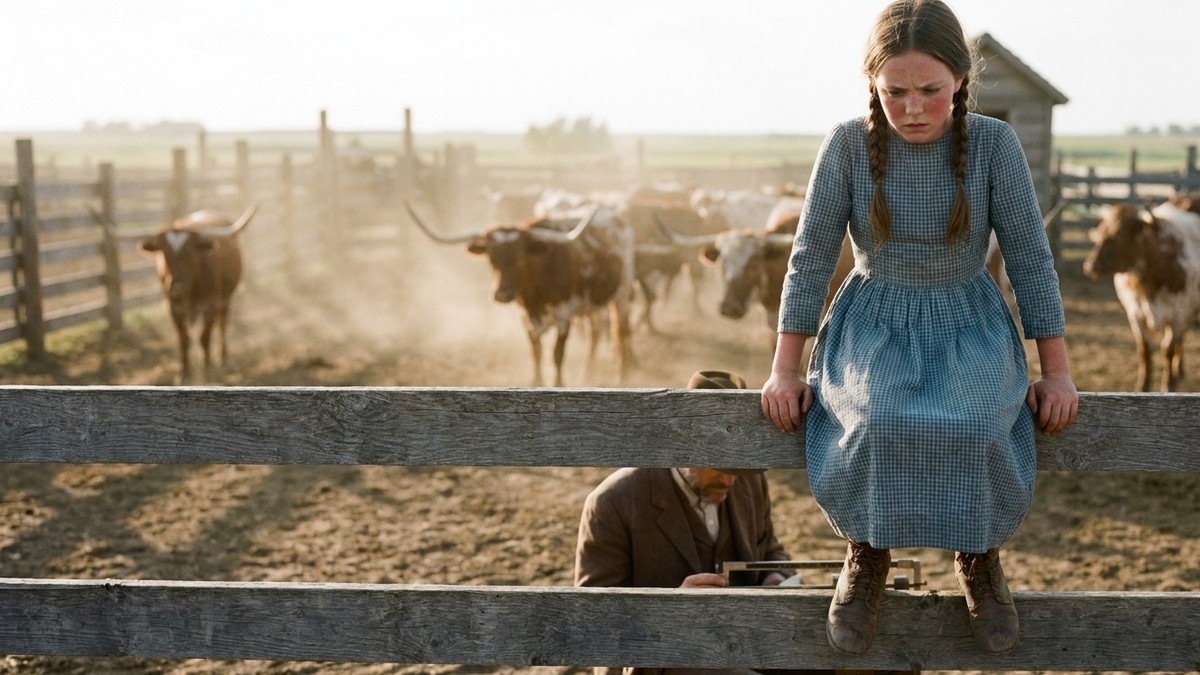
Lizzie climbed back up on the top rail of the fence, because she did not know what else to do with herself. Her hands were still shaking a little. She sat on them.
After a while, Elmer came back on the lathered livery horse. He tied it at the scale house and walked over to the fence and stood below her, turning his pencil in his fingers.
"Miss Tate," he said. "That check your grandmother did. With the nines." He looked at his boots. "Would you show me how it goes?"
Lizzie looked over at the wagon. Gran was sitting in it again, with her shawl around her shoulders and her eyes closed in the late sun.
Gran opened one eye and nodded.
Lizzie climbed down. She took the slate from the clerk's table, wiped it clean with the heel of her hand, and wrote a number on it.
"Thirty-seven dozen at eleven cents," she said. "What's that?"