Part 1
The medicine show parked its wagon square in front of Lucinda Hale's drugstore, and the banjo started before the dust had settled.
It was July 1884, in Cedar Fork, Colorado, a valley town of three hundred people and one drugstore. Lucinda had kept that drugstore by herself for three years, since Thomas died. She stood behind the window glass with a dust rag in her hand and watched the man climb up onto the wagon's tailboard.
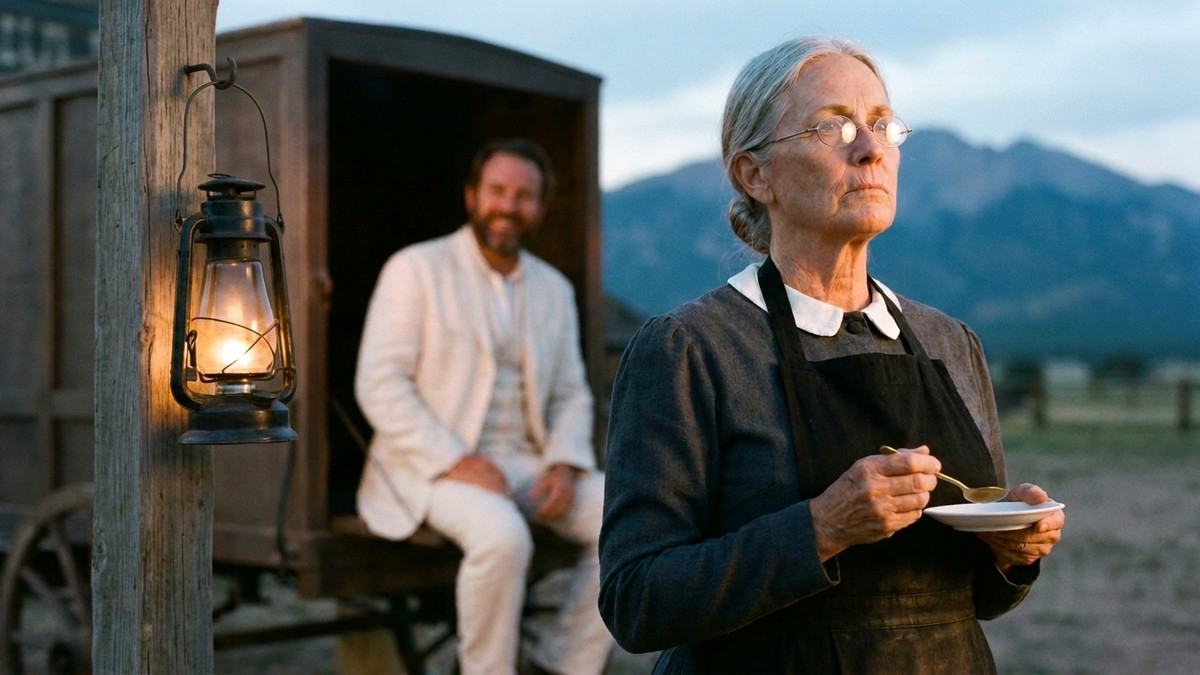
He wore a white linen suit and a beard trimmed to a point. Behind him, painted in gold on red, the wagon said DR. JASPER QUILL'S GOLDEN MIRACLE TONIC.
"Friends," he said. "I don't sell whiskey. I don't sell opium. I sell a purely vegetable remedy, gathered by my own hand, without one drop of spirits in it. Safe for the nerves. Safe for the stomach." He held up a brown bottle so the sun came through it like honey. "Safe for the smallest baby in this valley."
Lucinda put down the rag.
Thomas Hale had been a careful man. He had come west with two crates of brown glass and a book of formulas, and he had never once bought a barrel of alcohol from a wholesaler without testing it.
Lucinda had watched him do it a hundred times. A little alcohol in his brass spoon. A moment held above the lamp chimney to warm it. Then a match.
If it burned with a soft blue flame, the alcohol was strong. If it would not catch, somebody in Denver had watered the barrel.
"Water won't burn, Lucy," he used to say. "Spirits will. The warmer the spoon, the weaker the spirits that will catch. Never forget the warm."
The brass spoon was still in the drawer under the counter. She had not used it since the funeral.
By suppertime, half the women in Cedar Fork were standing in the street with their purses open.
Lucinda went out onto her step. The banjo player, a thin boy with a sunburned nose, was playing something quick and sweet. The street smelled of horses and hot dust.
"Ladies," Lucinda said. "That is not medicine. That man is selling liquor in a bottle with a pretty label."
The banjo stopped.
Dr. Quill looked down at her and smiled very kindly.
"Ladies, I believe Mrs. Hale has a store to keep," he said. "And I believe I am standing in front of it."
The laughter was not unkind. That made it worse. Lucinda felt her face go hot, because she knew how it had sounded. It had sounded like a widow worried about her till.
She had said it badly. She knew it the minute it was out.
Mrs. Purdy, the mayor's wife, bought six bottles. The two Temperance Union ladies who had closed the saloon for a month last spring bought four each. They looked at Lucinda while they paid.
On Wednesday morning, Annie Kroll came into the drugstore with her baby on her hip.
The baby was eight months old, a fat red-haired girl named Grace who had cried every night since spring. This morning she was asleep against her mother's shoulder, heavy as a sack of meal, with her mouth open.
"First good night in a month," Annie said. She was nineteen and looked forty. "One spoonful of the doctor's tonic. She slept straight through."
"May I?" Lucinda said.
Annie held out the bottle. Lucinda pulled the cork and smelled it.
Molasses. Something bitter, like burnt orange peel. And under it, sharp at the back of her nose, the smell of a saloon floor on a Monday morning.
She put the cork back in.
"Annie," she said carefully, "how much did you give her?"
"Just what the label says." Annie's chin came up. "Mrs. Hale, everybody knows you don't like him. But she slept."
She took the bottle back and went out. The bell over the door rang behind her.
The show would leave on Saturday's noon train. Dr. Quill said so from the tailboard every evening. Two hundred bottles left, friends. A dollar each. When they were gone, they were gone.
By Saturday every mother in the valley would have one.
Thursday night Lucinda stood at the back of the crowd and watched the show with her arms folded. The boy had set a torch on a pole beside the wagon to light the stage. When the wind turned, the flame leaned out over the tonic crate.
Dr. Quill stopped in the middle of a sentence. He picked up the crate himself and carried it to the far end of the tailboard, well away from the torch. Then he turned back to the crowd and finished his sentence with a smile.
Lucinda watched him wipe his hands on his white trousers.
Friday evening she went out to the wagon with Thomas's brass spoon in one hand and a white saucer in the other.
The crowd saw her coming and made way, the way people make way for a fight. Somebody laughed.
"Mrs. Hale," Dr. Quill said. He did not seem worried. He seemed pleased. "Have you come to buy a bottle?"
"I've come to test one."
"Then test away, ma'am." He uncorked a bottle with a flourish and handed it down to her. "I have nothing to hide from Cedar Fork."
Lucinda poured a spoonful of tonic into the saucer. The sun had gone behind the mountains, and the air coming down the valley was cool against her neck.
She struck a match and touched it to the tonic.
Nothing happened.
The match hissed and went out in the brown liquid. A little curl of smoke rose up and was gone.
The crowd laughed, loud this time, and long. Somebody clapped. On the tailboard, Dr. Quill spread his hands, as if to say he had told them so.
Lucinda looked down at the dead match lying in the saucer. Across the crowd, Annie Kroll turned her face away.