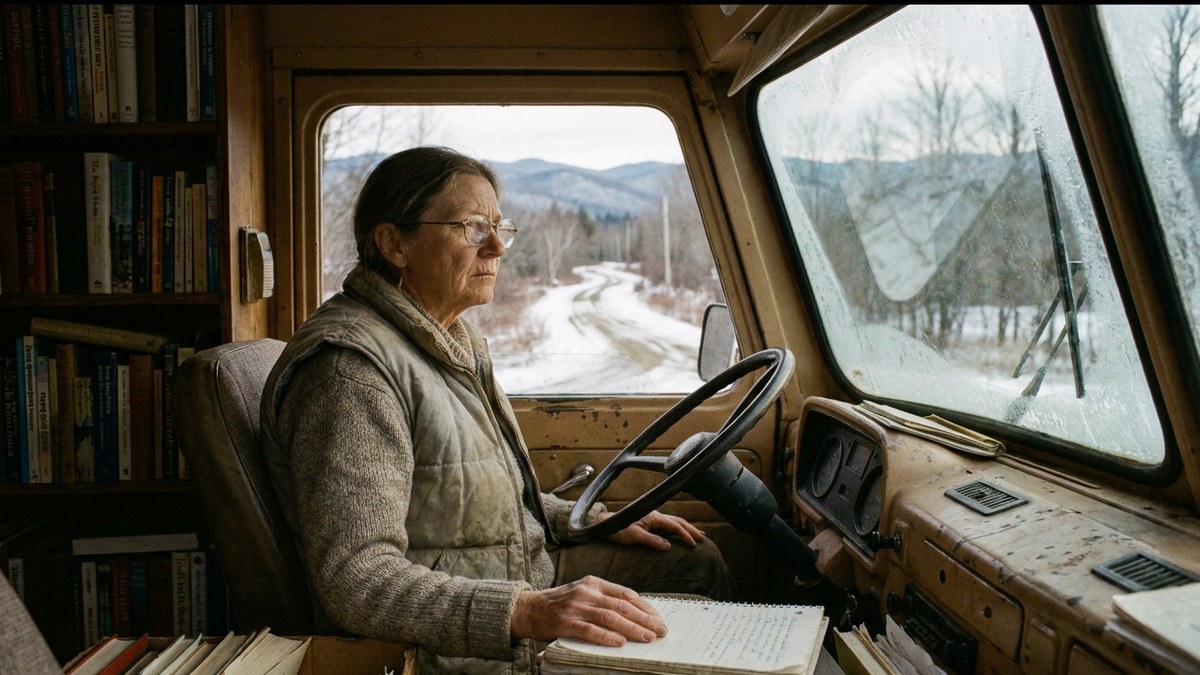
Wesley Hensley had met the bookmobile every Thursday for two years, and this Thursday he wasn't at the stop.
Faye Combs sat behind the wheel with the engine running and the heater going, and she looked out at the empty wide spot at the mouth of Laurel Fork where the boy always waited. It had snowed four inches overnight.
The gravel road up the hollow was white and unbroken. No tracks going in or out.
She checked her watch. 10:40. She'd waited five minutes already, which was four minutes longer than the schedule allowed.
She waited five more.
Wesley had waited for her in the rain under a black umbrella twice his size. He'd waited in August heat with sweat running down his face. Once, when she was twenty minutes late from a flat tire, he'd still been standing there reading, and he'd looked up and said, I knew you'd come.
Faye was sixty-six. She'd driven the bookmobile for the county library in eastern Kentucky for twenty-nine years. Kentucky had more bookmobiles on the road than any state in the country, and Faye figured hers had seen more mud than any of them.
Her route ran four days a week up the hollows and ridges of the county, to houses where the nearest library was forty minutes away on a good road and the roads were rarely good. She knew every stop. She knew every family on every stop, and most of their dogs.
And she kept a log.
It was a spiral notebook on the dashboard, separate from the library's computer. In it, she wrote down what every regular checked out, in pencil, in her own shorthand.
Partly it was so she could bring them what they'd like next. Partly it was just how she was.
Wesley Hensley was eleven. He lived up Laurel Fork with his grandfather, Ollie, in a little house at the head of the hollow, a mile and a half up the gravel.
His mother was gone. Faye didn't know the whole story and had never asked.
Wesley read like other boys breathed. Westerns, mostly, and anything with a dog in it. He'd read every Hank the Cowdog book on the bookmobile twice.
He'd never once missed a Thursday.
Faye picked up her log and turned to Wesley's page.
She ran her finger down the last few lines. She hadn't paid them much mind when she wrote them. She'd been busy, and the boy read so much.
Three weeks ago, Wesley had checked out a Western and a book of first aid for scouts.
Two weeks ago, a cookbook. Easy Meals for Beginners.
Last week, he'd asked her shyly if she had anything about strokes. What they were, and how people got better from them. She'd found him a library pamphlet and a book from the health shelf, and he'd thanked her, and she'd thought he was doing a school report.
Faye looked at the three lines for a long time.
Then she looked up the white road into the hollow.
She called the library from the cab. She told the branch manager she was running late at Laurel Fork and would explain later. Then she put the bookmobile in low gear and turned up the hollow road.
It was not a road the bookmobile was supposed to drive on in snow. Faye knew that. She drove it anyway, slow, in the old tracks under the new snow, with the books swaying on their shelves behind her and her hands tight on the wheel.
The Hensley house sat at the head of the hollow, small and gray, with a tin roof and a porch across the front and a woodpile under a tarp. Faye had been up to it once, years ago, to deliver a box of donated books at Christmas.
She stopped the bookmobile in the yard and sat looking at it.
No smoke was coming out of the chimney.
It was nineteen degrees. In a house heated with a woodstove, in nineteen degrees, there should have been smoke.
She got out. The snow came over her boots.
On the porch, beside the door, two library books were stacked neatly on top of a plastic grocery bag to keep them dry. A Western and the book about strokes.
Tucked into the top book was a folded piece of notebook paper.
Faye unfolded it. The handwriting was careful, grown-up, and slanted. It was a man's handwriting, or somebody trying hard to make it look like one.
Please take these back. W. can't come no more. Thank you for everything.
O. Hensley.
She read it twice.
Ollie Hensley had signed his library card in 1998 with a careful, shaky X. Faye remembered because she'd witnessed it herself. He'd been embarrassed, and she'd told him plenty of good men never had the chance to learn, and that his grandson would read enough for the both of them.
Ollie Hensley could not write.
Faye knocked on the door. She waited. She knocked again, harder.
"Wesley," she called. "It's Miss Faye. With the bookmobile."
For a long time, there was nothing. Just the wind in the bare trees up the ridge and the creek running under the ice.
Then, from right on the other side of the door, close enough that he must have been standing there the whole time, a boy's voice.
"Please go away, Miss Faye," Wesley said. "Please. We're fine."