Sal Benedetto had won the Golden Gloves in 1971, and he hadn't thrown a punch since the night he almost killed a man with one.
That was fifty-three years ago. Most of the people on Eastern Avenue didn't know the second part. They only knew the first.
They knew it because of the photograph taped inside the window of Sal's newsstand, on the corner of Eastern and Conkling in the Highlandtown neighborhood of Baltimore. A skinny nineteen-year-old kid in satin trunks with his gloves raised over his head, grinning, with a crooked nose that wasn't crooked yet. Underneath it, in faded marker, somebody had written Sal "The Hammer" Benedetto, 1971 Champ.
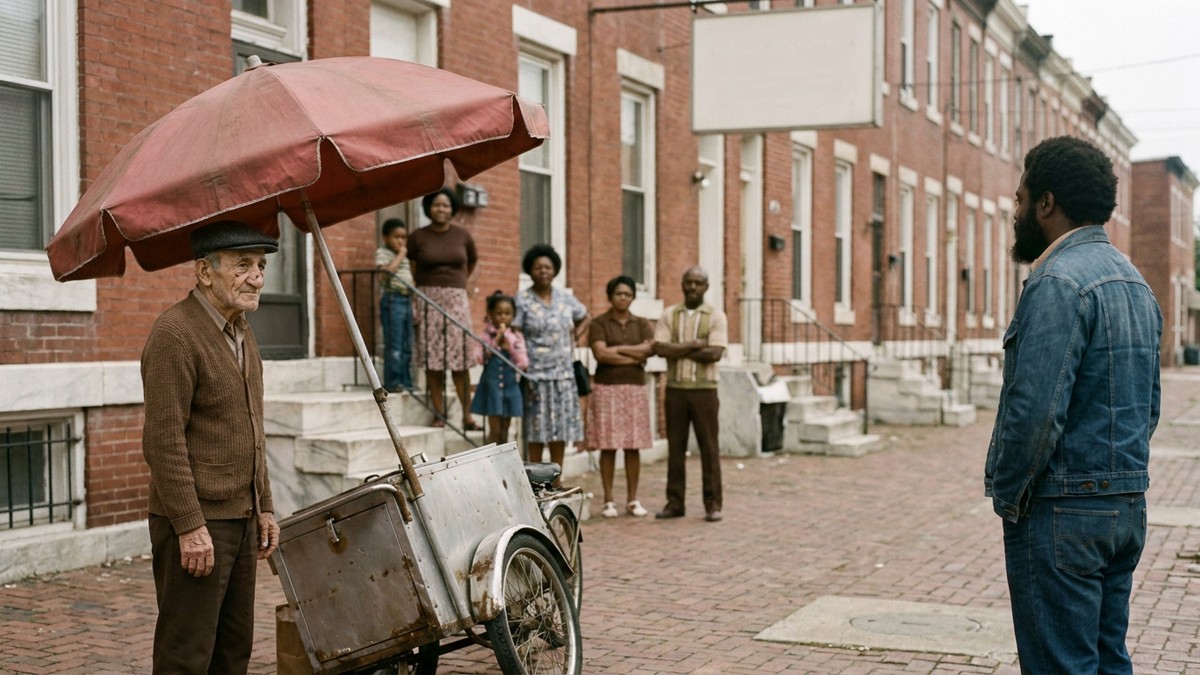
Sal was seventy-four now. His nose was very crooked. He wore a gray newsboy cap and a cardigan with leather buttons, and he opened the newsstand at five-thirty every morning, rain or shine, for the men going to work and the women coming home from the night shift at Hopkins.
He sold newspapers, lottery tickets, cigarettes, gum, and coffee. Or he used to sell coffee.
These days, Tessa sold the coffee.
Tessa Moreno was twenty-six. She'd grown up three blocks away. She'd saved for two years, waiting tables, to buy a used coffee cart with a red umbrella, and she'd asked Sal in March if she could set it up on his corner.
"You'll take my coffee business," Sal had said.
"Your coffee's terrible, Mr. Benedetto," Tessa had said. "I'll be doing you a favor."
He'd laughed so hard he had to sit down. Then he'd told her yes.
She was good at it. She had a line by six-fifteen most mornings. She knew her regulars' orders by the second visit, and she wrote encouraging things on the cups in Sharpie.
Have a great day, Mr. Augie. You've got this, nurse Pam. Sal stood behind his counter in the mornings and watched her work and felt about thirty years younger.
He didn't like Troy Mahaffey.
Troy was about forty, big and soft and loud, with a beard and a sweatshirt from a gym he didn't go to. He'd started coming around in May. He'd lean on Tessa's cart and talk to her for twenty minutes while the line backed up behind him.
He'd ask what time she got off. He'd ask where she lived. He'd order a large coffee and walk away without paying, and laugh about it.
"Put it on my tab, sweetheart," he'd say.
"I don't have tabs," Tessa would say.
"You do for me."
Sal watched him do it for two weeks. He watched Tessa's face get tighter every morning. He watched her start looking up the avenue at six o'clock before she unfolded her umbrella, the way people look for weather.
One morning in June, Troy reached over the cart and took Tessa's phone out of her hand while she was taking a customer's order.
"Let me just put my number in here," he said, grinning.
"Give that back."
"Say please."
Sal came out from behind his counter. He walked over, slowly, and stood next to the cart, close enough to Troy that the big man had to notice him.
"Give the young lady her phone," Sal said.
Troy looked down at him. Sal was five foot eight.
He'd been a welterweight. Troy had him by seventy pounds and six inches, and he looked at Sal's cap and his cardigan and his crooked nose, and he smiled.
"Or what, Pop?"
Sal didn't answer. He just stood there, perfectly still, looking at Troy.
He didn't raise his voice, and he didn't raise his hands. He just looked.
After a long moment, Troy laughed and tossed the phone on the cart. "Relax, old man. I'm just being friendly." He walked off up the avenue.
The neighborhood heard about it by lunch.
Augie, the barber across the street, came over at noon and leaned on Sal's counter. Augie was seventy-one and had known Sal since grade school at St. Elizabeth's.
"Sal," he said. "You should've laid him out."
"No."
"One shot. You still got it. I've seen you hit that heavy bag in your basement."
"No, Augie."
"The Hammer," Augie said, shaking his head. "The Hammer won't hit a guy who's bothering a girl on his own corner. What's the matter with you?"
Sal looked at him for a long time.
"You were there," he said quietly. "In 1973. Outside the Venetian Lounge. You remember."
Augie's face changed. He looked down at the counter. He didn't say anything else.
Mrs. Dombrowski, who lived in the rowhouse with the painted window screen across the street, the one with the swans on it, said Sal ought to call the police. Sal agreed.
Tessa called them on Wednesday. An officer came by and wrote down Troy's description, and said there wasn't much they could do about a man who hadn't hit anybody, and told Tessa to call again if he came back.
He didn't come back on Thursday or Friday.
Tessa started to relax. She wrote a joke on Sal's cup on Friday morning.
Free coffee for the champ. Don't tell my boss.
On Saturday morning, the avenue was busy. Saturday mornings in Highlandtown were always busy. Old women with shopping carts.
Kids on bikes. Families going to the bakery on the next block. Men standing outside the barbershop arguing about the Orioles.
At 9:20, Troy Mahaffey came around the corner from Conkling Street with two friends.
They were his size, or close to it. They were laughing about something. Troy walked straight up to Tessa's cart, past the three people in line, and put both of his big hands flat on the counter.
"Hey, sweetheart," he said. "Heard you called the cops on me."
Tessa took a step back. "Please leave."
"That wasn't nice," Troy said. "That wasn't friendly at all."
And he shoved the cart.
It went over hard. The red umbrella snapped. Two big steel thermoses of coffee hit the sidewalk and burst open, and a river of hot coffee ran across the concrete toward the gutter.
Cups rolled into the street. The little cash box popped open, and quarters went everywhere.
Tessa made a sound. Somebody on the sidewalk screamed.
Sal was already coming out from behind his counter.
Troy turned around and saw him. He grinned, wide and ugly, and spread his arms.
"Here he comes," he said to his friends. "The Hammer." Then he looked down at the old man in the cap and the cardigan. "So what are you going to do about it, Pop?"