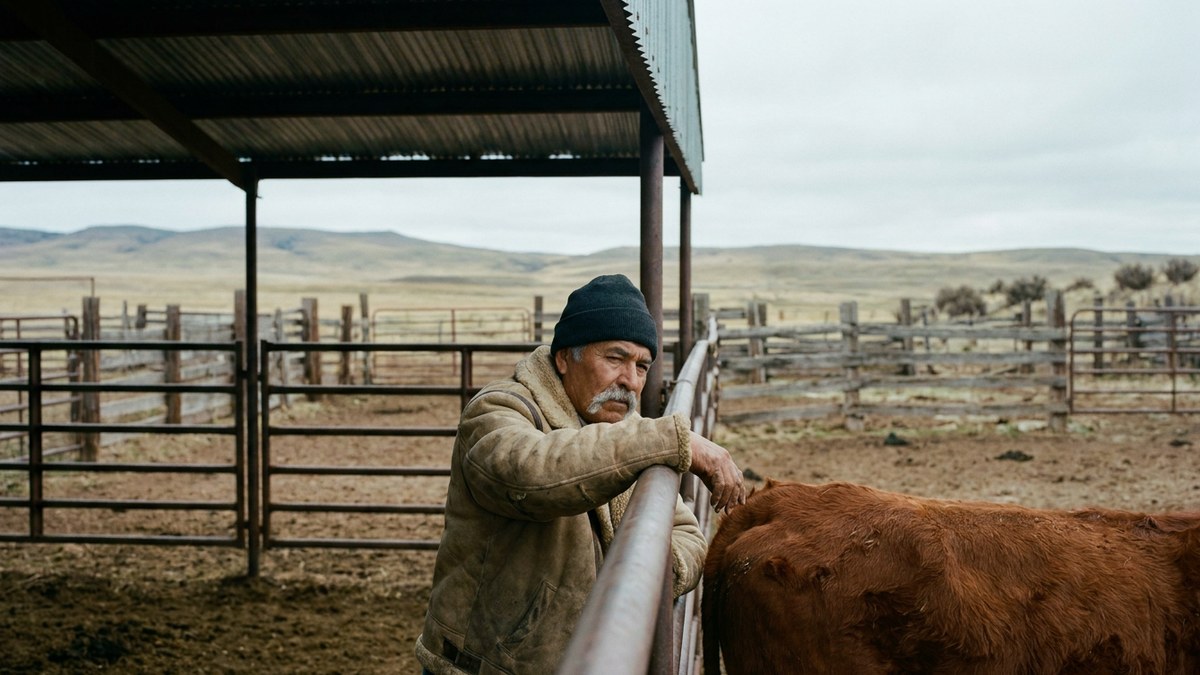
Ramon Ortega hadn't worn a badge in six years, but he knew a doctored brand when he saw one.
The steer stood in pen fourteen at the Arroyo Seco Livestock Auction, a red baldface with its head down and dust on its back. It was a cold Tuesday in November. Wind came off the high plains and rattled the tin roof over the pens, and the smell of diesel and wet hay hung over everything.
Ramon had come to sell four old cows. He'd sold them, cashed the check, and was walking back to his truck past the pens when the brand stopped him.
A lazy J, lying on its side on the left hip. Under it, a short straight bar.
He leaned on the rail and looked for a long time.
"You're thinking about buying him?" said a voice behind him.
Maria Baca was the brand inspector for the district. She was thirty-six, careful, and good at her job. She had a clipboard under her arm and a pair of electric clippers in her coat pocket, and she'd inspected every animal that went through that sale ring for six years.
"I'm thinking about that bar," Ramon said.
Maria checked her sheet. "Lazy J Bar. Registered to the Wynn place out on the Mesa Road. Caleb Wynn brought in one steer this morning. Papers are clean."
"Whose brand is the lazy J by itself?"
"Tomas Lujan's." She said it slowly, and then she looked at the steer the way Ramon was looking at it.
Ramon nodded at the hip. "Look at the J. See how wide it is? How the edges have gone soft, almost fuzzy? That brand went on a calf. A calf grows. The brand grows with him. By the time he's a big steer like this, that mark's spread out to twice the size it went on."
"All right."
"Now look at the bar."
Maria looked. The bar was narrow and sharp, its edges clean as a pencil line.
"That bar didn't grow up with him," Ramon said. "Somebody put it on this year. On a grown animal."
Maria was quiet for a while. Then she took out the clippers, climbed into the pen, and talked to the steer in a low voice until he stood still. She clipped the hair around the brand down close.
Under the clipped hair, the J showed as a wide, pale scar. The bar showed pink at the edges.
"It could be a rebrand," she said. "People rebrand when the first mark doesn't take. Bars blotch sometimes."
"They do."
"I can't call a man a thief because a bar is skinny, Ramon."
"I'm not asking you to. I'm asking whether Tomas Lujan has reported any cattle missing."
Maria went to the office. When she came back, her face had changed.
"Eleven head," she said. "Reported in August. His north fence was down after that hailstorm. He figured they'd wandered and he'd find them. He didn't."
She held the steer. That much she could do. She marked it on her sheet, put a red tag on the gate, and called the sheriff's office.
Sheriff Eli Navarro got there at two, with mud on his boots from a rollover on the highway and his radio talking on his hip.
He was thirty-five, and he'd been a deputy under Ramon for nine years before he ran for the office. He was good. He was also tired, and he looked at Ramon the way a son looks at a father who's shown up uninvited to help him change a tire.
"One steer," Eli said, after he'd seen the brand. "One skinny bar."
"Eleven missing in August," Ramon said.
"I heard. I'll go talk to Caleb Wynn tomorrow. Today I've got a semi on its side on 87 and a bull loose by the school."
Eli put his hat back on. "Ramon. Don't go out there."
"I'm going home."
"That's what you said in 2011, and I found you in a stock trailer behind a pawn shop in Tucumcari."
"I found the saddles, didn't I?"
Eli didn't smile. "Tomorrow," he said, and left.
Ramon stood at the rail a while longer.
He'd known Caleb Wynn since the boy was in diapers. Caleb's grandfather, Bud Wynn, had been Ramon's best friend for fifty years.
They'd branded each other's calves every spring since 1974. When Bud died in 2023, Ramon had been a pallbearer, and Caleb, twenty-six then, had stood at the graveside in his grandfather's good hat with his jaw clamped tight.
Bud's brand was the Lazy J Bar. Tomas Lujan's was the Lazy J.
Ramon remembered Bud laughing about it once at a branding. Fifty years, and the only thing between my cows and Tomas's cows is one little bar.
Ramon got in his truck. He did not drive home.
The Wynn place sat at the end of six miles of washboard gravel off the Mesa Road. The sun was going down red behind the mesa when Ramon pulled in.
Caleb's pickup wasn't there. The house was dark.
Ramon walked down to the barn. The door was open a foot. He pushed it the rest of the way and stood in the doorway until his eyes adjusted.
Bud's old workbench was still along the back wall. Ramon had helped him build it. On top of it, laid out neat on a feed sack, was a branding iron.
Not Bud's old Lazy J Bar iron. That one hung on its nail on the wall where it had always hung. This one was a single short straight bar on a long handle, the metal black and scaled, the kind of iron a man could carry in a pickup and use on any brand he wanted to finish.
Ramon picked it up. It was cold. It had been used.
Behind the barn, in the small trap pasture against the mesa, cattle shifted and bawled.
He counted them in the last of the light. Ten head. Red baldfaces, every one.
Headlights swung across the barn wall.
A truck door shut. Boots crossed the gravel and stopped in the doorway behind him, and Ramon turned around with the iron still in his hand.
Caleb Wynn stood there with the dusk at his back.
"You were Granddad's best friend," Caleb said quietly. "So I guess you know what you have to do."
Then he reached up and slid the barn door shut behind him.