Part 2
"Ike," said Gwen Pryce, "I want you to watch something. And then I want you to fetch the others."
She took a little white china dish from the shelf, the kind she used for salt, and set it on the counter between them. She poured a pinch of Ike's dust into it. Then she took the stopper out of the brown bottle, very carefully, and let three drops of the clear acid fall onto the dust.
For a breath, nothing happened.
Then the dish began to fizz.
Tiny bubbles rose around some of the grains. A thin thread of reddish-brown fume curled up out of the dish, with a sharp smell that made Ike step back and cough. And slowly, as they watched, the clear acid around the dust began to turn color.
Green. A clear, bright, poisonous blue-green, like the stains on her father's hands.
"What in God's name," said Ike Rasmussen.
"Gold won't touch strong water," said Gwen. "Not a bit. You could leave it in there a year. But copper will. And brass is mostly copper." She pointed at the dish, where some of the bright grains had already gone dull and black and begun to crumble, while others lay in the green acid, shining, untouched. "Those are gold. Those were brass filings. Look how many."
Ike looked. His big face went slowly red.
"He paid me three hundred dollars in that," he said.
"He paid you a hundred and eighty in gold, at most," said Gwen. "And a hundred and twenty in brass. And he paid this store, and every store on Wallace Street, the same way." She put the stopper back in the bottle. "And he's leaving on the stage in less than an hour."
Ike was out the door before she finished.
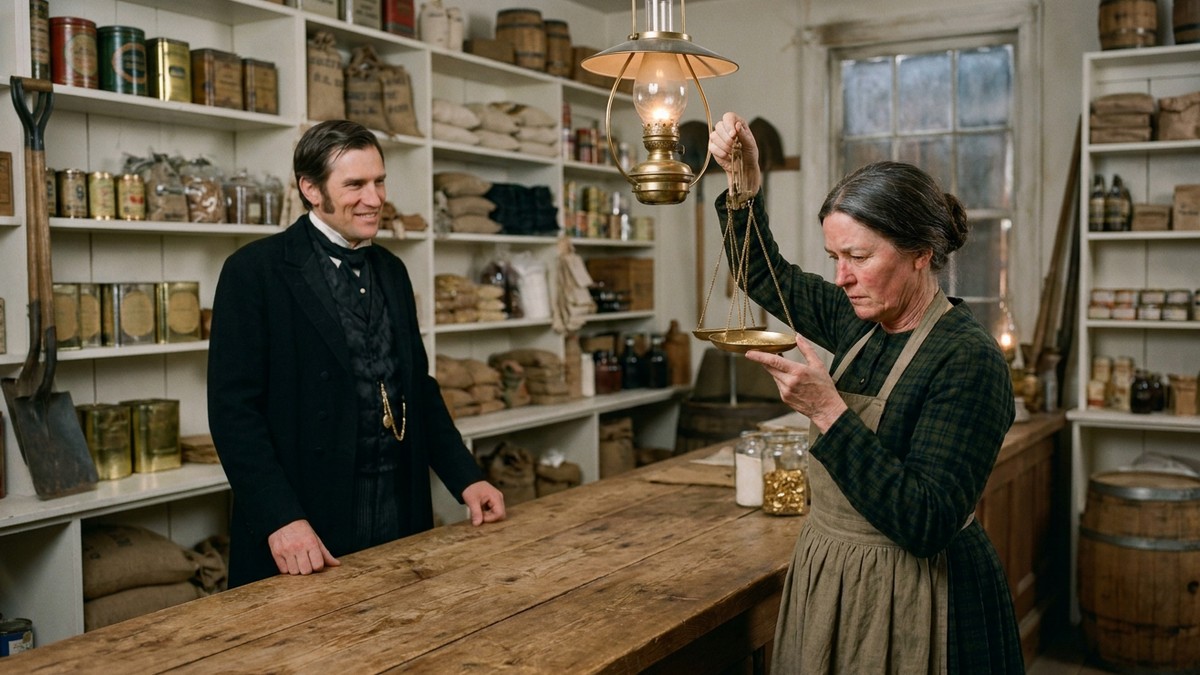
By the time the stage driver had loaded the mail sacks, there were thirty men in front of the Pryce store. Merchants from up and down Wallace Street, with their pokes of Ashby's dust. Saloon keepers. Freighters. Miners who had sold him things. Owen stood behind the counter with his mouth open. Gwen stood beside him with her china dish and her brown bottle and tested every poke, one after another, a pinch at a time, in front of all of them.
Every one turned green.
Then the crowd turned and went down the street toward the stage office.
Gwen did not go with them. She stayed in the store with Owen and the bottle and the dish full of green acid. She was frightened. She knew what a crowd in Virginia City could do that autumn. Everyone did.
But it was Ike Rasmussen who walked at the front of the crowd, a big slow man with his hand up, and it was Ike who did the talking.
They found Mr. Sterling Ashby at the stage office with his carpetbag and his fine black coat, and they walked him back up Wallace Street to the Pryce store, and set him in a chair by the stove. His smile was gone. His soft white hands were shaking.
Ike set the brown bottle and the china dish on the counter in front of him.
"Mrs. Pryce," he said. "Show him."
Gwen showed him. A pinch of dust from his own buckskin poke. Three drops of strong water. The fizz, and the sharp brown thread of fume, and the slow bright green.
Ashby watched it. He did not argue. Then he looked up at her.
"I'll tell you something true, Mrs. Pryce, since it hardly matters now," he said. "Every pinch of dust in this camp passes through ten hands before it gets to the bank. Half of it's been cut with something by some fool or other. I only cut mine a little more, and spent it a little faster." He shrugged. "Nobody looks. That's the whole trick. In two years, you're the first one who looked."
"My father looked," said Gwen. "For thirty years. At copper. In Swansea."
Ashby almost smiled.
"Then I suppose I was unlucky in your father," he said.
He paid it back.
All of it. Every merchant, every saloon, every freighter, with Gwen weighing and testing as he paid, in real coin from a money belt under his silk waistcoat that he had not mentioned to anyone. Ike Rasmussen got his three hundred dollars, and his mules too, because the mules had not left town yet. Then four men walked Mr. Sterling Ashby to the stage, and put him on it with his carpetbag, and told him never to come back to Alder Gulch.
He never did.
That evening, Ike Rasmussen came back into the store.
He stood at the counter with his hat in his big hands. He had a buckskin poke of his own on the counter, the dust from a whole season of freighting, every ounce he owned.
"Mrs. Pryce," he said. "I laughed at you. Right here at this counter. I said a storekeeper's wife ought to stick to weighing flour."
"I remember, Ike."
Ike pushed the poke across the counter.
"I'd take it kindly," he said, "if you'd test this. All of it. Every pinch. I'll pay you for your time."
Gwen tested it. It took her an hour. Every grain was gold. She would not take his money.
After that, Ike Rasmussen would not take dust from any man in Alder Gulch until it had been through Mrs. Pryce's strong water first. And because Ike was the biggest freighter in the gulch, the other freighters would not either. And then the merchants.
By Christmas, there was a line at the counter every Saturday night.
And Owen Pryce, who had laughed at his wife, climbed a ladder one morning in December and painted a new name over the door of the store, in big red letters, so that everyone on Wallace Street could see it.
PRYCE AND PRYCE.