Part 1
Mr. Julian Marsh asked Louisa Penrose to marry him on the twenty-sixth day after they met, under the cottonwood by her well.
It was May 1885, in Ness County, in the high dry grass country of western Kansas, where the homesteaders were still breaking sod and the nearest town was a cluster of frame stores along the new railroad. Louisa was fifty-seven. She had come out with her husband, Thomas, in 1879, and they had filed on a quarter section on Walnut Creek and built a sod house and then a frame one. Thomas had died in the winter of 1883. Louisa had stayed on alone, and finished proving up the claim in her own name.
She had the deed now. A hundred and sixty acres, free and clear, with a good well and forty acres in wheat. It was all she had in the world, and she had earned every foot of it.
Mr. Marsh had come to Ness City in April, on the train. He said he was a widower from Ohio, a cattle buyer, looking for land to settle on. He was perhaps fifty, tall and silver-haired and beautifully mannered, with warm brown eyes and a laugh that made the whole room laugh with him.
He came to church on his first Sunday. He sat behind Louisa. After the service he carried her basket to her buggy and asked, very respectfully, if he might call.
He called the next Sunday. And the next. He brought her a bolt of blue calico from the store, because he said it was the color of her eyes. He mended her pump. He sat on her porch in the evenings and talked about Ohio, and about his dear late wife, and about how lonely a man could be in a new country.
Louisa had been lonely for two years. She had not known how lonely until Julian Marsh sat on her porch.
"Twenty-six days," said her neighbor, Mrs. Dorcas Fenn, when Louisa told her. Mrs. Fenn was a sharp-tongued woman of sixty who lived a mile down the creek and had buried two husbands. "Twenty-six days, Louisa. I knew my first husband three years before he asked."
"He's a good man, Dorcas."
"Maybe he is." Mrs. Fenn sniffed. "But I'll tell you what I think, since nobody else will. At our age, a woman should be glad of an offer at all, and not too particular about where it comes from. But she should be very particular about her deed."
Louisa laughed. But that night she lay awake thinking about it.
Julian had not asked about her deed. Not exactly.
He had only said, once, on the porch, in his warm way, that when they were married it would be simpler for everything to be in both names. The house. The land. The bank account. So that if anything happened to her, God forbid, he could take care of everything without any trouble from lawyers. That was how it was done in Ohio, he said. Between people who trusted each other.
And he wanted to be married soon. In three weeks, on the sixteenth of June. He had cattle business in Dodge City in July, he said, and he could not bear to leave her behind unmarried.
Three weeks.
Louisa lay in the dark and thought about that. Then she thought about the other things he had said, on the porch, in the evenings, about his life. She had a good memory. Thomas had always said so.
He had said he had lived in Emporia, in Lyon County, before he went back to Ohio. That he had bought mules in Carthage, in Jasper County, Missouri. That he had spent a winter in Beatrice, Nebraska, in Gage County, where he had nearly bought a farm.
Three places. Three counties.
Louisa got up and lit the lamp.
She wrote three letters that night, at the kitchen table, in her best hand.
To the Clerk of the Probate Court of Lyon County, Kansas. To the Recorder of Deeds of Jasper County, Missouri. To the County Judge of Gage County, Nebraska.
Each one said the same thing, politely and plainly. She was a widow of Ness County, Kansas, and she wished to know whether there was any record in the clerk's books of a marriage, in the last ten years, of a man by the name of Julian Marsh. She enclosed a dollar for the clerk's trouble, and a stamped envelope for the reply.
She did not tell Julian. She did not tell Mrs. Fenn.
In the morning, she drove to Ness City and mailed the letters herself. Then she went into the store, where Julian was waiting to drive her home, and smiled at him, and let him take her arm.
She felt like a traitor all the way home.
The days went by. Julian came every evening. He was kinder than ever. He brought her a little gold locket and fastened it around her neck himself. He talked about the wedding, and the dress she would wear, and the life they would have.
On the ninth of June, a week before the wedding, he brought a paper.
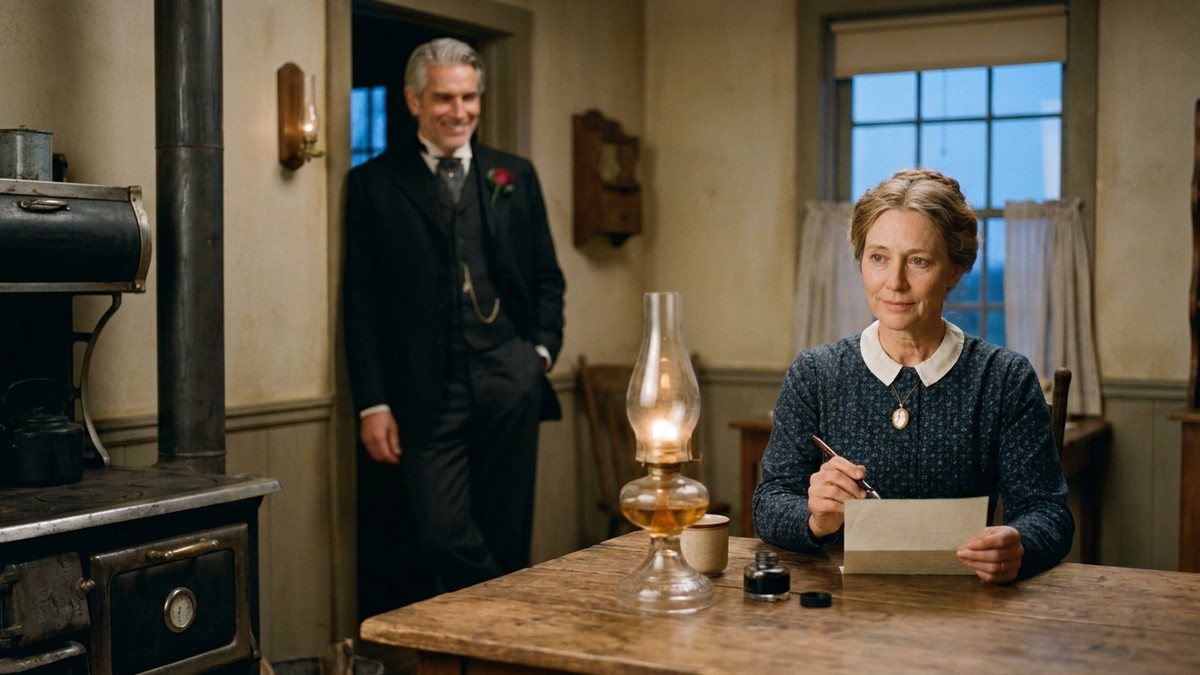
"Just a little thing, my dear," he said, laying it on the kitchen table beside her coffee cup, with a pen and ink. "A deed of joint ownership. I had a lawyer in Ness City draw it up. So we needn't trouble about it after the wedding." He smiled his warm smile. "Sign there, at the bottom. Then it's done, and we can think about happier things."
Louisa looked at the paper. She looked at the pen.
The mail would come to Ness City on the train that afternoon. She had been waiting for it every day for two weeks.
"I'll sign it tomorrow, Julian," she said. "I've a headache tonight."
For just a moment, something moved behind the warm brown eyes. Something she had never seen there before.
Then he smiled again, and kissed her hand.
"Of course, my dear. Tomorrow."