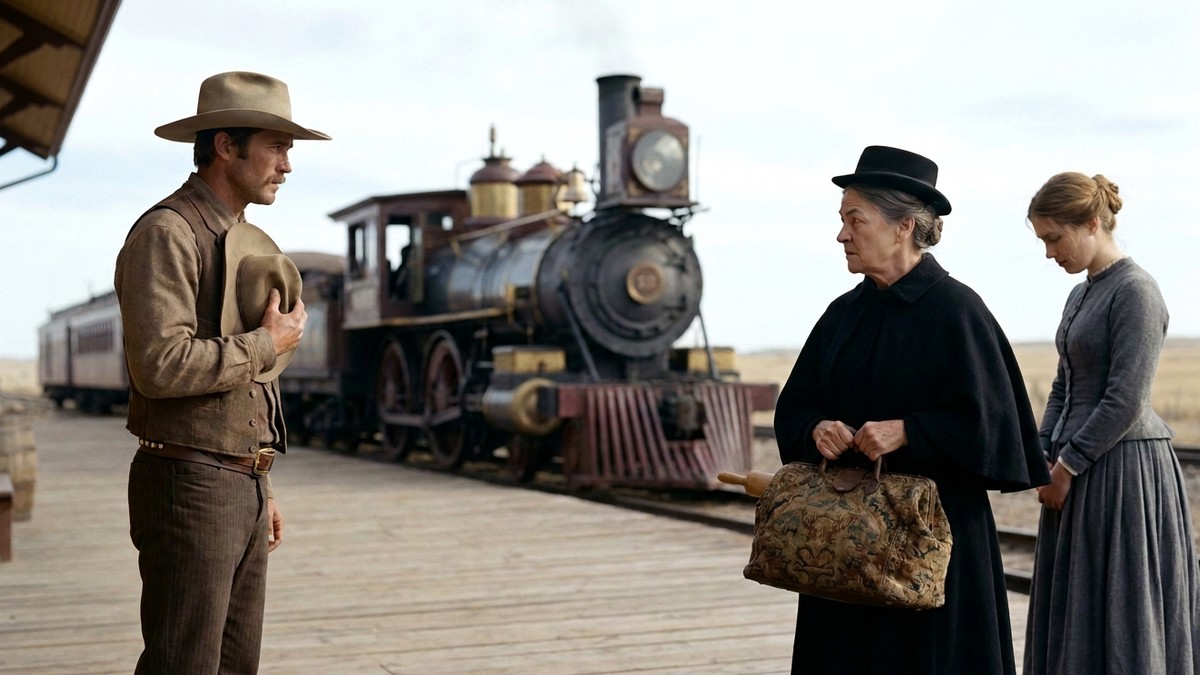
Part 2
Nobody spoke.
Ben looked at Augusta Rowe. He knew what she was thinking, because he was thinking it too. Eleven haystacks stood inside the pole fences behind the house. Eleven stacks, for five hundred cattle, and the worst of the winter still ahead. Every forkful they gave away was a forkful their own herd would not eat in March.
And Shorty Briggs had laughed at the hay. In front of all of them. He had refused to touch a pitchfork. He had called her a dairy widow behind her back, Ben knew it, at the bunkhouse stove.
Augusta Rowe got up from her chair.
"Clara," she said, "get Mr. Briggs some coffee. He's frozen through. Mr. Haskell, hitch up the hay sled."
Shorty stared at her.
"Ma'am," he said. "I..."
"You can say it later," said Augusta Rowe. "Your cows can't wait. Get your coat back on."
They brought Shorty's cattle up out of the draw that night by lantern light, through snow to the horses' chests. Of forty head, thirty-one were still on their feet. Ben and Shorty pushed them up the creek to the pole corrals by the house, and Augusta forked hay over the fence to them from the sled, steady as a clock, in the bitter dark.
Then she did the sum.
"Eleven stacks," she said at breakfast, writing on the back of a seed catalog. "Five hundred and thirty-one head. If we feed full rations, the hay is gone by the first of March. Winter won't be over by the first of March."
"So what do we do?" said Ben.
"Half rations," said Augusta. "And we cut the cottonwoods."
They cut them all winter.
Every day, Ben and Shorty went down to the creek with axes and felled cottonwood trees along the bottom and dragged them up to the cattle with the team. The cattle stripped the bark and the twigs and the small branches down to the white wood. It was poor feed. But it was feed. With the half ration of hay on top of it, it was enough to keep a cow on her feet.
Clara kept the stoves going and the coffee hot, and cooked for four people, and when the men came in at night half frozen she rubbed their hands with snow. Then she sat by the stove and read to them out of the only book in the house, which was "Ivanhoe," while the wind screamed outside.
Ben listened to her voice more than to the story. She did not stammer when she read. He had not known that.
Out on the open range, the cattle died.
They died in the draws, where they had crowded in out of the wind. They died along the fences. They died standing up, frozen, and lay down only when the spring thaw came. On the bigger outfits, the riders who went out in March came back and could not speak of what they had found.
The last haystack on Chugwater Creek was finished on the twentieth of March.
On the twenty-second, a warm wind came down from the mountains, and this time it stayed.
When the snow went off, Ben and Shorty rode the range to count.
Of Ben Haskell's five hundred head, four hundred and fifty-three were alive. Of Shorty's thirty-one, all thirty-one. Along the whole length of the Chugwater, and up and down the range, the neighbors had lost half their herds, some of them more. Some had lost everything. The big outfits whose men had laughed at the Cheyenne Club began, that summer, to sell out and go back east.
The money from the five hundred steers Ben had sold in October had paid the interest at the bank. In May, when the banker in Cheyenne learned that Ben Haskell still had a herd, he renewed the note without a word.
Shorty Briggs came up to the house on the first warm evening in April, while Augusta was on the porch shelling dried beans.
He stood at the bottom of the steps with his hat in both hands.
"Ma'am," he said. "I said a few things. Last fall."
"I recall," said Augusta.
"I was wrong." He turned his hat around. "I've been on this range nine years. I thought I knew it. I didn't know a thing." He cleared his throat. "Thirty-one head. Every one alive. That's my whole stake, ma'am. That's everything I've got in the world."
Augusta shelled another bean.
"I'll be needing someone to run a mower in August," she said. "And to build pole fences for the stacks. More stacks, this year. Twice as many."
"Yes, ma'am," said Shorty Briggs. "I'll run it."
He did. That August, and every August for eleven years. He became, people said, the best hay man in Laramie County, and told anyone who would listen that he'd learned it from a dairy widow from Ohio.
Ben Haskell married Clara Rowe on the fifteenth of May, 1887, on the porch of the log house on Chugwater Creek, with the cottonwood stumps all down the creek bottom behind them, already putting out green shoots.
Shorty Briggs stood up for him. Augusta Rowe gave the bride away, in her good black silk, with her jaw set like concrete and her eyes not quite dry.
When it was done, Ben turned to his wife. He had thought a long time about what to say, and in the end he said the only thing that came to him.
"How do you do," he said, "Mrs. Haskell."
And Clara, who had said those words to the platform boards at Cheyenne the September before, looked up at him this time, straight in the eyes, and laughed.
"Very well, Mr. Haskell," she said. "Very well indeed."