Part 1
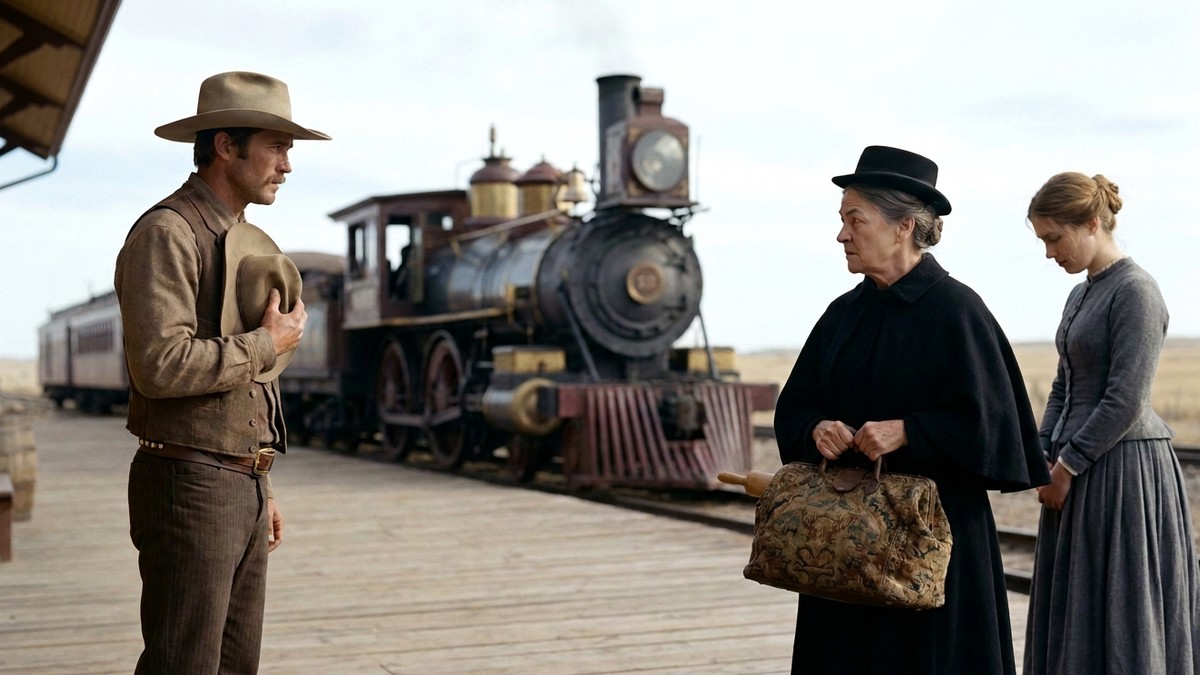
Ben Haskell sent for one wife, and two women stepped off the train at Cheyenne, and the second carried a carpetbag and a rolling pin.
It was September 1886, in Wyoming Territory. Ben was thirty-four, a rancher with a thousand head of cattle on Chugwater Creek, a log house with three rooms, a mortgage at the Cheyenne bank, and nobody to talk to from one month to the next but his foreman and his horse. In the spring he had put a notice in a matrimonial newspaper back east. A Miss Clara Rowe of Ohio had answered. They had written all summer. She was twenty-six, she said, quiet, a good plain cook, and fond of animals.
She had not said anything about her mother.
Clara was small and brown-haired, with gray eyes, and so shy that she said "How do you do, Mr. Haskell" to the platform boards and then said nothing else at all.
Her mother said everything else.
"Augusta Rowe," she said, and shook his hand like a man. She was sixty-one, square and solid, with iron-gray hair and a jaw that looked as if it had been set in concrete. "I'm a widow, Mr. Haskell. I ran a forty-cow dairy in Knox County, Ohio, for twenty years after my husband passed, and I sold it in June. I'm not about to send my only daughter off to the end of the earth to marry a stranger without having a look at him first."
Ben looked at her. Then at Clara, who was looking at her shoes.
"Ma'am," he said weakly, "the house only has three rooms."
"Then you'll sleep in the bunkhouse," said Mrs. Rowe, "until the wedding. Which will be in the spring, if the two of you still want it then. Now, which wagon is yours?"
She had the house scrubbed in two days.
She had the woodpile stacked by the third. By the end of the first week she had walked over every acre of the creek bottom, and ridden out with Ben on a borrowed horse to see the range, and looked at the cattle for a long time without saying anything.
Then, at supper, she put down her fork.
"Mr. Haskell," she said, "where is your hay?"
Ben stared at her.
"Hay, ma'am? We don't put up hay. Nobody does. Cattle graze the open range all winter. They paw through the snow to the grass."
"And how was the grass this summer?"
He did not answer at once. Everybody on the range knew how the grass was. There had been almost no rain since spring. The range was overstocked, with more cattle every year coming up from Texas, and the grass was short and brown and eaten down to the roots.
"Poor," he said.
"And the price of cattle in Chicago?"
That he did not want to answer either. The price had fallen to half what it was two years before. That was why he had the mortgage.
"Mr. Haskell," said Augusta Rowe, "I don't know cattle. But I know cows. I know that a cow can't eat what isn't there. And I know that every muskrat on this creek has built his house twice as thick as usual this fall, and the geese went south three weeks early." She folded her hands. "I'd cut every blade of hay in that creek bottom, starting tomorrow. And I'd sell half the steers, now, while somebody will still pay something for them."
Ben's foreman, Shorty Briggs, laughed out loud.
He was a lean, leathery Texan of forty, who had been on the Wyoming range since '78 and owned forty head of his own, branded with a lazy S, that ran with Ben's herd.
"Ma'am," he said, "with respect. This is Wyoming. We don't feed cows here. Cows feed themselves. Every outfit from here to Montana has run cattle on open grass for ten years and done fine. You sell steers at these prices, you lose your shirt. You're talking dairy farm. This is a cattle ranch."
"Is it," said Mrs. Rowe.
"It is, ma'am."
Ben looked from one to the other. He did not know what to say. Then, at the end of the table, someone set down a teacup.
It was Clara.
"Mother ran the dairy twenty years," she said. Her voice was very small, and her face was red, but she said it. "Every winter, she knew when it was going to be bad. She was never wrong. Not once."
It was the most Ben had heard her say since the platform at Cheyenne.
He looked at her. Then he turned to Shorty.
"Get the mowers out," he said.
Shorty Briggs and two of the hands quit rather than make hay. Shorty stayed on as foreman but would not touch a pitchfork. "I'm a cowboy," he said, "not a hired man."
So Ben ran the mower. Augusta Rowe drove the rake. And Clara, in an old sunbonnet, with her skirts tied up, forked hay onto the stacks beside her mother until her hands blistered and bled, and did not say one word of complaint.
They cut every meadow on the Chugwater. They stacked it inside pole fences, close to the house.
And in October, while the neighbors laughed, Ben drove five hundred steers to the railroad at Cheyenne and sold them for barely half what they had cost him.
"Haskell's gone soft," the men said at the Cheyenne Club. "Letting a dairy widow from Ohio run his outfit."
The first snow came in the middle of November. It did not melt.
Another storm came in December, and another. The snow lay four feet deep on the level. Out on the range, the cattle pawed at it and found nothing. The thin grass was buried too deep.
Then, in January, a warm chinook wind blew down from the mountains, and for two days the snow went soft and wet. Everybody on the range took a breath.
And then the cold came back. It came on a howling north wind and froze the wet snow solid. A crust of ice, hard as a sheet of iron, over every foot of the range. No cow could paw through it.
On the third night after the freeze, someone pounded on the door of the log house on Chugwater Creek.
It was Shorty Briggs. His beard was white with frost. His face was gray.
"Ma'am," he said to Augusta Rowe. His voice cracked. "Mr. Haskell. My forty head. They're down in the draw below the bluff, what's left of them. They're starving. I can't..."
He stopped. He took off his hat.
"I need hay," he said.