The bull heard him before it saw him.
Buster whistled. A long, sharp, two-note whistle he had used in arenas for twenty-four years. It cut through the screaming like a knife.
The big black bull stopped trotting. It swung its head around.
It saw an old man in brown slacks, standing alone in the middle of the arena, forty feet away, holding a straw hat out to one side.
Buster did not run at it. That was the first thing young bullfighters always got wrong. You did not run at a bull. You let the bull come to you. You made yourself the most interesting thing in the arena.
He waved the hat. Slowly. Out to the left. Away from the children.
"Hey, bull," he said, in a low, calm voice. "Hey, now. Over here. Look at me."
The bull looked at him.
It pawed the dirt once. It lowered its head, with the tipped horn.
Behind him, Buster could hear the children being pulled back from the pipe fence, the parents running, the announcer finally saying something sensible. He did not look. He did not take his eyes off the bull's eyes.
He knew something about bulls that the young bullfighters were still learning. A loose bull in an arena does not really want to fight. It wants to get out. It is looking for the way home. And in a rodeo arena, home is the out gate, where the bull goes after every ride to have its rope taken off.
In the Logan County fairgrounds arena, the out gate was on the north side.
To Buster's right. Behind him.
The children were in front of him. To the south.
All he had to do was turn the bull around.
He took one slow step to his left. Then another. Waving the hat.
The bull's head followed the hat.
Buster took another step. Now he was between the bull and the children, a little to the side, so that the bull was looking at him and past him at the same time. He was close enough to smell it. Close enough to see the white of its eye.
His heart was going like a drum. He was seventy-nine years old.
He did not let any of it into his voice.
"That's right," he said softly. "Look at me. Not at them. At me."
The bull lowered its head and took one step toward him.
Buster turned his body sideways, the way you do, so it could see the open ground behind him to the north. The empty arena. The out gate, standing open now, where one of the young chute men had finally thought to swing it wide.
He took off his hat and threw it.
Not at the bull. Past the bull. Over its shoulder. To the north. A spinning straw hat, sailing through the air toward the out gate.
The bull's head swung around after it.
And Buster Hobbs stepped in, fast, the way he had fifty years ago, and slapped the bull hard on the rump with his open hand, and shouted.
The bull jumped forward, away from him, after the hat. It saw the open gate. It saw home.
It went through the out gate at a dead run and into the stripping pen, and the young chute man slammed the gate shut behind it.
Buster stood in the middle of the empty arena, breathing hard, with his hands on his knees.
For a moment, the whole fairgrounds was absolutely silent.
Then the grandstand stood up.
He did not stay for the cheering. He walked to the gate, very slowly, and let himself out, and went to sit on a hay bale behind the chutes until his heart slowed down.
Somebody brought him a bottle of water. Somebody brought him his hat. A young mother with a little girl in a mutton busting helmet came and stood in front of him and tried to say something and could not, and finally just put her arms around his neck.
He did not see the tall, white-haired man watching him from the other side of the chutes.
The induction dinner was that night at the Hall of Fame ballroom. Four hundred people. Television cameras.
Buster was not there. He was home on Noble Street, in his recliner, with an ice pack on his knee and his dog in his lap.
At eight-thirty, his telephone rang.
It was the director of the Hall of Fame. He sounded strange.
"Mr. Hobbs," he said. "I'm sorry to bother you at home. But there's a car outside your house. We'd like you to get in it."
"What for?"
"Because Jesse Ray Holcomb won't accept his award," the director said, "until you're in the room."
Buster walked into the ballroom at nine-fifteen, in his clean brown slacks and a borrowed sport coat, with his straw hat in his hand.
Jesse Ray Holcomb was standing at the podium on the stage with his Hall of Fame plaque in front of him, untouched. He had been standing there for forty-five minutes, waiting.
When he saw Buster in the doorway, he leaned into the microphone.
"Folks," he said, "there's a man walking in the back door right now that I didn't recognize this morning. I walked right past him in the lobby. I'm ashamed of that. I'll be ashamed of it the rest of my life."
The room turned to look.
"I didn't recognize him because the last time I saw his face," Jesse Ray said, "it was covered in greasepaint, and I was lying on my back in the dirt at the Cheyenne Frontier Days arena in July of 1974, and a bull named Tornado Alley was about to put a horn through my chest."
The room went silent.
"Buster Hobbs jumped on that bull's head," Jesse Ray said. "With his bare hands. He took the horn in his own ribs instead. He broke four of them. They carried him out on a stretcher. I walked out. And I won the world title that December."
He looked down at the plaque on the podium.
"Not once did they put his picture on a wall," he said. "Not once did he get a buckle. He's half out of the frame in my photograph in your lobby, folks. That blur in the corner. That's him. That's the only reason I'm in the picture at all."
He lifted the plaque off the podium.
"This afternoon, he did it again. For your grandkids. At seventy-nine." Jesse Ray's voice cracked. "So I'm not taking this home unless he's standing up here with me."
Buster walked up to the stage. It took him a while. Four hundred people stood the whole time.
Jesse Ray met him at the top of the steps. He did not shake his hand. He put his arms around him, two old men in the light, and held on.
Then he put the Hall of Fame plaque in Buster Hobbs's hands, and stepped back, and started to clap.
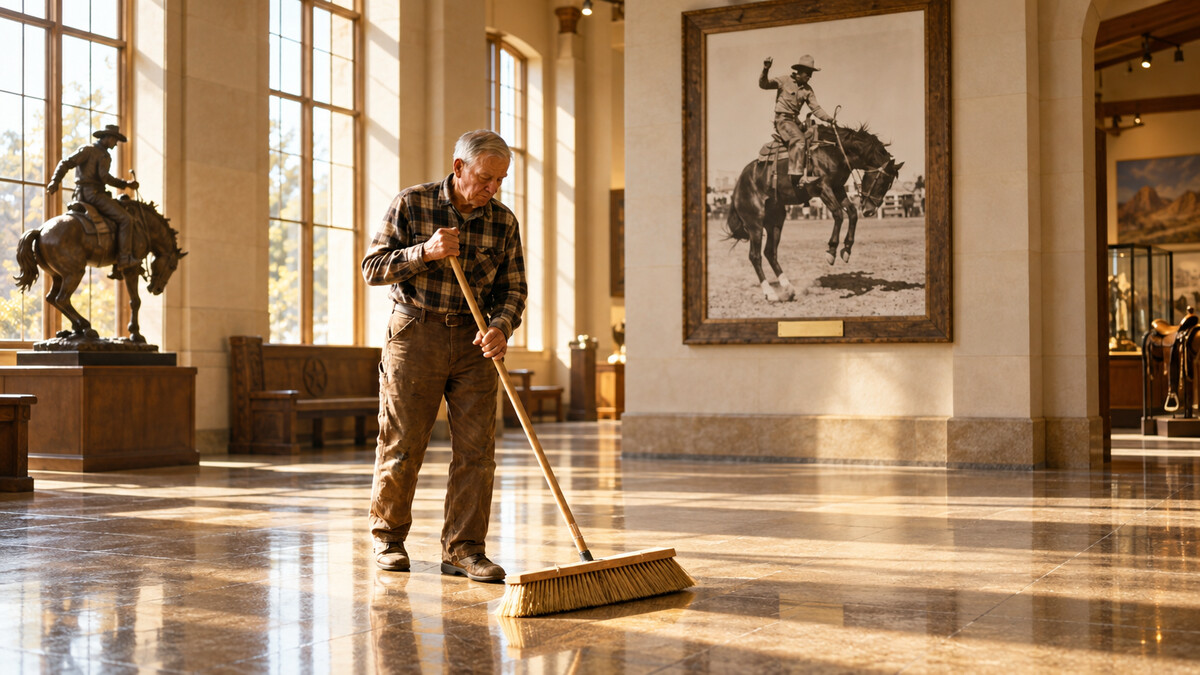
The next spring, the Great Plains Rodeo Hall of Fame changed the photograph in the lobby.
It was the same picture. Jesse Ray Holcomb in mid-air over a big gray Brahma, one hand high, his hat flying.
But they had found the full negative in an old newspaper archive, and they had printed the whole thing. And now the man in the corner was not half out of the frame.
He was all the way in. Baggy striped pants, red shirt, greasepaint, running full speed at the bull.
The new plaque underneath had two names on it.
Buster swept around it three mornings a week, slowly, and every time, he stopped for a moment and looked.