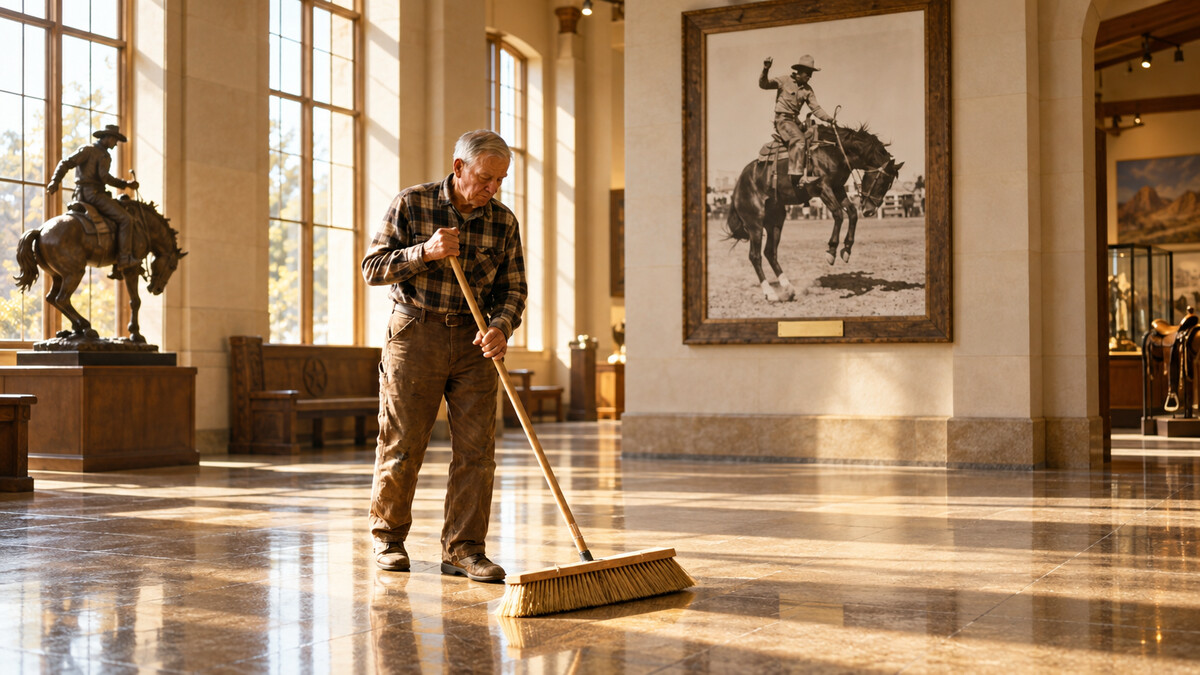
On the morning of the Great Plains Rodeo Hall of Fame induction in Guthrie, Oklahoma, the man who had saved the life of the guest of honor was pushing a broom across the museum lobby, and not one person there knew who he was.
Buster Hobbs did not mind. He had been sweeping that lobby three mornings a week as a volunteer for six years. He liked the quiet. He liked the old saddles in the glass cases and the black-and-white photographs on the walls.
He stopped sweeping in front of one of them now.
It was a photograph of a bull rider in mid-air over a big gray Brahma bull, his hat flying off, one hand high. The plaque underneath said: Jesse Ray Holcomb. 1974 World Champion Bull Rider. Inducted this year.
In the far corner of the photograph, half out of the frame, there was a blur. A man in baggy striped pants and a red shirt, running toward the bull.
Buster looked at the blur for a long time. Then he went back to sweeping.
Buster was seventy-nine. He had been a rodeo clown from 1966 to 1990, the kind they called a bullfighter now. His job had been to run at a two-thousand-pound bull when it threw a cowboy and make the bull chase him instead.
He had done it in arenas from Pendleton to Madison Square Garden. He had broken nineteen bones. He had lost most of his hearing in his left ear and three teeth and the use of two fingers on his right hand.
He had saved, by his own rough count, a couple of hundred cowboys from getting hurt. Maybe more. Not a soul kept count of that. Not the way they counted wins.
When his body quit in 1990, he had gone home to Guthrie and worked as a janitor at the high school for twenty years. He had married a nice woman named Lou Ellen, who died in 2019. He had no children. He had a dog and a little house on Noble Street and a box of old rodeo programs under his bed.
The Hall of Fame had not asked him to the induction dinner. He had not expected them to.
Jesse Ray Holcomb arrived at eleven, in a black pickup driven by his grandson.
He was seventy-four, tall and white-haired, with a limp and a big silver belt buckle. He had won the world title in 1974 and two more after that, and then he had gone into the cattle business in Texas and done very well. He was the biggest name being inducted that year. There were television cameras.
Buster watched him walk through the lobby, shaking hands with the director, signing autographs, smiling for the cameras.
Jesse Ray walked right past him. He did not look at the old janitor with the broom.
That was all right too.
It had been fifty-two years. Buster had been in a clown suit and greasepaint then, with a wig, and Jesse Ray had been flat on his back in the dirt with a bull's horn coming down at his chest.
He probably had not gotten a good look.
The Hall of Fame weekend always had an exhibition rodeo on Saturday afternoon at the county fairgrounds, before the induction dinner. Bronc riding, a little team roping, a youth barrel race. And for the little kids, mutton busting, where children five and six years old rode woolly sheep across the arena and fell off into the soft dirt while their parents cheered.
Buster went every year. He sat in the top row of the grandstand, where it was quiet, with a bag of popcorn.
The bull riding was at three o'clock. Just three bulls, ridden by young cowboys from the high school rodeo team, for show. The bulls were young too. Nothing like the old Brahmas.
Buster watched the first two rides with half an eye. Then something made him sit up.
The third bull was loading badly into the chute. A big black crossbred with one horn tipped down. He was fighting the gate. Slamming it. The two young men working the chute were nervous. Buster could see it from the top of the grandstand.
And the latch on the bucking chute was an old one. A drop latch. He had seen a hundred of them. The kind that could pop if a bull hit it hard enough at the wrong angle.
At the far end of the arena, beyond a single low pipe fence, the mutton busting kids were lining up for their turn. Twenty little children in helmets and vests, with their parents leaning on the rail.
Buster set down his popcorn.
The bull hit the gate one more time. The latch popped.
The chute gate swung open. The young cowboy who had been sitting down on the bull was thrown sideways into the chute rails, hanging on to the boards, and the big black bull came out of the chute into the empty arena with an empty back.
For about two seconds, the arena froze.
The bull stood in the middle of the arena, head up, blowing. He was not bucking. He was looking.
Then he turned toward the far end of the arena, toward the low pipe fence and the sound of children laughing.
And he started to trot.
Somebody screamed. The announcer said something into the microphone that the crowd could not understand. The two young bullfighters who had been working the exhibition were at the wrong end of the arena, behind the chutes, and they started running, but they were a long way off.
Buster Hobbs was already on his feet in the top row of the grandstand.
He did not think about it. He had not had to think about it in fifty years. He went down the grandstand steps two at a time, on his bad knees, his bad hip, his hands on the railings, and at the bottom he did not go to the gate.
He went over the fence.
Seventy-nine years old, in his good brown slacks and his church shoes, Buster Hobbs climbed the arena fence and dropped into the dirt, and he took off his old straw hat, and he started walking straight toward a two-thousand-pound bull.