Part 2
Ruth let him in. She did not offer him coffee. Then, because her mother had raised her, she did.
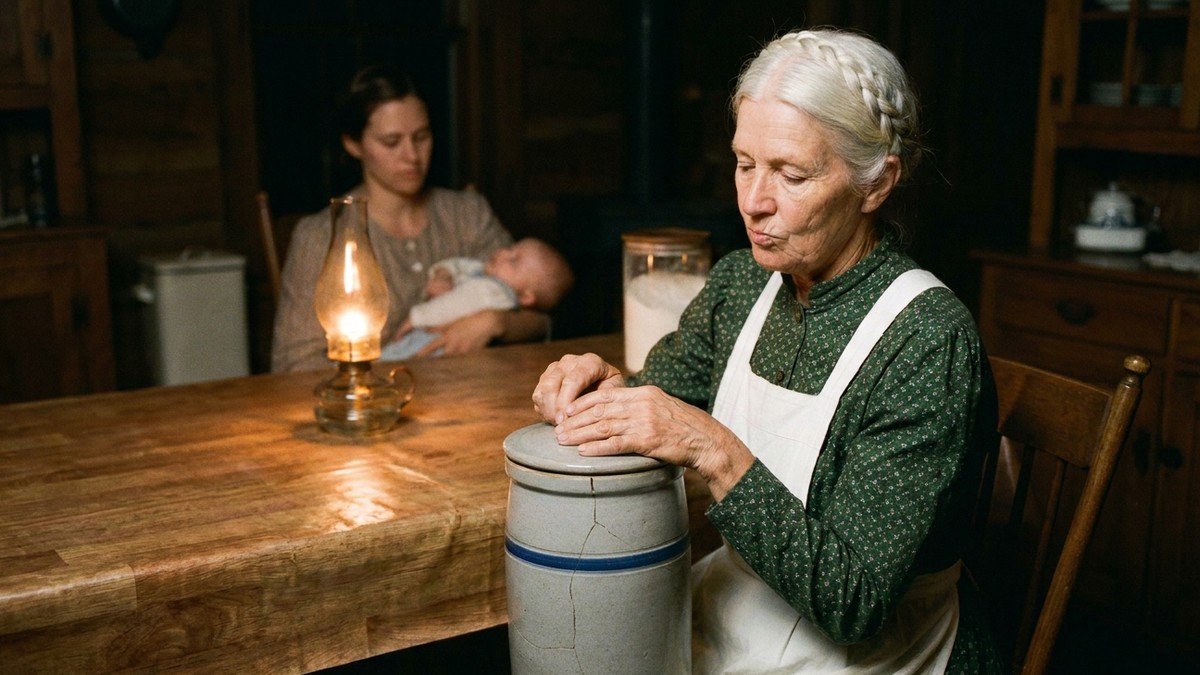
Lyman Price sat at her kitchen table with his hat on his knee and the churn between them. He did not look at it. He looked at the oilcloth.
"My correspondent bank in Omaha will carry me," he said, "if I can show them five hundred dollars in hard money by Monday. Gold or silver. With that, I open my doors again. Without it, the examiner comes and the bank goes to a receiver, and the depositors get what the lawyers leave them." He swallowed. "Which won't be much."
"Five hundred dollars," Ruth said.
"I've tried everyone I know. Nobody in this county has hard money this month." He almost smiled. "Except, I'm told, the cow."
Ruth did not smile back.
"You called in the notes," she said.
"I had to. I need every dollar I can raise."
"You'll raise it by taking the Nyquists' mares a week before harvest."
"Mrs. Oberg." He put both hands flat on the table. "A bank is a promise that not everybody will want their money in the same week. This month, everybody did. If I let one note go, I'm giving away money that belongs to the people who trusted me with it. To Mrs. Kemp. To the Hallorans. You understand that? It isn't mine to forgive."
He believed it. She could see that he believed it, and for a moment she almost did too.
Then she remembered the paper Ole Nyquist had pushed across this same table, two hours ago.
"Payable to L. Price," Ruth said.
He looked up.
"The Nyquist note. I read it tonight under that lamp. It doesn't say the Rock Ford Exchange Bank. It says L. Price." She folded her hands. "So does the Hallorans', I'd guess. You lent them your own money, Mr. Price, at two percent a month. Those notes aren't the depositors'. They're yours."
The kitchen clock ticked. A moth bumped against the lamp chimney and fell and climbed back up.
Price's face went slowly red, from the collar up.
"That's my own savings in those notes," he said. "Everything outside the bank. If I forgive them, I've got nothing left but the bank."
"Then you'll know how the rest of us feel," Ruth said.
She got up. She went to the churn and lifted out the flour sack and set it on the table between them. It made a soft heavy sound, the sound of twenty years.
"Five hundred dollars," she said. "In gold and silver. No interest. You can pay it back when the bank can stand."
Price stared at the sack.
"On one condition," Ruth said. "Tonight, at this table, you write across the Nyquist note and the Halloran note that they are paid in full. And you sign it. And tomorrow you take the second paper off your door."
He did not answer.
Ruth counted the money out while she waited, because her hands wanted something to do. Eagles in one stack. Silver dollars in stacks of ten. The greenbacks smoothed flat with the side of her palm. She counted it twice, the way she always had.
Five hundred, exactly. The rest she put back in the sack.
Price took the pen from his inside pocket. He had the two notes with him; she had guessed he would. A banker always carried his papers.
He wrote across the first one. Then the second. His hand shook on the second signature, and he went over the L twice.
He pushed them across to her.
Ruth read them both under the lamp. Then she pushed the money across to him.
They sat looking at each other with the money and the notes changed places on the oilcloth. It was nearly one in the morning. Outside, the wheat hissed in a little wind.
"Why?" Price said finally. "After the supper. After what I said."
Ruth thought about rain on a window in Iowa, and two little boys in wet coats, and a paper nailed to a door.
"Because somebody has to open a door around here," she said. "It might as well be you."
The Rock Ford Exchange Bank opened again on the first of August. The line went down the boardwalk and around the corner. Lyman Price stood in the doorway himself all morning, without his watch chain, and shook the hand of every person who came in.
Mrs. Kemp was first in line. She drew out every cent she had, counted it twice on the marble counter, and then, while Price watched, slid half of it back across to him.
Ole Nyquist cut his wheat with his own two bay mares. The Hallorans cut theirs and then cut Mrs. Kemp's little patch for nothing. In October, Anna Nyquist paid back Ruth's twenty dollars in butter, one pound at a time.
Price paid the loan back in full, in gold, the next September. He brought it out to the farm himself, in a canvas bag, and he brought something else with him in the buggy.
It was a new stoneware churn with a blue band. He carried it up her porch steps in both arms and set it down in her kitchen and took off his hat.
"For butter," he said. "I hear the old one cracked."
After he had gone, Ruth poured the cream from the morning's milking into the new churn and fitted the lid and the dasher.
She churned until it came. The old one stood in its corner behind the flour bin, holding nothing but rags.