Part 1
The card sharp had taken sixty dollars from the soldier before the train cleared Sidney, and Hattie Lacroix had watched every throw.
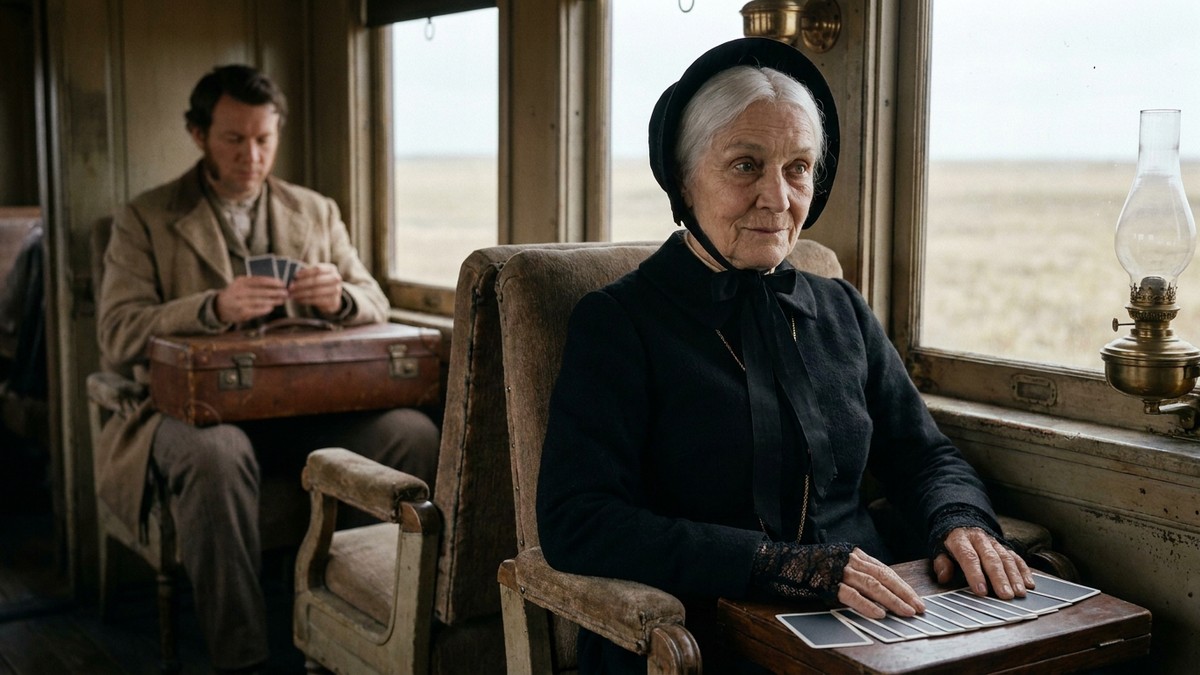
It was October 1874, on the Union Pacific eastbound out of Cheyenne. The coach was hot at the stove end and cold at the other, and it smelled of coal smoke, oranges, and wet wool. Hattie sat in the middle, which was neither, with a deck of cards spread on the little board across her knees.
She was playing solitaire. She was seventy-two years old, and she played it slowly, the way a woman does who has nowhere to be until Omaha.
The cards were old and soft at the corners. They had been her husband's.
Across the aisle, a man in a fawn coat had set a valise on his knees for a table. On it lay three cards, face down. Two black sevens and a red queen.
"Find the lady," he said, in a voice like a man telling a bedtime story. "Find the lady, and the bank pays even money. Easiest game in the West, friends."
He showed the queen. He picked up the cards, two in his right hand and one in his left, and let them fall onto the valise with a soft flick, crossing and recrossing. Then he took his hands away.
A big jolly man in a checked suit put down five dollars and turned over the queen.
"Well, I'll be," the jolly man said, and pocketed ten.
A thin man in a black frock coat, who looked like a preacher, won next. Then the jolly man again.
Hattie turned over a jack and laid it on a queen.
She knew the jolly man and the preacher had boarded together at Cheyenne. She had seen them share a match on the platform. They were not winning. They were advertising.
The soldier was nineteen. Hattie had learned that much in the first hour, because he had told the whole car his business. Private Eli Barnes, discharged at Fort D. A. Russell, going home to Marengo, Iowa, with his final pay in his shirt.
"Ninety-one dollars," he had told her, patting it. "My ma's got a note on the farm. This'll pay off most of it."
Now he leaned over the valise with his face shining.
"Can I try?"
"Any man can try, son," the dealer said.
The boy won five dollars. Then ten. Then he put down twenty, and lost, and put down twenty more to win it back, and lost again.
Hattie's hands had stopped moving on the cards.
She could stand up now. She could say it out loud: those two are with him. But then the whole car would turn and look at her, and somebody would ask how a white-haired lady from Cheyenne knew such things. And at Omaha her daughter would be waiting on the platform, with her new husband's people, who were Methodists and owned a hardware store and had never once asked Hattie what Jules did for a living.
She looked down at the cards in her lap.
Jules Lacroix had dealt faro on the Mississippi boats for thirty years. He had dealt it honestly, which made him a rare man on the river, and he had never dealt three-card monte in his life. But he had shown Hattie how it was done, one winter evening in New Orleans, so that nobody would ever take her for a fool.
Watch the hands, Hattie. The cards are just paper.
The boy lost the last twenty.
He sat back on the seat. He took his hand off his shirt pocket, slowly, like it had been burned. The jolly man clapped him on the shoulder and said hard luck, son, hard luck, and the preacher shook his head.
"North Platte in forty minutes," the conductor called from the end of the car.
Hattie saw the dealer glance at the jolly man. A very small glance. She knew what it meant. They would get off at North Platte, all three, and wait for the westbound, and start again.
Forty minutes.
The dealer was gathering his cards to quit. For one moment, as he squared them, his right thumb lay along the edge of the top card in a way Hattie had seen before, a long time ago, on a kitchen table in New Orleans. Then he tucked the deck in his coat and the moment was gone.
Hattie put her own cards away in their worn leather case. She folded the little board and set it against the window.
Then she stood up, which at seventy-two took a moment, and stepped across the aisle.
"Young man," she said to the dealer. "Before you go. I'd like to play one hand."
The jolly man laughed out loud. The preacher smiled into his collar. The dealer looked her up and down, from her black bonnet to her sensible shoes, and something in his face relaxed.
"Why, ma'am, I'd be honored," he said. "Table limit is twenty dollars."
Hattie did not have twenty dollars. She had eleven, and a ticket, and a basket lunch.
She reached into the neck of her dress and drew out a thin gold chain. On the end of it was a man's pocket watch, heavy and old, with a deep scratch across the lid.
She laid it on the valise.
The dealer looked at the watch. He looked at the scratch across the lid, and at the initials engraved under it.
His hand, reaching for the cards, stopped in the air.