Part 2
The initials under the scratch were J. L.
The dealer's eyes came up slowly from the watch to Hattie's face. He was perhaps forty, with a clean jaw and a gold tooth he did not show often. For a moment he did not look like a card sharp at all. He looked like a boy who has been caught with his hand in the cake.
"Ma'am," he said, very low. "Where did you get this watch?"
"From my husband," Hattie said. "A knife put that scratch on it, one night above Vicksburg, when he wouldn't deal to a man who was cheating."
The jolly man in the checked suit leaned in. "Come on, Charlie, deal the lady a hand. Table's waiting."
The dealer did not look at him.
"Deal, young man," Hattie said. "North Platte in thirty-five minutes."
He dealt.
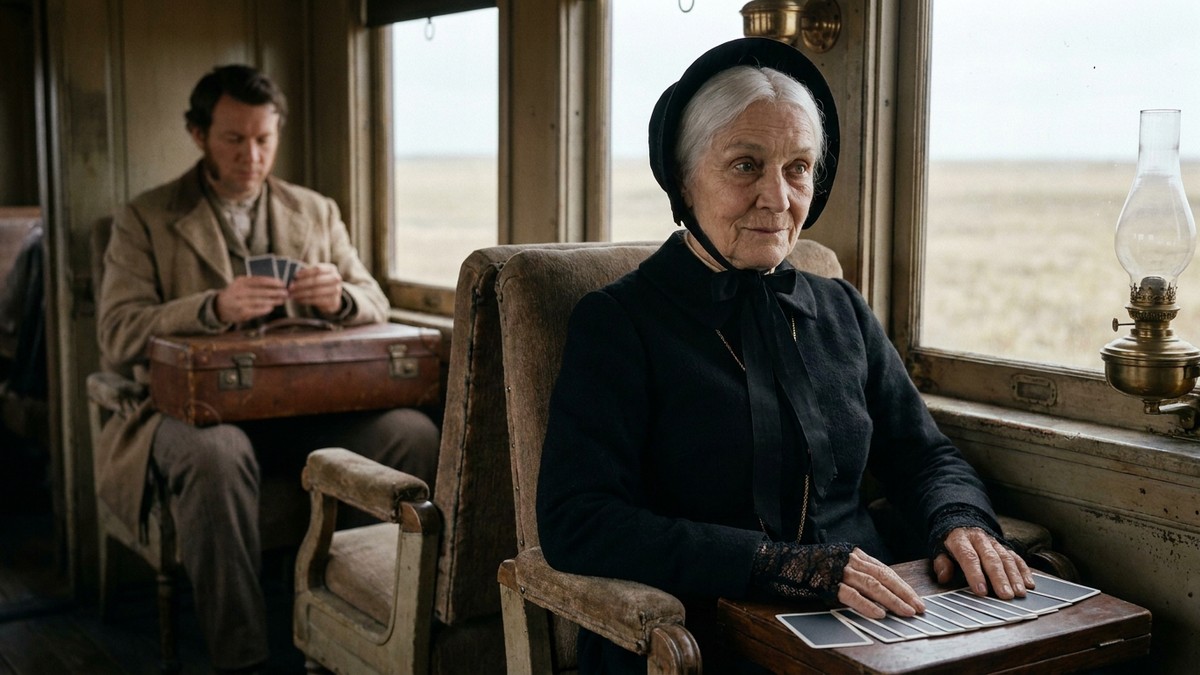
He showed her the queen, red and plain. He picked up the three cards, two in the right hand and one in the left, and threw them onto the valise. Flick, cross, flick. His hands were very good. They were the best hands Hattie had seen since Jules.
She did not watch the cards. She watched his right thumb.
It lay flat along the cards the whole time. It did not lift.
The queen went to the left. It had always gone to the left. That throw was honest, and she understood that he was asking her a question with it.
She put one gloved finger on the left-hand card.
"That one," she said.
The jolly man laughed. "Lady, everybody picks the left."
The dealer turned it over. The red queen looked up from the valise.
Somebody across the aisle whistled. The dealer counted twenty dollars out of his wallet and laid it beside the watch without a word.
"Again," Hattie said. "Sixty dollars this time. The boy's sixty."
Eli Barnes made a noise like he had swallowed something.
"Ma'am," the preacher said smoothly, "the bank has a limit."
"The bank," Hattie said, "can speak for itself."
The dealer glanced once at the preacher. Then he picked up the cards.
This time he threw fast.
Flick, cross, flick, cross. The cards whispered on the leather. At the same moment the jolly man stood up to reach for his hat, and a bag of oranges tipped off his knee and rolled bumping down the aisle. Half the car turned to look.
Hattie did not turn.
On the third throw, the dealer's right thumb lifted. Barely. A hair. The width of a fingernail paring. The top card went out, and the bottom card, the queen, stayed in his hand a beat longer and went somewhere else.
She had seen it once before, on a kitchen table in New Orleans in the winter of 1849, with a coal fire burning and Jules laughing at her because she could not catch it. She had made him do it forty times that night. On the forty-first, she caught it.
The cards lay still on the valise.
Every eye in the car was on the middle card, where the queen should have landed. The jolly man was nodding at it. The boy was staring at it.
Hattie put her finger on the right-hand card.
"That one," she said.
The dealer did not move. Then he reached out and turned the card over himself, slowly, and the red queen lay face up on the valise for the second time.
Nobody in the car said anything at all.
The dealer counted out sixty dollars. His hands had been beautiful on the cards, and they were ordinary on the money. He held it out to her.
Hattie took it and put it straight into Eli Barnes's hands.
"Count it," she said. "Then button your shirt over it, and don't unbutton it until you're in your mother's kitchen."
The boy counted, his lips moving. Sixty. He looked at her as if she had grown wings.
Hattie picked up the first twenty dollars from beside the watch, folded it once, and held it out to the dealer.
He looked at it.
"That's yours, ma'am. You won it."
"I didn't come here to win anything," Hattie said. "Put it back in your pocket. And get off at North Platte with your friends."
He took the twenty. He leaned close, so only she could hear.
"Every man who leans over this valise means to rob me," he said. "That boy too. He'd have taken my whole roll if he could have found the lady. I just see that he can't." He put the bill away. "Mr. Lacroix paid my way off the boat at Vicksburg in '58 instead of putting me over the rail. He told me to find honest work."
"And did you?"
"For about a year." He almost smiled. "I'll not tell anyone who you are, Mrs. Lacroix."
"I'd be obliged," Hattie said.
At North Platte, three men got off the train and did not get back on. The car felt larger afterward, and quieter, and somebody opened a window.
Eli Barnes sat down beside her before Kearney and stayed there all the way to Omaha.
"Ma'am," he said, somewhere past Grand Island. "How did you know which one?"
Hattie had spread her solitaire game across the little board again. She laid a red six on a black seven.
"Beginner's luck," she said.
At the Omaha depot, her daughter was waiting on the platform in a new blue dress, with her husband and his mother beside her. Hattie stepped down from the car with her basket on her arm and the watch tucked inside her dress where it belonged.
"Mother," her daughter said, kissing her. "Was it a terrible trip?"
"No, dear," Hattie said. "It was very quiet."