Part 1
At noon on April 22, 1889, a cavalry bugle blew, and Ada Lowry kicked a borrowed mare into the fastest fifteen miles of her life.
She was twenty-four and taught school in Kansas, and she had never raced anything in her life. All around her on the northern line of the Oklahoma country, thousands of people went at once. Wagons, buggies, men on mules, a man running on foot with a spade. The ground shook. The dust rose up so thick she rode the first mile with her eyes half shut.
That morning, at the line, Delia Byrd had checked the mare's girth one last time.
Delia was sixty-eight and had been married forty years to a horse trader. She was coming behind with the wagon, the trunk, and two crates of schoolbooks, because she said her racing days were over and somebody had to bring the slates.
"Mind her when you get there," Delia had said. She ran her palm down the mare's neck. "A horse run hard in this heat will lather white under the saddle and between the legs, and the salt dries in the hair. You can wash a man's face, Ada. You can't wash the truth off a horse before supper."
Ada had laughed and said she would mind it.
She found the creek bottom a little after two o'clock.
Cottonwood Creek, low and brown, with big trees along it and black soil on both banks that she could smell from the saddle, rich as a barn floor. There was a quarter section there she had studied on the government map all winter. She knew the corner stones by heart.
She came through the trees with the mare blowing and lathered, and pulled up hard.
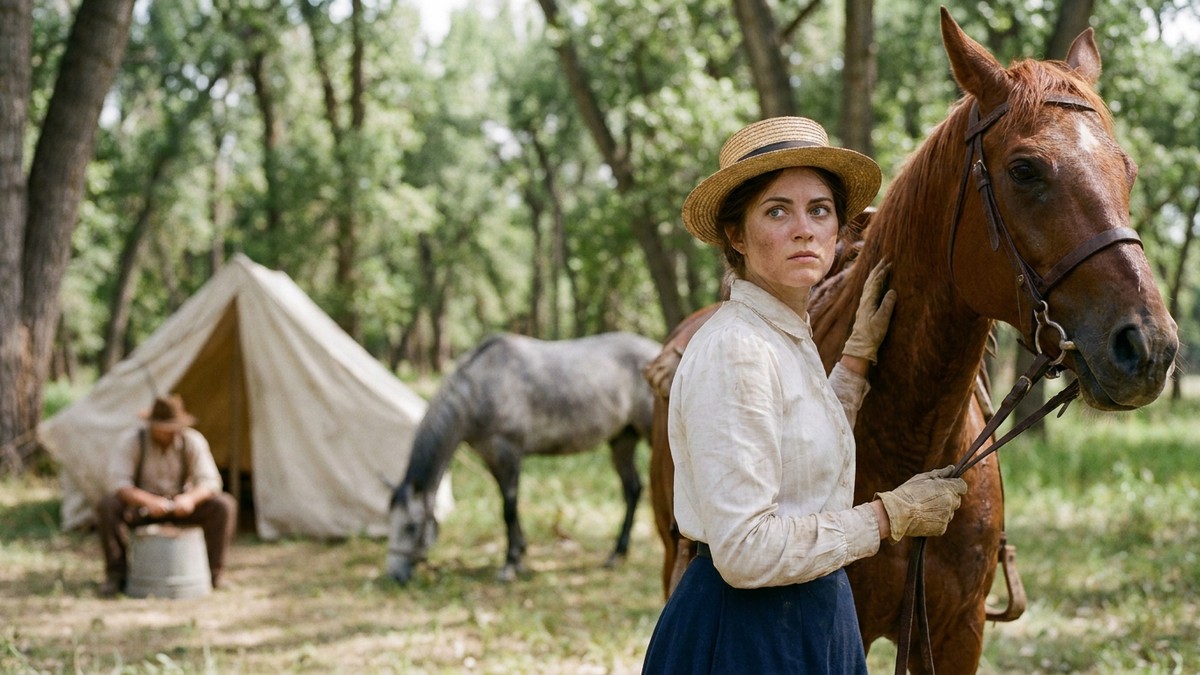
There was a tent on her quarter.
A man sat in front of it on an upturned bucket, whittling. His horse grazed beside the tent with its saddle off. Behind him, between the tent and the creek, someone had turned a strip of ground with a spade.
Little green leaves stood up in two neat rows. Radishes.
"Afternoon, miss," the man said. He did not get up. "Claim's taken."
His name was Lem Vickers. He said he had run from the line at noon like everybody else, and his horse was faster, and that was all there was to it.
Ada sat on the blowing mare and looked at his horse. It was a big gray, grazing quietly. It did not lift its head.
"You got here before me," she said. "From the line."
"That's what I said."
By three o'clock other people had come through the trees. A family in a wagon. Two brothers on mules. A man in a city hat who had already found out there was nothing left on this stretch of the creek and wanted to watch something happen. They stood around and listened.
"He's a sooner," Ada said to them. "He came in before noon. He was hiding in these trees."
The brothers on the mules looked at Vickers. Vickers looked back at them and kept whittling.
"Lady says I'm a sooner," he said pleasantly. "Lady got here second."
Somebody laughed. The man in the city hat said, well, that was the way of a race.
Ada's face went hot. She got off the mare, walked to the nearest of Vickers's stakes, a pine stake with a rag tied to it, and pulled it out of the ground.
That stopped the laughing.
"Now you've done it," one of the brothers said quietly.
The deputy marshal rode in at five o'clock, because somebody had gone for him.
He was a tired, sunburned man who had been listening to land arguments since noon. He looked at the stake in Ada's hand. He looked at Vickers's tent.
"Ma'am, pulling a man's stakes is how people get shot out here," he said. "Hundreds of claims are going to be contested. The land office in Guthrie will hear them. The man who files first will have the paper, and the one who files second will have the trouble."
"He came in early," Ada said.
"Can you prove it?"
She opened her mouth and could not think what to say.
"Then here's how it'll be," the deputy said. "Mr. Vickers rides to Guthrie at sunup and gets in the line. You can follow him, or you can go back to Kansas. But if I find any more of his stakes pulled, I'll put you off this creek myself."
He rode away. The crowd began to drift back to their own trouble. Vickers went back to his bucket and his whittling, and once he looked up at her and smiled.
Ada sat down under a cottonwood with the stake across her knees. She felt ashamed of herself, and furious, and very young.
Behind Vickers's tent, a pile of split firewood was stacked against a stump. The split faces had gone gray, the way wood does after it sits out a few days. She looked at it without really seeing it.
Delia's wagon came creaking through the trees at sundown.
Ada told her all of it. The tent. The radishes. The stake. The deputy.
Delia listened without a word, chewing the inside of her cheek. When Ada had finished, Delia climbed down from the wagon seat, slowly, one foot and then the other.
She lit the lantern.
Then she walked across the clearing, past the bucket where Vickers sat, straight to his big gray horse. It lifted its head and looked at her.
"Evening, ma'am," Vickers said, half rising. "That's my horse."
"I can see it is," Delia said.
She set the lantern on the ground. She put one hand on the gray's shoulder to steady him, and with the other she reached under his belly, between the front legs, where the cinch would lie.