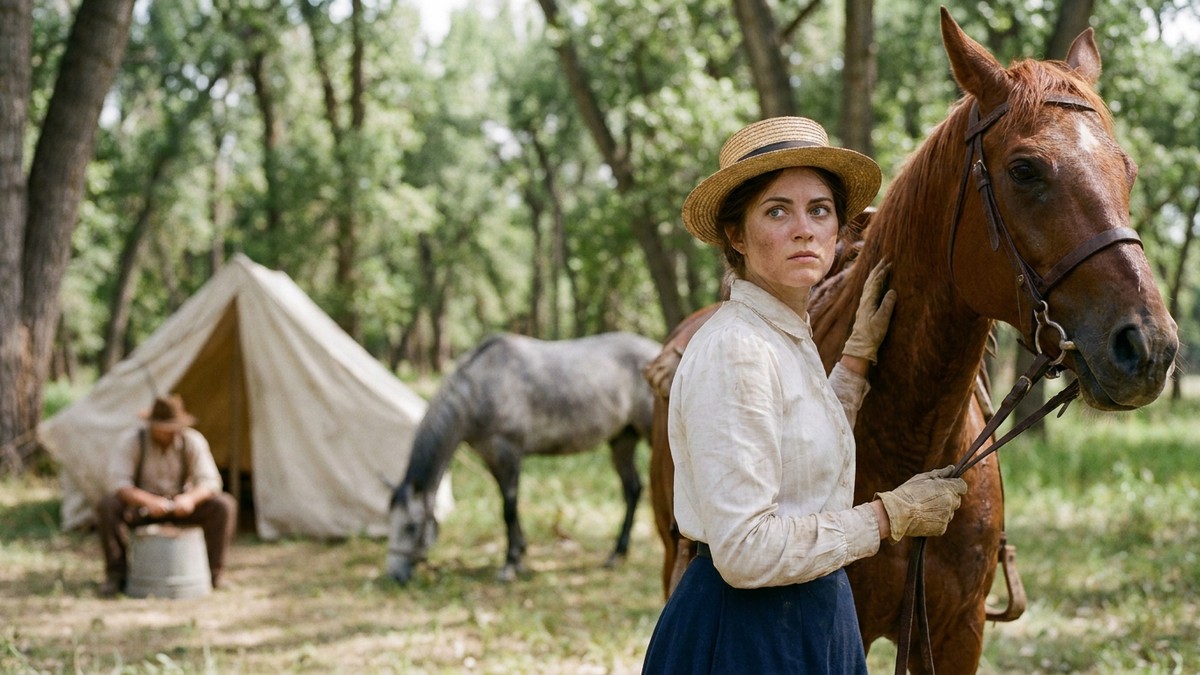
Part 2
Delia's hand came out from under the gray horse and she held it up to the lantern.
"Dry," she said.
She did it again, behind the elbow, along the flank, under the place where the saddle had been. Each time she held her hand to the light. Each time it came out clean.
Ada walked over without being told. Her own mare was tied to a cottonwood ten feet away, and she slid her hand under the mare's belly the same way. It came out gritty and damp, with a white crust of dried salt on her fingertips that glittered in the lantern light.
"That's fifteen miles," Delia said. She nodded at the mare. "And that's a horse that hasn't run since breakfast." She nodded at the gray. "His hair's lying flat. There's no salt in it, not a speck. A horse doesn't sweat clean."
"I rubbed him down," Vickers said.
"With what?" Delia looked around the clearing. "I don't see a brush or a sack or a wet rag. And rubbing won't take the salt out of the hair. Only water will, and that horse hasn't been in the creek. His legs are dry to the knee."
The two brothers had come back across the clearing at the sight of the lantern. So had the family from the wagon, the father in front and two children peeking around him.
Ada looked at the radishes.
She had planted radishes in a schoolyard every April for four years, with children on their knees beside her in the dirt. She knew it the way she knew her times tables.
"Radishes come up in four days in warm ground," she said. "Five if it's cool. Those have their second leaves." She looked at Vickers. "You didn't plant those this afternoon, Mr. Vickers. You planted them last week."
Then she remembered the woodpile.
She walked to it and picked up a split stick and held it to the lantern beside a stick she broke fresh from a dead branch. One was bright yellow inside. The other was gray as an old fence.
"Wood doesn't go gray in three hours," she said.
Nobody said anything for a while. The creek went on running over its stones in the dark.
The older of the two brothers spoke first.
"Mister, I came in at noon on a mule, same as my brother," he said. "If this lady goes to the land office in Guthrie, I'll stand up and tell them what I saw tonight. I expect he will too." He jerked his chin at the father of the wagon family. "So will he."
The wagon man nodded slowly.
Vickers sat down on his bucket. He looked at the knife in his hand as if he had forgotten what it was for, and then he folded it and put it away.
"I buried a wife and a little boy in Arkansas," he said, "working another man's cotton for eleven years. You think that line was fair today? Men with railroad tickets and blooded horses. Men who could afford to wait at the line a month." He looked up at Ada. "I came in a week early because I couldn't afford to come in fair."
Ada did not know what to say to that. She found she did not want to say anything clever at all.
"The law says any man who came in early can't claim here," the older brother said, not unkindly. "You know that."
"I know it," Vickers said.
He got up and began, without hurrying, to take down his tent.
Delia made coffee.
She made it over Vickers's own fire, with Vickers's own gray firewood, and she gave him the first cup, and he drank it standing up beside his saddled horse with the tent rolled behind the cantle.
Ada brought him the stake she had pulled. She held it out to him.
"I'm sorry I pulled it," she said. "That was wrong of me, whatever else."
He looked at the stake, and at her, and took it.
"Those radishes," Ada said. "I'll buy them from you. I don't know what radishes go for out here."
For the first time that day, Vickers almost smiled.
"Keep them," he said. "They're the only honest thing I put in this ground."
He swung up into the saddle. The gray horse, rested and dry, walked off into the dark toward the north line, and the sound of its hooves went away down the creek until there was only the water.
Ada drove her own stakes by lantern light. Delia held the lantern.
In the morning she rode the mare to Guthrie, which had been empty prairie two days before and now had ten thousand people in it, living in tents. She stood in line at the land office for most of two days. When her turn came, she filed on the quarter section on Cottonwood Creek, and nobody contested it.
When she came back, there were three children sitting in the shade of Delia's wagon.
Two belonged to the wagon family. One belonged to the older brother, who had sent for his wife and daughter from the line. They were sitting in a row on a crate of schoolbooks, swinging their feet.
"They heard there was a teacher," Delia said.
Ada looked at them. She looked at the two green rows behind where the tent had been.
She knelt down at the end of the first row and pulled up one radish. It was a pale thread of a root with two green leaves, and black creek dirt clinging to it.
"First lesson," she said, and held it out to the smallest child. "Count the leaves."