Part 1
The third time they cut Jo McCabe's fence, they cut it in the same places, and she still did not see why.
It was September 1883, in Brown County, Texas, in the worst drought anyone could remember. The grass had gone the color of a paper sack. Pecan Bayou had shrunk to a chain of green pools between white rocks. And all summer, all over the middle of Texas, men had been going out at night with wire cutters.
Josephine McCabe was sixty-one. Her husband Robert had bought the land on the bayou in the spring and ordered the barbed wire from Fort Worth, a whole wagonload, glinting on the spools. Then in April he had died of a fever in eleven days.
She had finished the fence for him. Four miles of it, cedar posts and four strands of wire. It was the last thing he had wanted, and she had not let herself think about anything except getting it done.
"Same three places," said Clint Ransom.
Clint had been Robert's foreman for nine years. He stood in her kitchen doorway with his hat in his hand and dust to his knees.
"Down by the old crossing. Then at the two draws below the house. Every strand cut between every post, clean as a whistle, and the ends wrapped back around the posts so the cattle don't tear themselves up getting through." He shook his head. "Neat about it, I'll give them that."
Jo wrote it down on the back of an envelope, the way she had written down the first two. The crossing. The two draws. She looked at the list and saw only that someone hated her.
"Forty head of ours went through to the bayou," Clint said. "And somebody else's scrub cattle came in on our grass."
"Fix it," Jo said. "Again."
Robert had been an easy man in most things. He had only a few rules, and he said them often.
"A fence has two sides, Jo," he used to say, standing at a new post with his hand on the wire. "Walk both."
She had not walked any of it. She had ridden out once, in July, to see the last post set, and she had looked at the long shining line of it going away toward the bayou and cried so hard she had to sit down in the grass. Since then she had let Clint ride the fence.
She had told herself it was because of her bad leg. It was not her leg.
The fourth cut came on Saturday night.
This time there was a paper nailed to the gatepost by the road, written in pencil in big careful letters. Clint brought it in and laid it on the kitchen table.
Take down your fence or we will burn your grass.
Jo read it twice. In a summer like this, a grass fire would run to the Colorado River.
"That's enough," Clint said. His voice was very quiet. "Mrs. McCabe, every rancher on this bayou is hiring men. The Hadley outfit has six, with rifles, sitting up on their fence at night. I've written to a man I know in Fort Worth. He'll send me three good hands who know their business. They'll be on the Saturday stage."
"Hired guns," Jo said.
"Hired fence riders." He did not look away. "Ma'am, it's that or lose the place. Robert would say the same."
She did not know whether Robert would say the same. That was the worst of it. She had always known what Robert would say, and now she did not.
"Saturday," she said.
"Saturday."
After he had gone, she sat at the table a long time with the pencil note on one side of her and the envelope on the other. The crossing. The two draws. She went to bed and lay awake, listening to the windmill creak.
Somewhere in the night she heard, very faint and far off, a high thin twang, like a fiddle string snapping. Then another. Then another.
She was in the saddle before the sky was gray.
She did not wake Clint. She did not take a rifle. She rode Robert's old dun gelding down the fence line toward the bayou in the cold blue half dark, with the wire running beside her like a line of silver thread.
Near the old crossing, she smelled the bayou before she saw it, green water and mud and the musk of cattle. And she heard voices.
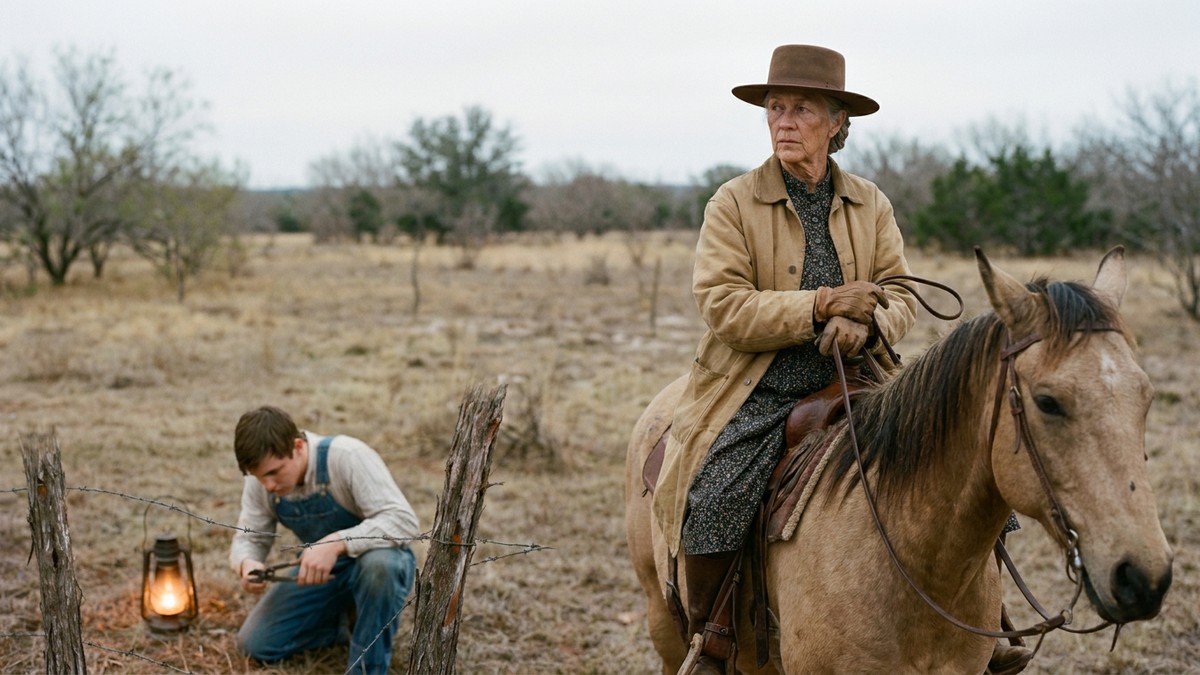
Three men stood at the fence by the crossing with a lantern on the ground. Two had wire cutters. One was only a boy, fourteen perhaps, holding the horses. The wire was already down between two posts, coiled back neat as yarn.
She rode out of the dark into the lantern light before they heard her.
They froze. The boy dropped a rein. The man in front turned, a lean young farmer with a week of beard and wire cutters still open in his hand.
Jo knew him. Wes Calder. He had a hundred and sixty acres up the bayou and a wife and four children, and he had come to Robert's funeral in a borrowed coat.
He looked at her, and then past her, into the dark, for the riders with rifles.
There were none.
"Mrs. McCabe," he said slowly. "You'd best ride on home."
Jo looked down at him from Robert's dun horse. Then she gathered her skirt in one hand, swung her bad leg over the saddle, and climbed down into the lantern light.