Part 2
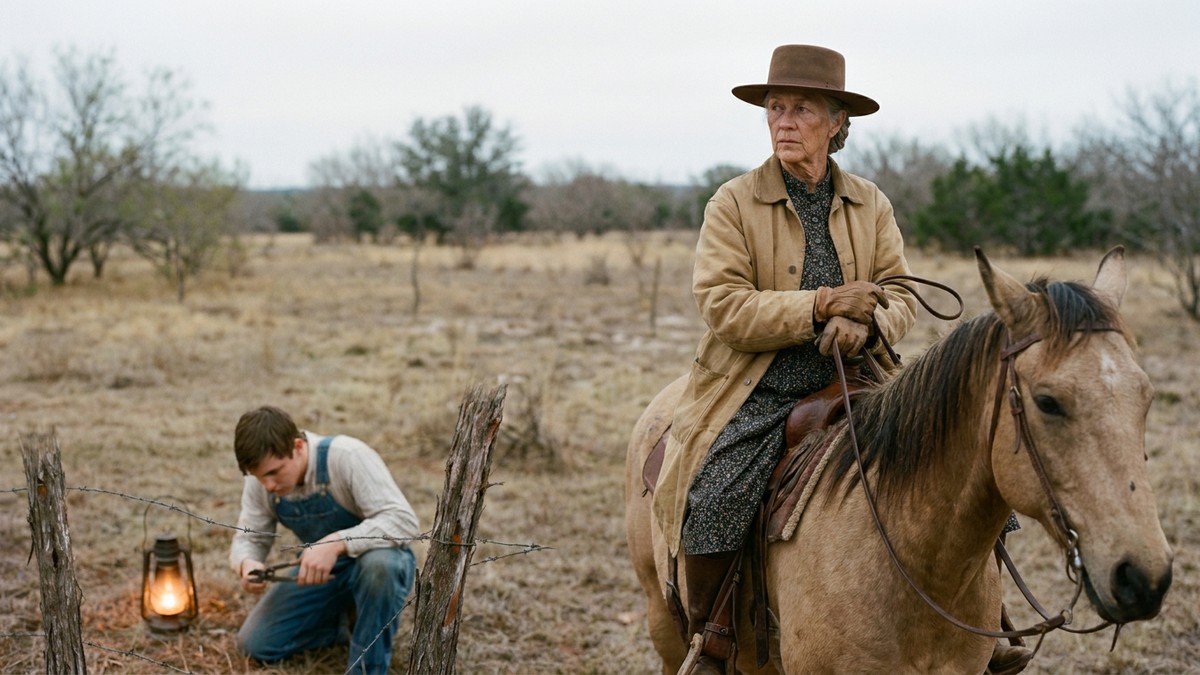
Her bad leg nearly gave when she landed. She held the saddle horn until it steadied. Then she let go of the horse and stood in front of three men with wire cutters, sixty-one years old, in her husband's old canvas coat.
"I'm not going home, Mr. Calder," she said. "I'd like to know why it's always here."
Wes Calder stared at her. The boy holding the horses had gone white to the ears.
"Ma'am?"
"The old crossing. The two draws. Four times now, the same three places. You could cut my fence anywhere in four miles of it. Why here?"
Calder did not answer at first. Then he lowered the wire cutters, slowly, and pointed with them at the ground under her feet.
"Look down," he said.
Jo looked down.
In the lantern light she saw two shallow grooves running under the downed wire, straight as rails, worn deep into the hard dirt and grown over with dead grass. Wagon ruts. Old ones. They ran from the dark behind her, under her fence, down the bank to the ford in the bayou.
"That's the county road," Calder said. "Was, anyhow. Since before the war. It's how my kids get to the schoolhouse at Blanket and how my wife gets to church. Your fence goes square across it. Now they walk four miles around."
He swung the cutters toward the draws below her house.
"And those are the cow trails to the only water left on this bayou. Every small man up the creek has watered his stock at those two pools since the drought started. Your fence put a wall between my cows and the water God put there." His voice cracked a little. "I've lost eleven head since August, Mrs. McCabe. I've got four kids. I'm not proud of this. But I'm not going to stand and watch them starve."
Jo stood very still.
A fence has two sides. Walk both.
She had never walked this side. She had never once ridden down to the old crossing and looked at the ground. If she had, she would have seen the ruts in July.
"The burning note," she said. "Was that you?"
Calder shook his head hard. "No, ma'am. Some fools from over on the Jim Ned. I told them I'd shoot any man who set a fire in a drought." He looked at his boots. "Didn't figure you'd believe that."
"I believe it," Jo said. She did. Every cut end of her fence had been wrapped back neat around the posts, so the cattle would not be torn. Men who would do that did not burn grass.
The sun came up while they stood there. The bayou turned from black to green. A heron lifted off one of the pools and flew away low over the water.
"Mr. Calder," Jo said. "If I put a gate here, where the road runs, and keep it in repair, will you stop cutting my fence?"
He looked at her as if she had spoken in a foreign language.
"And if I put a lane down to those two pools," she went on, "fenced on both sides, so your stock can come to water without coming on my grass. Would that be fair?"
"Ma'am," he said, "that would be more than fair."
"Then you'll help me build it," Jo said. "You and your friends here. My foreman will furnish the posts and the wire. You'll furnish the work. And I'd be obliged if you'd tell the men on the Jim Ned that the McCabe fence has gates now."
The boy holding the horses let out his breath all at once, like a balloon.
Clint Ransom was waiting at the barn when she rode in, with his rifle and his face like thunder.
She told him. All of it. He listened with his jaw working.
"You're letting them win," he said.
"I'm letting them get to school," Jo said. "Clint, I want you to write to your man in Fort Worth today, and tell him we won't be needing his three hands."
"Mrs. McCabe..."
"Robert would have walked the fence," she said. "I didn't. That's my fault, not Wes Calder's. Write the letter."
Clint looked at her for a long time. Then he leaned the rifle against the barn wall and went inside to find a pen.
It took them nine days to build the lane and the gate.
Calder came with two neighbors and his oldest boy. Clint came with the McCabe hands and the wagon full of cedar posts, scowling for the first two days and not scowling by the fourth. On the sixth day Jo saw him and Wes Calder squatting together over a post hole, arguing about tamping, like two men who had known each other all their lives.
The gate went in last, across the old county road, on two thick cedar posts. Clint hung it himself. He got the hinges perfect, and then he made a latch a child could lift.
On the first Monday in October, Jo was standing at the crossing in the early light when she heard a creak and the clop of a slow horse.
Four Calder children came down the old road on one fat mare, with their dinner pails, on their way to the schoolhouse at Blanket. The oldest girl leaned down from the mare and lifted Clint's latch.
The gate swung open on its new hinges and closed again behind them.