Part 1
At the church supper, the banker told the whole hall that Ruth Oberg kept her money in a butter churn.
It was June 1893, in Rock Ford, Nebraska, and the Lutheran church basement smelled of coffee and scalloped potatoes. Lyman Price stood by the pie table with a plate in his hand and his gold watch chain shining across his vest.
"Four percent on deposit," he was saying. "Safe as the courthouse. And yet some folks still bank with the cow." He smiled across the room at her. "Isn't that so, Mrs. Oberg?"
People laughed. Ruth was sixty-six and had sat in the same pew for twenty-one years, and she felt every one of those years turn and look at her.
"My churn has never closed its doors, Mr. Price," she said.
That got a bigger laugh. Price laughed too, and raised his coffee cup to her, and went back to his pie.
On the drive home Ruth wished she had kept her mouth shut. It had been a smart answer. Smart answers had a way of coming back around.
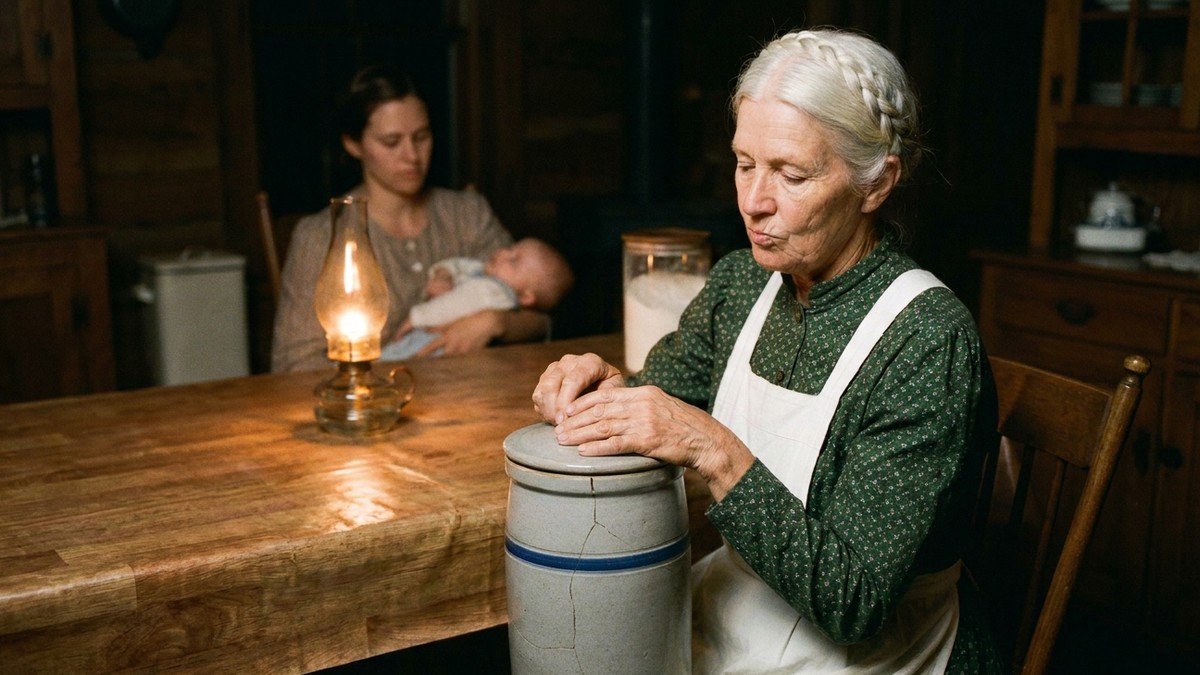
The churn sat in the corner of her kitchen behind the flour bin. It was a tall stoneware crock with a blue band, cracked down one side in the winter of 1879, no good for butter since. Ruth kept it full of rags on top.
Under the rags, in a flour sack, was six hundred and twelve dollars.
Gold eagles. Silver dollars. Greenbacks folded small. Every egg and every pound of butter for twenty years, every dollar her husband Nils had left her, counted twice and written in the back of her Bible.
People in Rock Ford thought she was a stubborn old Swede who did not trust banks. That was true, as far as it went.
What they did not know was 1873. That autumn, back in Iowa, she had stood outside a bank in the rain with Nils and their two little boys and read a paper nailed to the door. Six years of savings, gone by noon. She had never set foot in a bank since.
On Monday, the seventeenth of July, the Rock Ford Exchange Bank did not open.
The news came out to the farms by noon. Ruth heard it from Anna Nyquist, who drove into the yard so fast the dust caught up with her. Anna was twenty-four, with a baby on her hip and another coming, and her face was the color of skim milk.
"There's a paper on the door," Anna said. "It says suspended. Mrs. Oberg, what does suspended mean?"
Ruth looked at her a moment. In her mind she saw rain on a window in Iowa.
"It means wait," she said. "Come in. I'll put the coffee on."
By the end of the week, everybody knew what it meant. Banks were shutting from Chicago to Denver. In Lincoln, the papers said, they were going down like dominoes. Nobody could get a dollar out of the Rock Ford Exchange, and Lyman Price had not been seen in church on Sunday.
The Nyquists had one hundred and eighty dollars in that bank. The Hallorans had more. Old Mrs. Kemp, who took in sewing, had every cent she owned.
The second notice went up the next Monday.
Ruth read it herself, standing on the boardwalk in front of the bank with her market basket over her arm. It was tacked to the door below the first one, in Lyman Price's careful hand.
All chattel notes held by L. Price were called due. Payment by Friday, the twenty-eighth, or the sheriff would take the property pledged.
Ruth knew what the Nyquists had pledged. Everybody in the township knew. Their team, two bay mares and the harness, against a note for a hundred and fifty dollars. The Hallorans had pledged their team too, for two hundred.
The wheat stood ripe in the fields. Without a team, nobody would cut it.
She walked back to the wagon very slowly.
They came to her kitchen that night. The Nyquists, the two Halloran brothers, and Mrs. Kemp with her sewing bag, because she did not like to sit with her hands empty.
Nobody asked directly. They talked about the weather and the wheat. Anna Nyquist's baby fell asleep on Ruth's lap. The lamp buzzed with moths.
Finally Ole Nyquist put a folded paper on the table and pushed it toward her with one finger.
It was the note on his team. Ruth unfolded it under the lamp and read it twice. One hundred and fifty dollars at two percent a month. Payable to L. Price.
Not to the bank. To L. Price.
She folded it up and gave it back to him, and said nothing about it.
Then she got up, set the sleeping baby in Anna's arms, and went to the corner behind the flour bin.
She lifted out the rags. She carried the churn to the table in both arms. Somebody's chair scraped.
She lent the Nyquists twenty dollars for flour and binder twine, and the Hallorans thirty to hire harvest hands, and she put ten dollars into Mrs. Kemp's hand and closed the old woman's fingers over it before she could argue. She wrote each amount in the back of her Bible.
It would not pay the notes. It would keep them fed while the wheat stood waiting.
When they had gone, she sat alone at the table with the churn. Five hundred and fifty-two dollars left in the sack.
It was nearly eleven when somebody knocked.
Ruth opened the door. Lyman Price stood on her step in the dark. He had no watch chain on his vest. He was holding his hat in both hands, and in the lamplight his face looked ten years older than it had at the pie table.
"Mrs. Oberg," he said. "I've come to ask you for a loan."