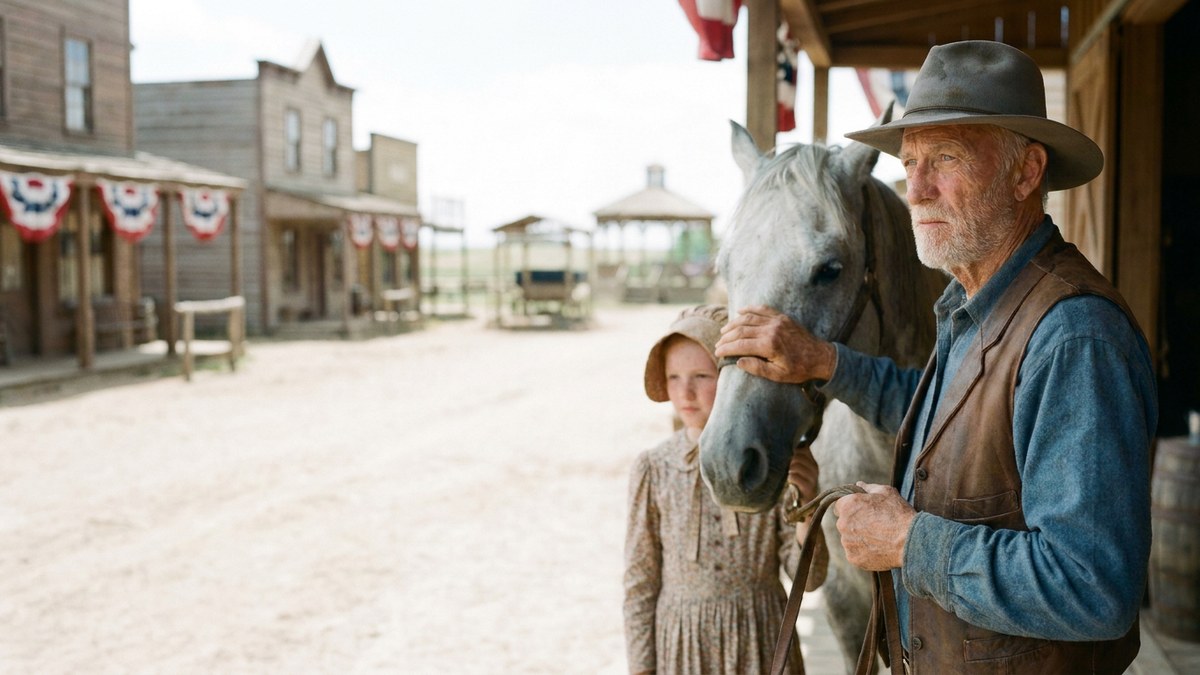
Amos set the hoof down very gently.
Somebody had done this while he was arguing at the bandstand. Somebody had walked into the corral while an old man was busy being right about a small thing.
That was his fault. He knew it.
He knelt on his good knee in the dust and opened the farrier's saddlebag.
"Grandpa, there's no time," Nell said.
"There's four minutes."
"You need a forge. You need the nail box at the shop."
"On a supply march in the winter of 1876," Amos said, "I set eleven shoes in one night by feel, in the snow, with no forge and no light. A shoe doesn't need fire to go back on. It needs a good hoof and a man who isn't in a hurry."
He pulled the last bent nail with his pincers. He set the shoe against the hoof wall, squinting. The old nail holes were clean. Good. He took three new horseshoe nails out of the leather pocket where he had always kept three, and he held them in his lips the way he had at nineteen.
Tap. Tap. Tap.
Each nail went in along the old line and came out the hoof wall where it should, a thumb's width up. He twisted off the points and bent the clinches over with the hammer, and rasped them smooth.
Nell held Kate's head and talked to her low. The mare stood like a statue. She had stood for him in worse places.
Down the street, the pistol cracked once, the first warning.
Amos set the foot down. He put a hand on the shoe and pushed. It did not move.
"Up you go," he said.
The whole town had gathered at the line in front of the church.
Fentress stood beside Buttercup with his watch in his hand. When he saw the gray mare walking up the street with the girl on her back, he put the watch away slowly. A thin boy of fourteen or so sat in Buttercup's saddle. The boy did not look at anybody.
"Well," Fentress said. "Good for her."
The starter raised the pistol.
Amos found his place at the edge of the crowd beside Hollis Grant. Hollis did not say anything. He just stood close, the way a man does when he means to catch you if you fall.
The pistol cracked.
Buttercup was gone like a thrown rock.
He went down the ridge road at a flat sprint, dust boiling up behind him, and in a quarter mile he was a hundred yards ahead. The crowd groaned. Somebody laughed.
Kate went out at her road gallop. Long and level and unhurried, her head low, her gray ears pricked. Nell sat her so quietly she seemed part of the saddle.
At the section stone, a mile out, Buttercup was two hundred yards ahead.
At the end of the first lap, as they came back past the church, he was still a hundred and fifty yards in front. But the crowd could hear him now. His breath came out of him in rough, loud bursts, like a man sawing wet wood.
Kate went past the church at the same long gallop. Her breath was even. Amos could hear it from where he stood, a soft, steady blowing, in and out, in and out.
"She hasn't changed her pace once," Hollis whispered.
"No," said Amos.
On the second lap the dust hid them both all the way out to the stone.
When they came back into sight on the ridge road, the crowd went still.
Buttercup was only fifty yards in front. The boy was kicking him. The brown gelding's head was going up and down, and his stride had gone short and choppy.
Kate came on behind him exactly as before.
They passed the church for the second time with thirty yards between them. Amos saw the boy look back over his shoulder. He saw the fear in his thin face.
The third lap.
The section stone. The turn. The long run home down the ridge road toward the cottonwood that stood alone by the creek crossing, a quarter mile from the church.
At the cottonwood, Nell leaned down low along Kate's neck.
She said one word. Nobody in the crowd heard it.
Kate's ears went flat. Her stride opened, long and low, like a door swinging wide. She went by Buttercup on the creek crossing as if he were tied to a post.
She crossed the line in front of the church by six lengths.
The crowd was yelling. Hats were going up.
Amos did not yell. He stood where he was and let Hollis hold him up by the arm.
Fentress paid the five hundred dollars on the bandstand, in front of the whole committee. He counted it out without a word.
Then Amos asked the committee for one more thing. He asked them to look at Buttercup's feet.
The boy brought the gelding over, wet and blowing. Amos lifted a front foot and showed them the shoe. It was a thin, light racing plate, barely heavier than a tin lid. No man in the territory would put a shoe like that on a horse that pulled a wagon from Missouri. It would not have lasted forty miles.
"He's a race horse," Amos said. "He was entered at noon under false colors. That first race was a ringer."
The committee voted in less than a minute. The three hundred and forty dollars from the noon race went back to the men who had bet it. All of it. Including Hollis Grant's two hundred.
Fentress took his hat off and looked at it for a moment.
"I lost a farm in Missouri to smiling men," he said. "I suppose I thought it was my turn to smile."
"It was your turn," Amos said. "You just spent it."
The boy's name was Tad. He was Fentress's nephew, and nobody had fed him since Pierre.
Amos found out the boy was the one who pulled the nails, on his uncle's orders. Tad told him himself, behind the livery, with his eyes on the ground.
Amos asked him if he knew how to hold a horse's foot.
Tad said he did.
"Then I'll need a boy at the shop this fall," Amos said. "If your uncle can spare you."
Fentress left on the evening train with his horse and without his nephew.
In September the schoolhouse got its new roof, cedar shingles, tight and pale.
Amos walked down to see it the first morning of school. Nell was already inside. Through the open window he could hear the children reciting, and the sound of rain beginning on the new shingles, soft as a mare blowing.
Not a drop came through.
> What really happened: Independence Day was the biggest celebration of the year in many Dakota Territory towns, and horse races were a standard part of the program alongside parades and speeches. By the 1870s, American sporting papers used the word "ringer" for a horse entered in a race under a false identity or false record, a common way to cheat small-town betting. The Army regularly judged worn-out horses "condemned" and sold them off, and many found second careers on farms and ranches. Sources: South Dakota State Historical Society; Civil War Monitor.