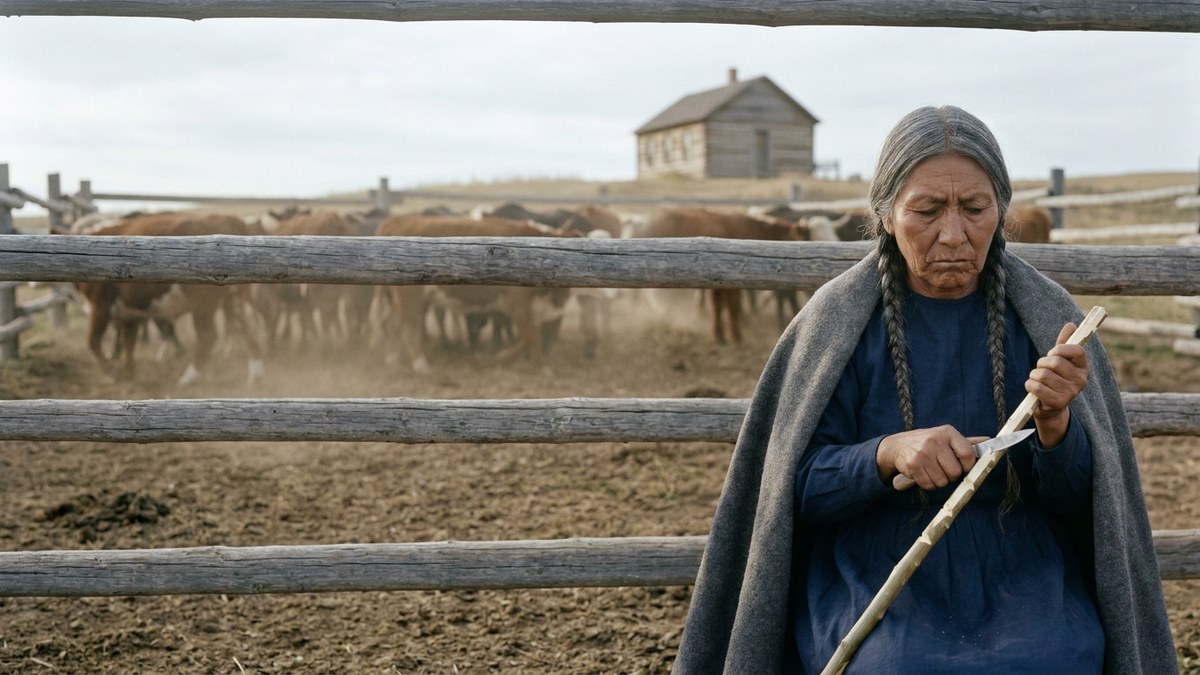
Red Willow Woman cut the forty-first notch into the willow stick and stopped, because the gate was closing and there were still cattle in the pen.
It was issue day at Cedar Butte Agency, Dakota Territory, the second Saturday of October, 1877. A cold wind came down off the bluffs and rattled the boards of the corral.
She stood where she always stood, by the third post, with the stick in one hand and her knife in the other. She was sixty-four years old. She had stood by that post every issue day for two years, since her husband died and the count passed to her.
The agent's clerk called out the number for the book. "Fifty-two head issued."
Red Willow Woman looked down at her stick. Forty-one.
Inside the schoolhouse on the rise above the corral, Hattie Lund closed her arithmetic book and looked out the window at the cattle pen.
She was twenty-six and had come out from Minnesota in the spring to teach the agency school. Twenty-two children came most days. They were quick and quiet and polite, and they watched her the way people watch weather.
On issue days nobody could keep their eyes on the slates. So by the end of May, Hattie had stopped trying. She had made the cattle into a lesson.
Every child had a copybook. Every issue day, they stood at the window and counted the cattle as they were let out of the pen, and wrote the number down. Then they added the weeks together. Then they divided the beef among the families by the number of mouths. It was the best arithmetic lesson she had ever taught.
"Forty-one," said a boy named Thomas Two Hawks, at the window.
"Forty-one," said the girl beside him.
Hattie wrote it in her own notebook, under all the other Saturdays.
Then she wrote it again, because she could not quite believe what the column added up to.
That evening Red Willow Woman walked up the rise to the schoolhouse with her granddaughter, Annie Kills Pretty, who was in Hattie's class and spoke English better than anyone at the agency.
She had never been inside the schoolhouse. She stood in the doorway a moment, smelling chalk and lamp oil, before she sat down on the bench by the stove.
She laid a bundle of willow sticks across her knees. There were twenty of them, tied with a strip of hide.
"My granddaughter says your children count the cattle," she said, and Annie spoke it in English.
"They do."
"Show me."
Hattie opened her notebook. Red Willow Woman untied the bundle. She laid the sticks out on the bench one by one, the oldest first, and ran her thumb down the notches of each.
"Forty," she said. Annie translated. "Thirty-eight. Forty-three. Forty."
Hattie followed down her column with one finger.
Forty. Thirty-eight. Forty-three. Forty.
They went through all twenty weeks. Not one number was different.
Red Willow Woman tied the bundle again.
"The book says fifty-two," she said. "Every week, fifty-two. Twelve head a week go somewhere. Two hundred and forty since spring. That is the meat for this winter."
Agent Silas Crandall kept his office in the log building by the warehouse. He was a heavy, tired man of fifty with ink on his cuffs, and he did not stand up when Hattie came in on Monday morning.
She showed him the notebook. She did not mention the sticks.
He read it all the way through. Then he set it down on his desk.
"Miss Lund," he said, "your children are very good at counting. I'm glad. But they count from a window two hundred yards away, through dust, with cattle milling. They miss some. Children do."
"Twenty weeks in a row? The same number of misses?"
Crandall leaned back in his chair. When he spoke again, it was softly.
"Congress promises beef for this agency and then sends money for two-thirds of it. The contractor shorts me, the freighter shorts me, and every inspector who comes through wants clean books. I keep this agency fed the only way it can be kept. You don't know the half of it."
"Then show me the half."
"I'd rather you taught spelling," Crandall said. "The Indian Office pays your salary, and it can stop paying it."
The inspector was due on Thursday.
His name was Major Ezra Boone, and he was coming down from the Army post on the Missouri to look over the agency books before winter. He would stay one night. He would leave on Friday noon.
Hattie wrote him a letter on Monday night and gave it to the mail rider.
On Tuesday the mail rider came back with the letter in his saddlebag. The agent's clerk had told him there was no mail going north that week.
Red Willow Woman heard about it from Annie that afternoon.
She went down to the river crossing below the warehouse. She walked the mud at the edge of the water, bent over, the way a woman looks for good plums.
Then she found what she was looking for. Wagon tracks, deep and fresh, going down into the ford. And beside them, coming up out of the water on the far side, the split, crowded hoof prints of cattle being driven across in the dark.
On Wednesday night, the night before the major came, Hattie sat late in the schoolhouse with the lamp low, copying the twenty weeks out fair, in her best hand, so the major could read them easily.
At ten o'clock she went down to her room behind the school for her shawl.
When she came back, the lamp was out.
She lit it again with shaking hands.
Her notebook was gone from the desk. The fair copy was gone with it. The drawer where she kept the children's copybooks stood open and empty.