Hattie ran down the rise in the dark without her shawl.
She knocked on the door of the cabin where Red Willow Woman lived with her daughter's family. The dogs barked. Annie opened the door with a blanket around her shoulders.
Inside, by the little sheet iron stove, Red Willow Woman was already sitting up, as if she had expected someone.
"They took everything," Hattie said. "My book. The copy. The children's copybooks."
Annie told her grandmother.
Red Willow Woman looked at the bundle of willow sticks lying on the shelf above the stove, in plain sight, where it had been all week.
"They did not take these," she said.
"They never thought of them," Hattie said slowly.
"No," said Red Willow Woman. "A white woman's book is evidence. An old woman's sticks are firewood."
She took the bundle down. She did not seem angry. She seemed like someone who had known a thing for years and was only sorry to be right.
"Your book is gone," she said. "But your children are not."
Hattie looked at her.
"Twenty-two children," Red Willow Woman said. "Twenty weeks. Every Saturday they say the number out loud at the window, and then they say it again to their mothers at supper. Annie tells me every week. Forty. Thirty-eight. Forty-three." She tapped her own temple. "You think they need a book to remember meat?"
Major Ezra Boone was sixty-one, short and gray and stiff from the saddle, and he arrived at noon on Thursday with two soldiers and a dislike of being hurried.
He spent the afternoon in Crandall's office with the ledgers. The agent's books were neat. Every week, fifty-two head received from the contractor. Every week, fifty-two head issued. Signed receipts for all of it.
At four o'clock Hattie asked to see him. Crandall said the major was tired.
The major said he was not.
He came out onto the porch of the agency office. Hattie stood at the bottom of the steps. Behind her, in a long uneven line in the cold wind, stood twenty-two children and Red Willow Woman, with the bundle of sticks in her arms.
"Major," Hattie said. "My records were stolen last night. I'd like to show you what's left."
Red Willow Woman went first.
She untied the bundle on the porch railing. She laid out the sticks, oldest to newest, and Annie stood beside her and gave each number in English as her grandmother ran a thumb down the notches.
The major wrote each number in his own pocketbook.
Then Hattie turned to the line of children.
"Thomas," she said. "The first Saturday in June."
Thomas Two Hawks stood up straight. "Forty."
"Mary. The third Saturday in July."
"Thirty-eight."
The major looked down at his pocketbook. Forty. Thirty-eight. He looked at the sticks. He looked at the boy.
"Ask them any week," Hattie said. "Ask them in any order you like."
He did. For half an hour he did, standing on the porch in the wind with his collar up, calling out dates at random to children who had never once seen his pocketbook. And every number came back the same as the notches on the willow sticks.
When he was finished, he closed the pocketbook.
"Mr. Crandall," he said without turning around. "Who owns the wagon that crosses your ford at night?"
Crandall came out onto the porch and looked at the children, and at the old woman, and at the bundle of sticks on the railing.
"I was going to make it right by spring," he said. "That was the plan. A few head now, and the money to make up the short contracts later. You can't run an agency on what they send."
"Then you should have written to Washington and said so," said Major Boone, "instead of writing fifty-two."
The freighter's name was in Crandall's desk, along with the receipts for the cattle he had bought at night. Hattie's notebook was in the desk too, under them, with the children's copybooks. The clerk who had taken them, a frightened young man from Yankton, asked to give his own statement before breakfast.
The major could not make the stolen beef come back. Two hundred and forty head were gone across the river into other men's stomachs.
But he could order the contractor's next herd issued in full, and he did. And he wrote to the Army post on the Missouri for eighty more head to be driven down before the first snow, to be charged against the agency's account, and he stood by the third post himself on the next issue day to watch them counted.
Fifty-two head went out of the pen.
At the third post, Red Willow Woman cut fifty-two notches into a new stick.
Up on the rise, at the schoolhouse window, twenty-two children counted out loud.
The snow came in November.
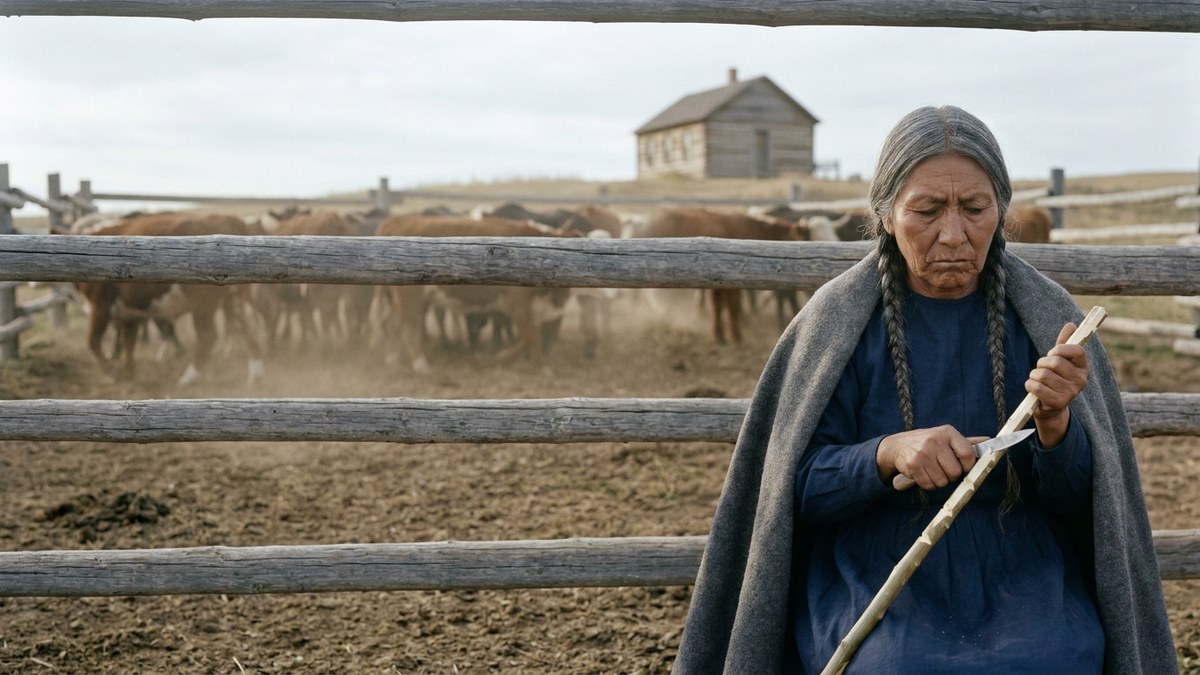
On a gray afternoon Annie brought Hattie down to her grandmother's cabin. Red Willow Woman sat by the stove with a fresh willow wand across her knees, peeling the bark with her knife in long, curling strips.
She handed Hattie a second wand and a small knife of her own.
"Next year," she said, and Annie translated, "you will count at the post with me. Your window is too far."
Hattie took the knife.
The willow smelled green and bitter in the warm room. Outside, the cattle were lowing in the agency pen, and the snow was falling quietly on all of them.
Red Willow Woman showed her where to make the first cut.
> What really happened: In 1875, Yale scientist Othniel C. Marsh carried complaints from Red Cloud and other Lakota leaders to Washington, charging that the Red Cloud Agency in the Dakota region had issued short and poor rations. A federal commission investigated that summer and took testimony about cattle weights, flour, and supplies. Historians describe a long-running "Indian Ring" of agents, contractors, and freighters who profited from shorting agency supplies in Dakota from about 1870 to 1890. Sources: Archives at Yale; South Dakota State Historical Society.