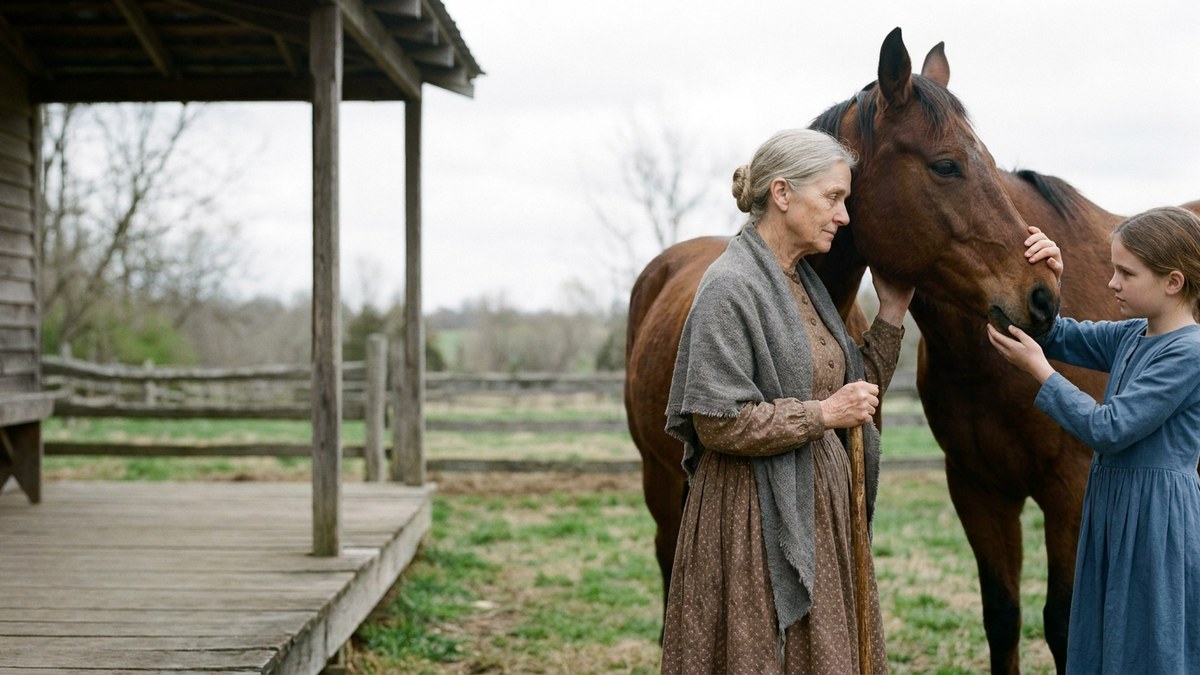
The bill of sale said the bay mare was five years old, and Hester Vail knew it was a lie before she had read the second line.
She did not need to read it. She could hear the mare breathing in the yard.
It was the first Saturday of April, 1874, in Corder's Crossing, Missouri, and her grandson Cal had just come home from the sale barn leading the mare on a new rope, grinning like he had found money in the road.
He had not found money. He had spent it.
"Eighty-five dollars," Cal said. "Mr. Pike said she'd bring a hundred and ten in St. Louis. Five years old, Grandma, and sound as a dollar."
Eighty-five dollars was the seed money. Every cent of it.
Cal was sixteen, the man of the house since his father died of the fever two winters back. His mother, Martha, stood on the porch with her hand pressed flat against her apron. She did not say anything. She looked at Hester.
Hester was sixty-seven. Her eyes had gone cloudy in the last few years, so that faces were soft shapes and print was a gray blur. But her ears were good, and her hands were better.
She walked down off the porch with her cane and stood beside the mare.
The mare's breath came slow and a little whistly through the nose. When Hester laid a palm on her neck, she did not throw her head. She just leaned, a little, into the warm hand, the way old horses lean.
"Josie," Hester said. "Come here and be my eyes."
Josie was eleven and had been Hester's eyes since Christmas.
For thirty years, before Hester's husband died, the two of them had traded horses all over central Missouri. Wagon horses, plow mules, buggy mares. Jacob Vail had done the talking. Hester had done the looking. There was not a horse trader on the river who would lie about a horse's age in front of Hester Vail, because she could read a mouth faster than most men could read a newspaper.
All winter, at the barn, she had been teaching Josie on Old Dan, their plow horse, who was twenty-two and patient as a church pew.
"Open her mouth the way I showed you. Thumb in the gap behind the front teeth. Gentle."
Josie did it. The mare let her.
"Now look at the bottom teeth. The front ones, in the middle. What do you see?"
"Cups," Josie said. "Little dark hollows in the top of each tooth. Like on Dan when you showed me the pictures in Grandpa's book. All six of them have cups."
Hester's hand stopped on the mare's neck.
All six. That was right, for a five-year-old. The cups wore away with the years, the center teeth first, then the next, then the corners. A horse with all six cups was young.
"Run your thumb along the side of one front tooth," Hester said. "Top to bottom. Is it straight up and down, like a closed book? Or does it lean out, like a bird's beak?"
Josie ran her thumb along it. She frowned.
"It leans," she said. "A lot. Like Dan's."
Cal had gone red.
"Grandma, you can't even see her," he said. "You're standing there with your eyes shut. She's got the cups. Josie just said so."
"She has cups," Hester said. "She also has the teeth of a mare of fifteen. Maybe sixteen. Both things can't be true."
"Mr. Pike said."
"I'm sure Mr. Pike said a great many things."
Cal took the rope out of Josie's hand. His voice cracked, which made him angrier.
"I'm the one who's got to take care of this family," he said. "Not you. You're going to march down there and make a fool of me in front of every man in the county."
He walked the mare to the barn without looking back.
Martha came down the porch steps and stood beside Hester in the yard.
"Mother Vail," she said quietly. "If it's true, is the money gone?"
"Not yet," Hester said.
The sale barn at Corder's Crossing ran every Saturday from spring to fall. Ike Lessard owned it, and he had a rule, painted on a board by the door: any trader caught lying about a horse's age or soundness gave the money back and never sold there again.
The rule was only good while the trader was still in town.
Royal Pike had brought fourteen horses up from Arkansas. He had sold eleven. He meant to sell the last three that afternoon and be on the Monday boat down the river.
Hester told Cal she was going to the sale barn.
Cal said that if she did, he would not go with her.
So she went with Josie.
The barn smelled of hay dust, sweat, and the sharp ammonia of the stalls. Thirty or forty men stood along the rail of the sale ring in the dim light, and when they saw Hester Vail come in on her cane with a girl leading a bay mare, the talk stopped all the way down the line.
Some of them remembered her. Some of them took their hats off.
Royal Pike stood in the middle of the ring. He was a tall, easy man of about forty with a soft hat and a soft voice. He smiled when he saw the mare.
"Mrs. Vail," he said. "I wondered if you'd come. Your grandson's a fine young man."
"He's sixteen," Hester said. "And you sold him a fifteen-year-old mare for a five."
The men along the rail murmured.
Pike only kept smiling. "That's a hard thing to say in front of all these folks, ma'am. Especially with your eyes the way they are. I'll make you a gentleman's offer. You show these men that mare's age in her mouth, plain as day, and I'll give the boy his money back and five dollars for his trouble. You can't, and you'll apologize to me right here."
Hester turned her head toward the dim gray blur where the mare stood. She could not see her teeth at all. Not in this light. Not at any distance.
"Josie," she said. "Open her mouth for the men."
Josie stepped up and put her thumb in the gap. The mare opened.
The nearest farmers leaned over the rail. Ike Lessard came with a lantern and held it close.
"Well," said old Amos Duff, slowly. "I count six cups. Clear as you like."
"Six," said the man beside him.
Somebody down the rail laughed.
Josie turned and looked at her grandmother. Her face had gone white.
"Grandma," she whispered. "They're right. The cups are all there. They look just like the pictures."