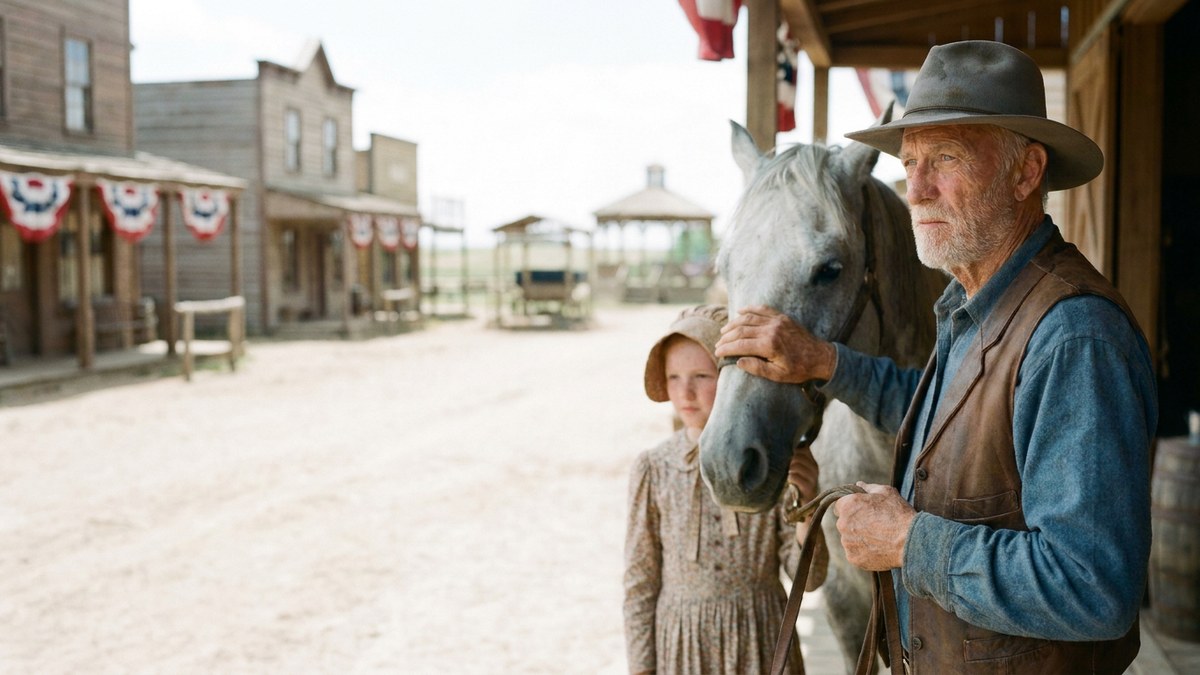
By noon on the Fourth of July, 1884, the stranger's plow horse had won three hundred and forty dollars from the town of Antler Creek, Dakota Territory.
Amos Teague watched it happen from a nail keg in the shade of the livery barn. His hip ached the way it always did in July, a deep, dull ache like a tooth.
The race had been a quarter mile, down the main street from the church to the grain elevator. Six local horses against one shaggy brown gelding the stranger called Buttercup. The stranger had said Buttercup pulled his wagon from Missouri. He had said it with a little embarrassed laugh, as if he were sorry to enter such a sorry animal.
Buttercup won by four lengths.
"He didn't even look tired," said Nell.
Amos's granddaughter was twelve, all elbows and freckles, and she was sitting on the ground at his feet with her chin on her knees. She had wanted to ride in the quarter mile. Amos had said no.
"No," Amos said. "He didn't look tired. He looked like a horse who'd done exactly what he was built for."
"What's he built for?"
Amos didn't answer right away. He was watching the stranger lead Buttercup back up the street. The gelding moved light, picking his feet up neat as a cat. When he stopped at the water trough, he stood square and quiet, and his flanks barely moved.
But when he'd crossed the finish, Amos had seen his nostrils open wide as teacups.
"A quarter horse spends all his money in the first half mile," Amos said. "After that he's broke."
Nell looked over at the corral behind the livery, where Kate stood dozing in the heat.
Kate was a gray mare, nineteen years old, gone nearly white around the eyes. She had carried a trooper in the Army for eight years. Amos had been a farrier sergeant in that same regiment, and when the Army sold off its condemned horses in 1879, he had bought her for eleven dollars, because she was the one horse he had never once seen quit.
"Kate saves hers," Nell said.
Amos smiled a little. "Kate saves hers."
The trouble came at one o'clock, when Hollis Grant walked over from the church with his hat in his hands.
Hollis was the treasurer of the schoolhouse committee. For two years the town had saved for a new roof on the schoolhouse, nickel by nickel, from pie suppers and box socials. Two hundred dollars. The old roof leaked so badly that last winter the children had sat at their desks in coats while snow came down through the boards.
"Amos," Hollis said. "I've done a terrible thing."
He had bet the roof money on Fred Ostrander's bay. Fred's bay had beaten every horse in the county for three summers. Hollis had meant to double the fund and surprise everybody.
"I'll pay it back," Hollis said. "I'll pay it back if it takes me ten years."
"You'll pay it back," Amos said quietly. "And the children will sit in the snow while you do it."
Hollis's face went red. Amos was sorry the moment he said it. But it was said.
The stranger's name was Lyle Fentress. He wore a gray town suit with a watch chain across his vest, and at two o'clock he climbed up on the bandstand where the mayor had read the Declaration that morning.
"Friends," Fentress said. "I hate to take a town's money and run. It doesn't sit right with me."
A few men laughed. Not many.
"So I'll make you an offer. Five hundred dollars against your three hundred and forty. Any horse in this town. Any distance up to three miles. You name it, and Buttercup will run it at four o'clock."
The crowd went quiet. Fred Ostrander shook his head and led his bay home.
Amos sat on his nail keg and rubbed his hip.
He had not bet on a horse race since 1868, when he lost a month's pay at Fort Riley and swore to his late wife he never would again. He had kept that promise for sixteen years.
He looked at Kate in the corral. Then he looked at the schoolhouse, with its sagging gray roof, down at the end of the street.
He stood up. It took him two tries.
"Three miles," Amos said.
Fentress looked down at him from the bandstand and smiled.
"And what horse would that be, Grandpa?"
"Gray mare in the livery corral."
Fentress looked across at Kate, at her white face and swayed back. The crowd started to laugh, and then stopped when they saw Amos's face.
"Who rides her?" Fentress asked. "You?"
Amos's hip answered that before he could. He had not been on a horse in two years.
"I'll ride her," said Nell.
Amos turned around. His granddaughter was standing right behind him, with her jaw set the way her grandmother's used to set.
"Nell," he said.
"You taught me," she said. "Every morning since I was six. You said I sit her better than any trooper you ever saw."
Amos had said that. He had meant it. He had never thought it would cost him anything.
"Three miles it is," said Fentress. "Out to the section stone on the ridge road and back, three times. Four o'clock sharp. If the mare's not at the line, the money's mine."
He climbed down from the bandstand. As he passed Amos, he spoke low, almost kindly.
"Every town I ride into thinks it's smarter than me, old man. I just let them prove it."
At three o'clock Amos sat Nell down on a hay bale and told her everything he knew.
Let Buttercup go. Don't chase him. Keep Kate at her road gallop, the long, steady one she used to hold for miles in the Army. Don't ask her for more until the cottonwood on the third time back. Then ask her once.
"Only once?"
"Kate knows what once means."
He went over Kate himself. Teeth, legs, back. He lifted each foot and tapped each shoe with the little hammer from his old farrier's saddlebag, the bag that still clinked when he walked, because he had never stopped carrying it.
The shoes were tight. He had set them himself on Monday.
Then Hollis came running to say that Fentress was claiming the girl was too light, that the mare should carry weight, and Amos went to the bandstand to argue it in front of the committee. It took forty minutes. He won.
He came back to the corral at five minutes to four.
Kate stood at the gate, saddled, with Nell holding her reins and her face white as the mare's.
"Grandpa," Nell said. "Look at her left front."
Amos lifted the hoof.
The shoe hung by a single nail. Three clinches had been pried straight with something thin and sharp. The fresh scratches still shone in the iron.
Down the street, the starter raised his pistol to check the load.