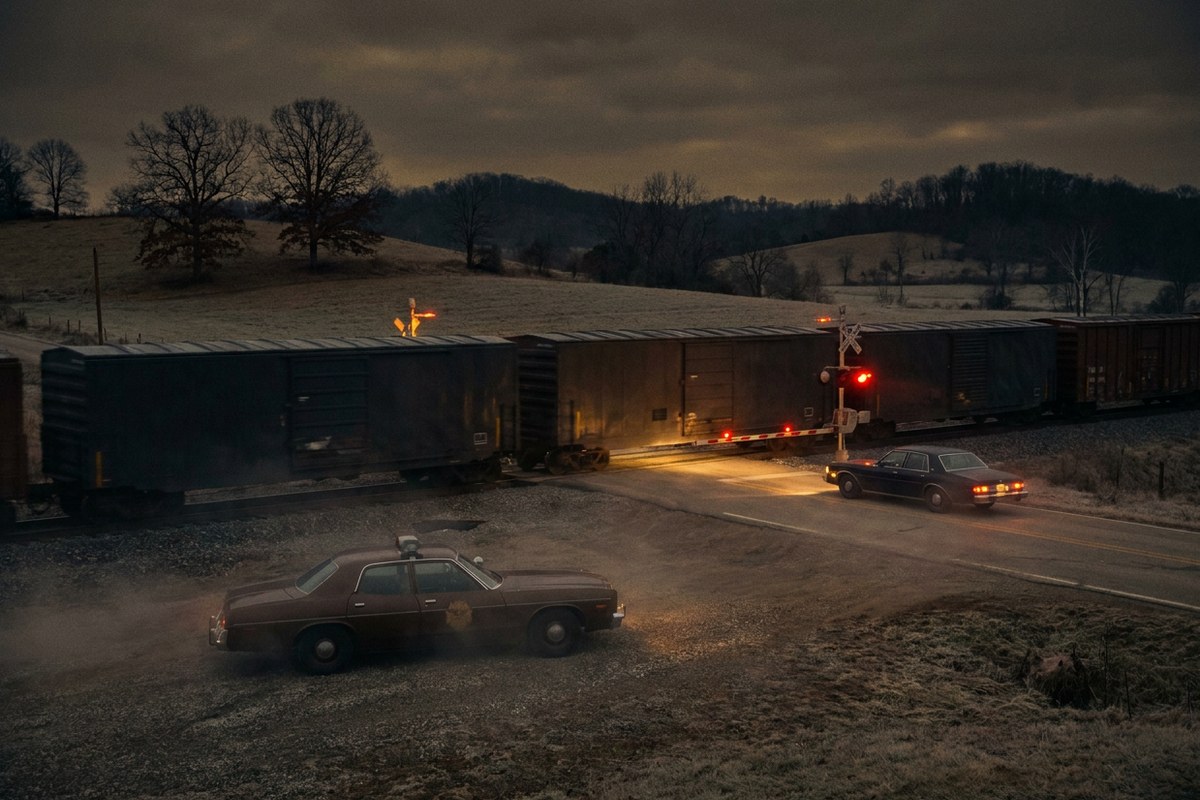
Tyler grabbed the door handle. Earl put a hand on his arm.
"Sit tight," Earl said.
"He's getting away."
"Where to?"
Tyler opened his mouth and shut it again. Through the gaps between the boxcars, he could see the sedan's headlights swing around on the old lane. They pointed toward the creek.
They stopped. They swung back.
Floyd's voice came back to him from the napkin. Dead end since 1971. Only way in or out is across those tracks.
The man had nowhere to go but back the way he came.
Earl started the car, eased it out from behind the mill, and parked it square in the middle of the crossing approach with the light bar on. Then he poured himself a cup of coffee from his thermos and waited for the train.
It was a long freight. Tyler counted eighty-three cars.
When the last one cleared the crossing and the gates went up, the sedan was sitting on the far side of the tracks with its engine running and nowhere to go. Earl got out, walked across the rails, and knocked on the driver's window with one knuckle.
After a moment, the window came down.
"Evening," Earl said. "I believe you've got something in your pocket that belongs to Bonnie Fultz."
His name was Dustin Rusk. He was thirty-one, and Tyler recognized him the moment the dome light came on.
They'd been two years apart at Calder County High School. Dustin's grandmother had lived on Feed Mill Road, two houses down from Arthur Boone.
Dustin had ridden his bike on the old lane every summer as a boy. He knew about the rusted box because he'd hidden firecrackers in it in 2005.
He'd gone to Dayton after high school, worked a warehouse job, gotten married, gotten divorced. The warehouse closed in the spring.
He fell behind on his child support in July. By September, he was sleeping on his cousin's couch in Marietta.
"I saw one of those scam videos online," Dustin said in the back seat of the Crown Victoria. He couldn't look at either of them. "A guy showing how it works. How they get the names. I thought, I'll just do it till Christmas. Just enough to catch up. Old ladies, they've got money in the bank. They won't miss it."
"Wanda Pickering's on Social Security and her husband's railroad pension," Tyler said. "That five hundred dollars was her Christmas."
Dustin put his face in his hands.
Earl didn't say anything for a while. Then he opened the envelope from Dustin's pocket and took out the card. He read the note he'd written that afternoon, out loud, in the dark.
"Dustin," Earl read. "Pull over and wait for me. I've known your grandma for forty years, and I'd hate to have to tell her I chased you."
Dustin made a sound that wasn't quite a laugh.
"How'd you know it was me?"
"I didn't," Earl said. "But I figured whoever it was, his grandma probably lived around here."
Irene Stull's check was in Dustin's glove box, uncashed. He hadn't figured out yet how to cash a check made out to a fund that didn't exist.
Wanda's gift cards were another story. The money was gone. Earl made Dustin write it down, every dollar, in a signed statement, along with the names of every woman he'd called.
There were eleven. Most of them had hung up on him. Some of them had Tyler's Tuesday table to thank for that, though they didn't know it.
The court would decide what happened to Dustin. Earl had been sheriff too long to promise anything. But when he drove the young man to the county jail in Marietta, he stopped first at Dustin's grandmother's house so Dustin could tell her himself.
"That's not part of the job," Tyler said afterward.
"It's the most important part," Earl said.
That Saturday morning, Arthur Boone had his great-nephew drive him around to the old lane behind the house. Arthur hadn't been back there in thirty years. He stood leaning on his cane while the boy pried the rusted mailbox off its post with a crowbar.
Arthur carried it home under his arm. He said he'd put tomato plants in it come spring, and that was the last mail it would ever get.
The next Friday, Dot took a sheet of poster board and a fat black marker and wrote a sign for the front window, in big letters an old woman could read from the sidewalk.
CHECK A CHARITY BEFORE YOU GIVE. A REAL CHARITY NEVER ASKS FOR GIFT CARDS. ASK TYLER, TUESDAYS 2 TO 4.
Wanda Pickering came in that afternoon for coffee. Dot didn't let her pay.
Then the Liars' Table took up a collection in a coffee can, which Floyd insisted on counting himself, twice. It came to five hundred and twelve dollars.
"Twelve dollars too much," Floyd said.
"Interest," said Pete Yoder.
Wanda tried to give it back. Dot told her she could try, but she wouldn't get far.
That evening, Tyler sat at the counter with Floyd's napkin map. He'd ironed it flat with Dot's dish towel and slipped it into a cheap black frame from the dollar store in Marietta.
He hung it on the wall beside the phone table, where he'd see it every Tuesday: the new road in a straight line, the old road curving around behind Arthur Boone's house to the railroad tracks, and in Floyd's careful block letters at the end of it, the words DEAD END.