Three widows came to Tyler Kessler's Tuesday phone table with the same Christmas card, and the charity on it didn't exist.
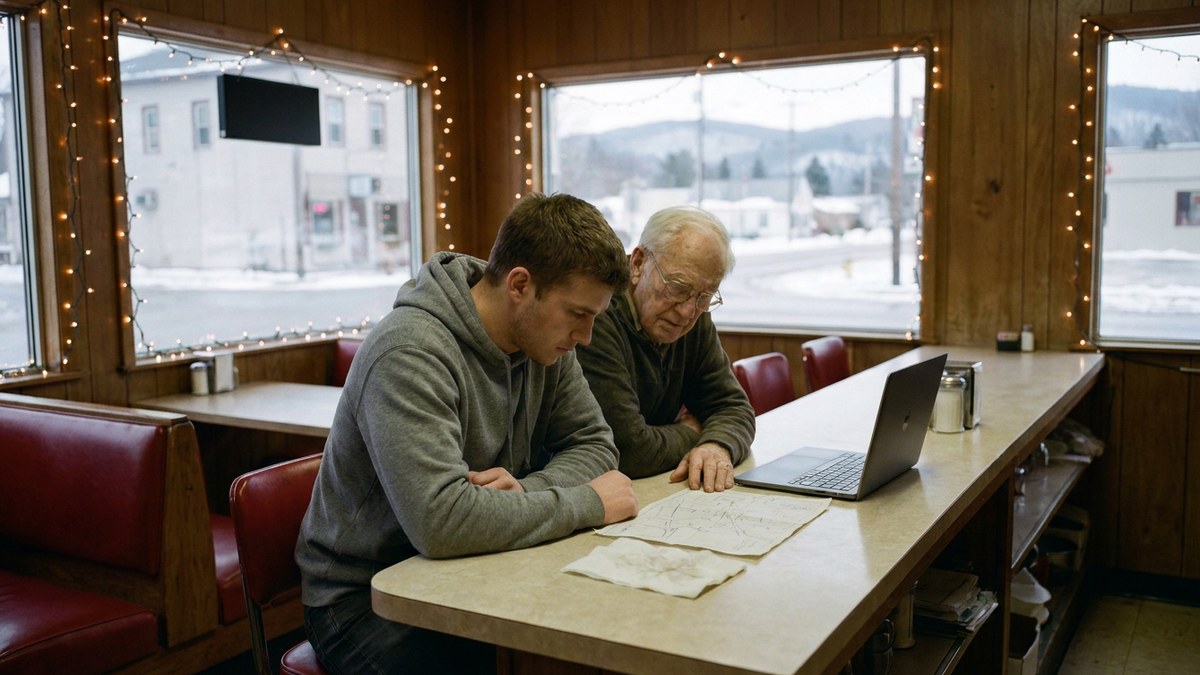
Tyler had been running the phone table at Dot's Corner Diner since spring. Every Tuesday from two to four, he sat in the back booth with a laptop and a box of chargers, and the older folks of Pine Hollow brought him their phones, their tablets, and their troubles.
This was a scam. He knew it the second he saw the cards.
They were cream-colored, with a red bell on the front and gold letters that said Calder County Christmas Relief Fund. Inside, a printed note thanked the reader for her late husband's years of generosity and asked her to continue his tradition of giving this holiday season.
Each card had the husband's name written in by hand.
"Harlan Fultz," said Bonnie Fultz, setting hers down. "Gone two years in March. Then a man called on Saturday. He was very polite. He said Harlan had always given at Christmas and asked if I'd like to keep it up."
"I gave him five hundred dollars," said Wanda Pickering. "Two drugstore gift cards. He asked me to scratch off the backs and read him the numbers."
The third widow, Irene Stull, kept both hands around her coffee cup. "Mine said to put a check in the mailbox at their collection point. 1142 Feed Mill Road. He said a volunteer picks up every evening." She looked at Tyler. "I mailed it Friday. Well. I put it in the box."
Tyler's stomach dropped.
"Mrs. Pickering," he said gently, "real charities don't ask for gift cards. Not ever. That's the one thing you can count on."
Wanda's chin trembled. Dot came over from the counter and put a hand on her shoulder without saying a word.
Tyler worked on it the rest of the afternoon.
He searched the Ohio Attorney General's charity database. There was no Calder County Christmas Relief Fund. He called the number on Bonnie's caller ID, and it rang through to a recording that said the number was no longer in service.
It was a spoofed number, made to look local. Whoever was on the other end could have been anywhere.
He figured out how they knew the husbands' names, though. All three men had obituaries in the Calder County Ledger in the past two years. The Ledger posted them online.
Each obituary listed the wife's name and town. One even listed the church where Harlan Fultz had ushered for thirty years.
"They read the obituaries," Tyler told his grandmother at the counter. "And then they call the widows."
Dot set down the coffee pot harder than she needed to. "That's lower than a snake's belly."
"It's also smart. And I can't trace a thing." Tyler rubbed his eyes. "The only real thing in the whole setup is the address. 1142 Feed Mill Road."
He pulled up the map on his laptop. Street view showed a small white house, a gravel drive, and a mailbox on a post by the road with BOONE painted on it.
"That's Arthur Boone's," said a voice behind him.
Floyd Eckert had come in on his walker for the afternoon pie, his ankle mostly healed from his adventure at Hollow Creek two weeks before. He peered at the screen over Tyler's shoulder.
"Arthur's ninety," Floyd said. "Worked at the glass works forty years. Couldn't scam a parking meter."
"Somebody's using his address."
"Well." Floyd squinted at the screen. "Somebody's using one of his addresses."
Tyler looked at him.
Floyd had carried the mail in Calder County for thirty-one years. He'd carried it on the route that included Feed Mill Road from 1966 to 1997, and he'd carried it before and after the county straightened the road in 1971.
He drew it for Tyler on a napkin, with a ballpoint pen, in the careful block letters of a man who'd addressed a lot of envelopes.
"Here's the new road," he said, drawing a straight line. "Here's Arthur's house. Here's his box, out front, where your computer shows it. But before '71, the road went around back. Here." He drew a curve behind the house.
"Along the creek, past the old feed mill, to the railroad crossing. Arthur's box was on the old road, by the tracks."
"And when they moved the road?"
"They put a new box out front. The county never took the old one down. It's still back there, last I saw, on its post by the tracks. Rusted shut, probably. Except somebody's been oiling it, I'd bet."
Tyler stared at the napkin. "My map doesn't even show the old road."
"Your map wasn't born yet," Floyd said.
"And there's one more thing about that old lane," Floyd said, tapping the curve. "When they straightened the road, they took the old creek bridge out. That lane's been a dead end since 1971. Only way in or out is across those railroad tracks at Feed Mill Road."
He wrote two words at the end of the curve, in capitals, and underlined them. DEAD END.
Earl Whitaker listened to all of it in the corner booth with his coffee getting cold.
"So he picks up from the old box after dark," Earl said. "Comes in across the tracks, takes the envelopes, goes back out. Arthur never sees him. Can't see that lane from the house."
"That's how I'd do it," Floyd said. "If I was a crook. Which I'm not."
"Irene's check is probably gone already," Tyler said.
"Probably," Earl said. "But Bonnie Fultz didn't give him anything yet. And he's going to call her back."
The man called Bonnie on Wednesday afternoon. Bonnie, with Earl sitting at her kitchen table and Tyler beside him holding her hand, told him she'd leave a check in the collection box that evening. Two hundred dollars, in Harlan's memory.
The envelope Bonnie left in the rusted box by the tracks had a Christmas card inside. Where the check should have been, there was a note in Earl's handwriting.
At 10:40 that night, Tyler sat in the passenger seat of Earl's Crown Victoria, lights off, parked behind the old feed mill with a clear view of the crossing.
June's picture on the dash caught a little moonlight.
At 10:52, headlights turned off Feed Mill Road and bumped across the tracks onto the old lane.
A dark sedan rolled slowly along the creek and stopped by the rusted mailbox. A man in a hooded jacket got out. He opened the box, took out the envelope, and stuck it in his pocket.
"Now," Tyler whispered.
Earl reached for the ignition.
And from the east, loud enough to rattle the windows, came the long horn of the eleven o'clock freight.
The crossing gates came down. The signal lights began to flash red. The first engine roared through the crossing between Earl's car and the old lane, and behind it, a wall of boxcars began rolling past, one after another after another.
On the far side of the train, the sedan's headlights came on.