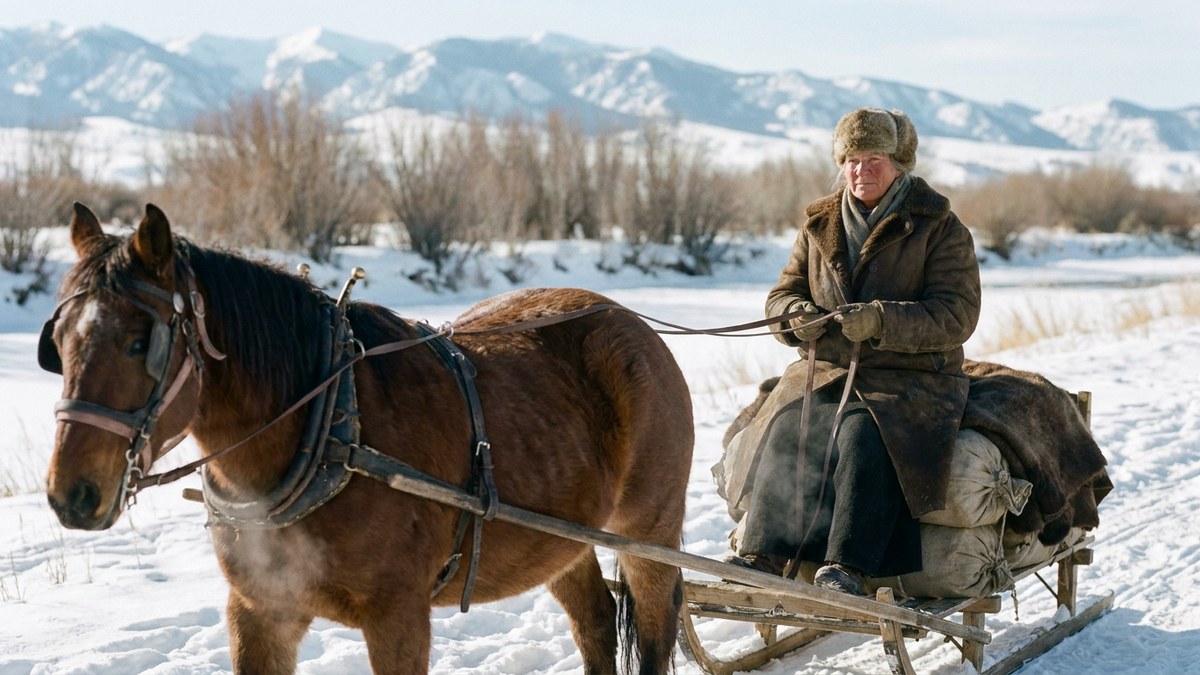
She went after the mare first.
Frank had taught her that in their first winter on Arrow Creek. Horse first. Then you. Then anything else.
She dug with the scoop shovel along Dolly's chest, talking to her the whole time in the same low voice she used to calm the stage teams, until the mare could get her front legs up onto the crust. Then Esther got hold of the bridle and pulled, and Dolly heaved, and came lunging up out of the coulee with snow pouring off her sides.
The sled was on its side but not broken. Esther righted it alone. It took her four tries. On the fourth, something in her back went with a sound she felt more than heard, and she stood bent over the runner for a while until she could breathe again.
Then she went after the letters.
The wind had dropped a little. She could see thirty yards now.
She found them one at a time. One caught against a sagebrush. Two pressed flat against the side of a drift like leaves. One lying face up on the crust, as if it had been waiting for her.
She counted them back into the sack with her mittens off and her fingers going white.
Six. There had been seven letters for the head of the creek.
She stood up and turned slowly with her back to the wind, and looked downwind, where anything light would go. There was a line of willows along the creek fifty yards off, black against the white. The wind ran straight into them.
Frank used to say the willows caught everything in that country. Hats, tumbleweeds, lost calves.
She walked to the willows with the snow to her knees. She did not hurry. She could not have hurried.
The square envelope was there. It was caught in the bare branches about three feet off the ground, flapping a little, its corner bent.
She came into the Pratt place at four o'clock, in the last light, with Dolly's head down and her own face so stiff she could not feel her mouth.
There was no smoke from the bunkhouse. The crew was out at the line camps, trying to keep the cattle alive. There was a thin line of smoke from the main house.
In the corral, six saddle horses stood with their heads down and their ribs showing. The hay yard was empty. The stack had been fed down to the ground.
Esther knocked on the door.
Cyrus Pratt opened it. He had a blanket over his shoulders and three days of beard, and he looked at her and at the sled and at the mare, and did not seem to understand any of it.
"Mrs. Galloway," he said. "What are you doing here?"
"You have mail," Esther said.
She sat by his stove with her hands in a pan of cool water, because she knew better than to put them in hot, and he stood by the window and opened the square envelope.
Inside was a letter and a card. The card was a photograph, mounted on stiff board. A young woman in a dark dress, holding a baby in a long white christening gown.
Pratt read the letter standing up. Then he sat down.
"My daughter," he said. "Ellen. We had words, when she married. Six years ago. I told her not to write." He held up the photograph, and his hand was not steady. "That's a boy. She named him Cyrus."
Esther did not say anything. She held her hands in the water and looked at the stove.
"She says if I'll have them, they'll come out on the cars in the spring," Pratt said. "In the spring." He looked at the window, at the six horses in the corral, at the empty hay yard. "I'll be lucky if I have a ranch in the spring."
She stayed the night, because there was nothing else to do.
In the morning it was Christmas. The wind had died. The sky was clear and hard and blue, and the snow went off in every direction, glittering.
Pratt hitched Dolly for her himself. He did not say much. He handed her up into the sled and tucked the buffalo robe around her knees, carefully, like a man who had not done that for anyone in a long time.
"I said things to you in October," he said.
"You did."
"I'd take them back if I could."
Esther picked up the lines. She looked at the six thin horses in his corral.
"I have hay," she said. "Forty acres of it, stacked. More than my stage horses can eat by spring. Send two men down with a sled tomorrow, Mr. Pratt. Take what those horses need."
He stared at her.
"What do you want for it?"
"I want you to be there in the spring," Esther said, "when your grandson gets off the cars."
She clucked to Dolly, and the sled went off down the creek on the crust, hissing, with the wind on her right cheek, going home.
The two men came the next day with a sled. They came every week until March.
In April, when the chinook finally came and the snow went off the basin in a week of mud and running water, a letter came for Esther in the first mail. It was from Cyrus Pratt. It was one line long.
They are on the cars. Come and meet them.
> What really happened: The winter of 1886 to 1887 was the worst in the memory of Montana ranchers, with heavy snow between Thanksgiving and Christmas, a brief thaw in January that froze into ice, and deep cold in February, and tens of thousands of range cattle starved or froze. Stages and mail were delayed for weeks across the cattle country. That winter a young cowboy named Charlie Russell answered a rancher's delayed letter by sending back a small watercolor of a starving steer, later known as Waiting for a Chinook. Sources: Montana Historical Society; University of Montana.