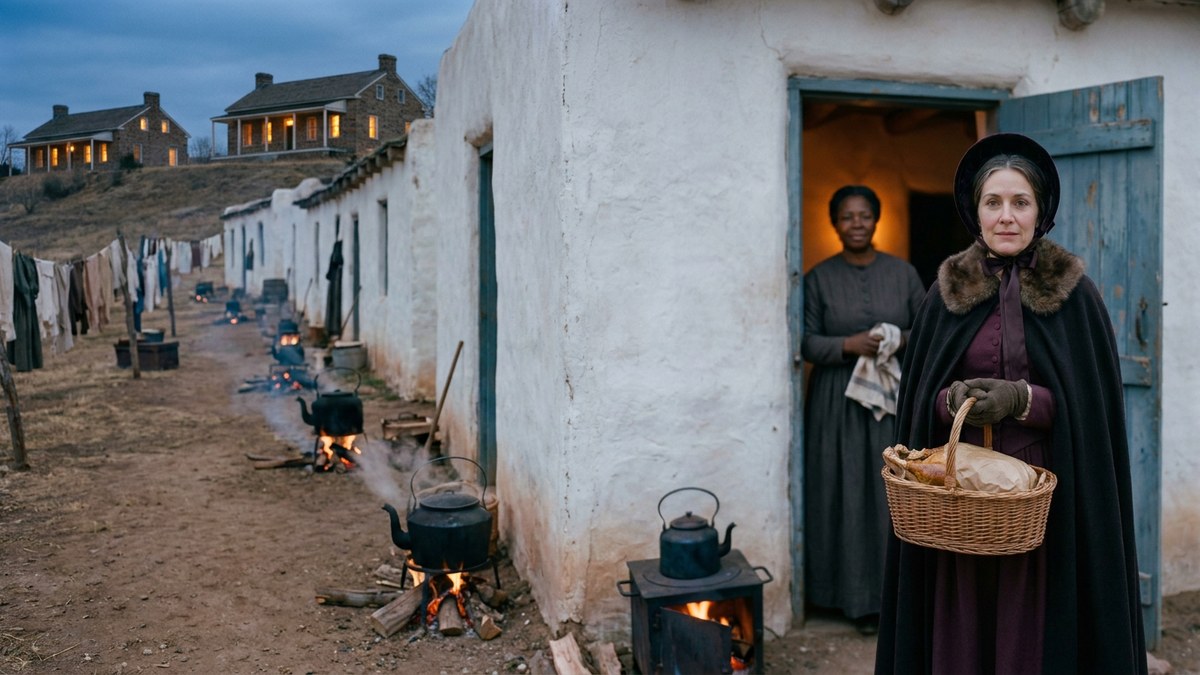
On the morning of Christmas Eve, 1878, Eleanor Ashby told her cook to roast two geese instead of one, and the whole of Officers' Row knew about it by noon.
"Two, Mrs. Ashby?" said Mrs. Dorsey from next door, over the fence. "Are you expecting a crowd?"
"One crowd," Eleanor said. "And one friend."
She was fifty-seven years old, the wife of the post commander at Fort Raney, Texas, and she had been an army wife for thirty-four years. She knew exactly what she was doing. That was the trouble.
Fort Raney sat on a bare rise above a creek in West Texas, a square of stone and adobe buildings around a dusty parade ground.
At the top of the rise stood Officers' Row: seven stone houses with porches and green shutters, where the officers' wives kept their silver and their calling cards and their rules.
At the bottom, past the stables, by the creek, stood a line of low adobe huts with laundry lines strung between them, and big iron kettles steaming over fires in the yards.
Everybody called it Suds Row.
The laundresses lived there. They were the wives of enlisted men, mostly. They washed for the companies at so much a soldier a month, and raised their children, and kept their husbands in clean shirts and their own counsel. At Fort Raney, where the troops were the Black soldiers of the Tenth Cavalry and the Twenty-fifth Infantry, most of the laundresses were Black women too.
An officer's wife did not go to Suds Row. She sent for her washing and paid for it at her back door. That was the rule, and it was older than Eleanor.
The friend's name was Celia Banks.
Seven years ago, in the spring of 1871, Eleanor had been riding in an army ambulance wagon across the Pecos River with a column moving to a new post. The river was high and brown. Halfway over, the ambulance hit a hole, rolled onto its side, and filled with water.
Eleanor had been trapped under the canvas. She remembered the cold of it, and the dark, and the weight of her own wet skirts dragging her down.
Then a pair of strong hands had found her collar and pulled.
The hands belonged to Celia Banks, a laundress riding in the wagon behind, who had seen the ambulance go over and jumped into the Pecos in her shoes. She dragged Eleanor to the bank and pushed the water out of her. Afterward, through two weeks of fever in a tent at the next camp, Celia sat with her every night.
Eleanor had thanked her then, privately, in the tent.
She had never once thanked her since. Not in front of anyone. In seven years at three different posts, she had nodded to Celia Banks across parade grounds and paid her for the washing at the back door.
It was the rule.
Now there was a new rule, and it came from Congress.
That summer, Congress had done away with the army's laundresses. No more would be hired or carried on the rolls. The women already on the posts could stay only as long as their husbands' enlistments lasted.
First Sergeant Isaiah Banks's enlistment ran out on the tenth of January. He would not sign again. He was forty-six, and his knees were gone, and he had a brother with a farm near San Antonio.
In two weeks, Celia Banks would leave Fort Raney for good.
Eleanor had lain awake three nights thinking about that.
Her husband found her in the kitchen at four o'clock, basting.
Colonel Robert Ashby was a fair man and a cautious one. He had been a soldier since Mexico and had learned when to fight and when to send a polite letter.
"Ellie," he said. "Mrs. Dorsey says you're taking a goose to Suds Row."
"Mrs. Dorsey is right."
"General Haverford and his wife are at our table tomorrow."
"I know. I'm roasting them a goose too."
The colonel rubbed his face. "The general's wife will hear of it by breakfast. You know how she is about the proper order of things. She wrote a book on army housekeeping, for heaven's sake."
"I've read it," Eleanor said. "It has a very good chapter on goose."
"There'll be talk. The other wives will cut you."
"Let them." Eleanor shut the oven door. "Robert. She pulled me out of the Pecos. I have been nodding at her across parade grounds for seven years because of a rule I didn't make. In two weeks she'll be gone. I will not let her leave thinking I forgot."
He looked at her. Then he went and found her heavy cloak and laid it over a chair, which was how Robert Ashby said yes.
At dusk, Eleanor wrapped the goose in clean towels in a basket, with a loaf of bread and a jar of cranberry sauce and a bottle of good wine.
She went out her front door, not her back one. She walked down the length of Officers' Row with the basket on her arm. On every porch, a curtain moved.
She walked past the flagpole and the guardhouse, past the stables, down the hill, into the smoke and lamplight of Suds Row.
Children stopped playing to stare at her. A soldier mending a harness stood up and touched his cap. A woman at a kettle said, "Lord have mercy," and did not say anything else.
Eleanor found the hut with the blue door. She had known for seven years which one it was.
She knocked.
The door opened. Celia Banks stood there in a plain dark dress with a dish towel in her hand, and her face went perfectly still.
And from behind Eleanor, on the path, came the sharp, unmistakable voice of the general's wife.
"Mrs. Ashby. What on earth do you think you are doing?"