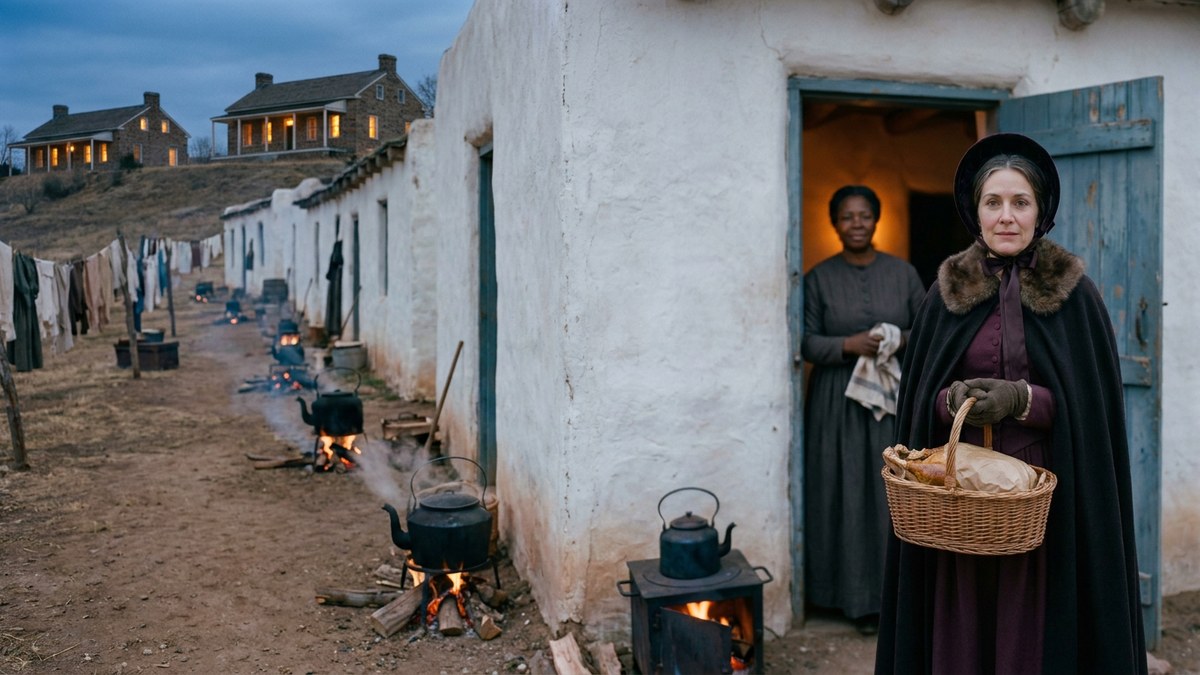
Eleanor turned around with the basket on her arm.
Mrs. Constance Haverford stood on the path in a fur-trimmed cloak, with a lantern in one gloved hand. She was sixty-five, small and straight and silver-haired, and she had followed Eleanor down the hill alone.
Behind her, all the way up the slope, the curtains of Officers' Row were open now.
"I am taking Christmas dinner to a friend," Eleanor said.
"To Suds Row."
"Yes, ma'am."
"On Christmas Eve. In front of the entire garrison."
"It seemed the best time," Eleanor said. "Everyone would be looking."
Celia had not moved from her doorway. Inside, behind her, Eleanor could see a small, clean room, whitewashed, with a table and two chairs and a little cedar branch in a can, hung with three red ribbons. Sergeant Banks stood by the stove in his shirtsleeves, very still, looking at the floor.
"Mrs. Ashby," Celia said quietly. "You'd better go on home."
"I will not."
"They'll make it hard on you up there. Harder than you know."
"They can make it as hard as they like," Eleanor said. "You pulled me out of the Pecos, Celia. You sat up with me two weeks. I have owed you a Christmas for seven years, and I am out of time to pay it."
Celia's eyes filled. She did not wipe them. She kept her chin up and looked past Eleanor at the general's wife on the path, the way a woman looks at weather coming.
Mrs. Haverford came forward into the light from the doorway.
She looked at Celia Banks. She looked at the cedar branch with its three red ribbons. She looked at Eleanor's basket.
"Is that the goose from my chapter?" she asked.
Eleanor blinked. "With the chestnut stuffing. Yes, ma'am."
"Then you've overcooked it. Everybody does."
She handed Eleanor the lantern, and pulled off her gloves one finger at a time.
"My mother washed for a company of the Third Infantry," said Mrs. General Haverford. "At Fort Wayne, in the war with England. I was born in a hut very like this one, at the bottom of a hill very like that one. I learned my letters from a sergeant. I married a lieutenant at seventeen, and I have spent forty-eight years walking up that hill and never once walking back down it."
She turned to Celia.
"Mrs. Banks," she said. "May I come in? I'm told there's a goose."
They ate at Celia's table, the four of them, because there were only four chairs once Sergeant Banks borrowed two from next door.
The goose was overcooked. The general's wife said so twice and ate two helpings anyway. Sergeant Banks, who had not said a word at first, told a story about a mule at Fort Concho that made Mrs. Haverford laugh until she had to set down her fork. Celia brought out a sweet potato pie she had been saving.
Somewhere in the middle of it, Mrs. Haverford asked how on earth Celia got the officers' shirts so white with nothing but creek water full of alkali. Celia told her: rainwater saved in barrels, a little bluing, a long boil, and never let a sergeant near the kettle. Mrs. Haverford took a small notebook out of her reticule and wrote it all down.
Later, there was a knock at the door. It was Colonel Ashby, in his dress coat, with General Haverford beside him.
"We were told," the colonel said carefully, "that this was where Christmas Eve had gone."
So there were six. They sat on the bed and on an upturned washtub. Nobody minded.
Late in the evening, when the men had gone outside to smoke, Mrs. Haverford set down her coffee cup.
"Mrs. Banks," she said. "You nursed Mrs. Ashby through a fever in 1871."
"Yes, ma'am."
"Did you nurse anyone else?"
Celia looked at her, puzzled. "Half the camp had that fever, ma'am. I nursed whoever needed it. I had the touch for it, my mama said."
"The post hospital here has had no matron for a year," Mrs. Haverford said. "The surgeon has asked three times. Congress has done away with laundresses, but it has not done away with hospital matrons. They are hired by the post, they draw pay, and they live on the post." She turned to Eleanor. "The commanding officer approves the hire. On the surgeon's word."
Eleanor understood. She did not trust her voice, so she only nodded.
"Your husband wants to farm, Mrs. Banks," said Mrs. Haverford. "Would he farm near a post?"
"He'd farm on the moon," Celia said slowly, "if I was there."
Celia Banks was hired as matron of the post hospital at Fort Raney on the second of January, 1879, on the surgeon's word, with the commanding officer's approval. Isaiah Banks took his discharge and rented forty acres on the creek below the fort.
She held the post eleven years.
The other wives cut Eleanor Ashby for about a month. Then, one by one, they found they needed the new hospital matron, for a child's croup or a fever or a baby coming early in the night. And the matron came up the hill to Officers' Row whenever she was sent for, and went in by the front door.
Every Christmas Eve after that, for as long as the Ashbys were at Fort Raney, Eleanor carried a goose down the hill to the house with the blue door.
It was always overcooked. Nobody ever said a word about it.
> What really happened: From 1802 the U.S. Army officially employed company laundresses, usually the wives of enlisted men, who were paid by the soldiers and housed on the post, often in a row of quarters nicknamed Suds Row or Soap Suds Row. Officers' families and enlisted families lived largely separate social lives. In 1876 the army stopped laundresses from traveling with the troops, and in 1878 Congress ended their authorization, a heavy blow to many military families. Black regiments, including the Ninth and Tenth Cavalry and the Twenty-fourth and Twenty-fifth Infantry, garrisoned many Texas forts in the 1870s. Sources: National Park Service; Texas Co-op Power.