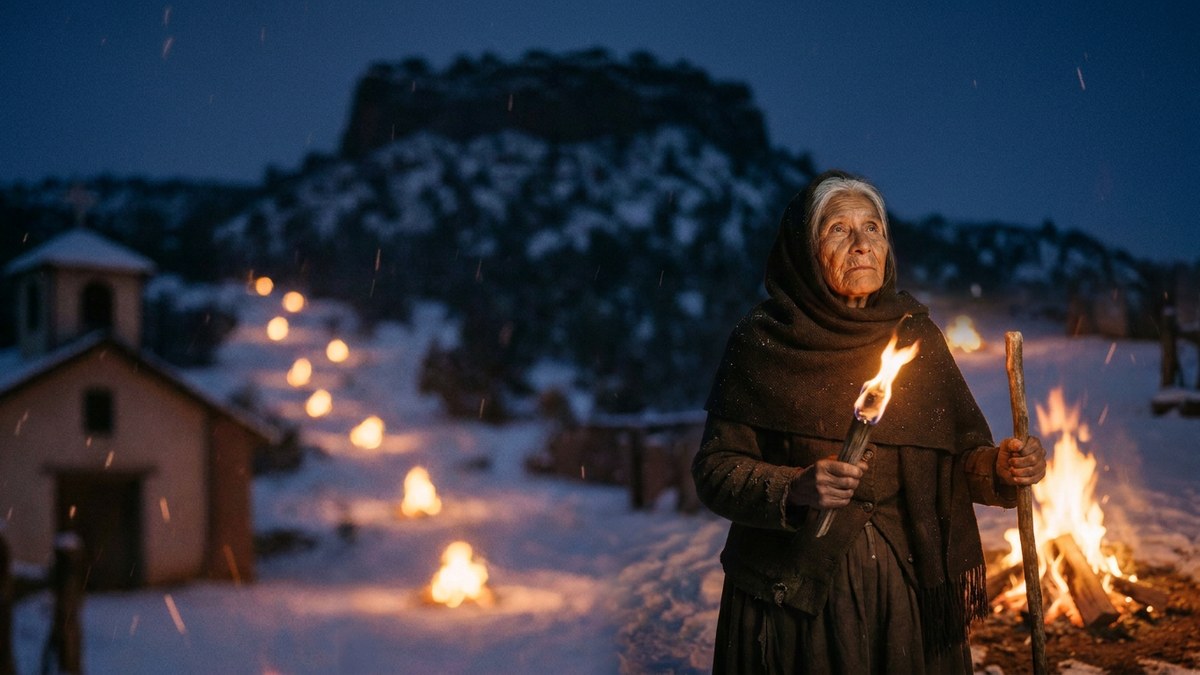
The Hatcher boy had been gone since noon, and by the time the bell rang for vespers on Christmas Eve, the men on horseback had stopped calling his name.
It was 1876, in the village of San Isidro, in the mountains of northern New Mexico Territory. Snow lay a foot deep in the valley and deeper on the ridges. The sky had cleared at sundown, and now the cold was coming down out of the stars like something poured.
Doña Tomasa Archuleta stood in her doorway at the top of the plaza and watched the riders come back in. There were nine of them. None of them had the boy.
She was seventy-two years old. She had seen this before.
The boy's name was Danny. He was eight.
His father, Ben Hatcher, had come from Texas two years before and bought the old Valdez ranch at the mouth of the canyon. He was a hard, loud, hardworking man who did not speak Spanish and did not care to learn it. He had fenced off the spring where the village women used to wash. He called the village "the Mexican town" and the church "that mud church," and he did not come to either.
His wife had died the first winter. Since then it had been Ben Hatcher and the boy, alone on the ranch.
At noon that day, Danny had taken a hatchet and gone up the canyon to cut a little piñon for a Christmas tree, because his mother had always had one. He had not come back.
Ben Hatcher came into the plaza last, on a lathered horse, with his face gray.
"He's on the north ridge," he said to anyone who would listen. "He's got to be on the north ridge. That's where the piñons are."
"We have been on the north ridge since three o'clock, señor," said Ramón Archuleta, Tomasa's grandson, as gently as he could. "There is no track. The wind has filled everything."
"Then we go back."
"In the dark, the horses will break their legs on the rocks. And then we lose men too."
Hatcher looked around the ring of faces in the lantern light. Brown faces, tired faces, faces he had never bothered to learn the names of.
"Then I'll go alone," he said.
Tomasa came down from her doorway.
She walked slowly, with her black shawl over her head and a stick in her hand, and the men made way for her, the way they always did.
She did not speak to Hatcher. She spoke to her grandson, in Spanish.
"Ask him which way the boy's house can be seen from. From the ridges. Which way he would look, if he were lost."
Ramón asked. Hatcher stared at the old woman.
"What does it matter? It's dark. He can't see anything."
"Tell him," said Tomasa, "that is exactly the trouble."
In the winter of 1841, when Tomasa was thirty-seven, her own son Pablo had gone out after a strayed goat in a storm like this one and had not come home.
The men searched all night with torches. They called his name until their voices broke.
They found him in the morning, curled under a juniper, two hundred yards from the back wall of the house. He had been that close all night. He could not see the house, and he could not hear the men over the wind, and he had sat down in the snow to wait, the way a child does.
He was seven.
Tomasa had lived thirty-five years since that morning. She had thought about those two hundred yards every winter of every one of them.
"A lost child does not find his way," she said to Ramón. "He waits for the way to find him. We have been calling him. We should have been showing him."
She lifted her stick and pointed. Above the village, the long white shoulder of the mesa ran up toward the ridges, toward the canyon, toward every place the boy could be. From the top of it, on a clear night, you could see the whole valley.
"Luminarias," she said. "From the top of the mesa, all the way down to the church door. A line of them. One every twenty steps. So that wherever he is, he sees fire, and the fire goes one way, and he follows it."
Ramón stared at her. "Abuela. That is a mile. That is a hundred fires."
"Then it is a hundred fires."
"It is every family's piñon. It's the coldest winter in ten years. That wood is for January."
Tomasa looked at him.
"In January," she said, "God will provide. Tonight, we will."
They did it.
Every family in San Isidro carried out its winter wood. Old men and boys and women with babies on their hips stacked the little squares of piñon three feet high, crosswise, the way you built luminarias for the Holy Family on Christmas Eve. They built them up the frozen path from the church, across the plaza, up the side of the mesa, one every twenty steps, until the line of them ran out of sight into the dark.
Ben Hatcher carried wood too. He did not understand a word anyone said. He carried it anyway, until his hands bled.
At nine o'clock, Tomasa lit the first one by the church door with a coal from her own fire.
The boys ran up the line with torches. One after another, the fires caught and stood up, until a road of fire ran from the church all the way to the top of the mesa, burning in the snow, smelling of piñon smoke, bright enough to be seen from every ridge in the valley.
It was the most beautiful thing Tomasa had ever seen.
At ten o'clock, the wind came back.
It came over the ridge from the north with the snow in it, hard and sideways. At the top of the mesa, far away, the highest fire flickered. Then it went out.
Then the one below it.