"They're going out," Ben Hatcher said. "Up top. They're going out."
He said it in English, but everyone understood him.
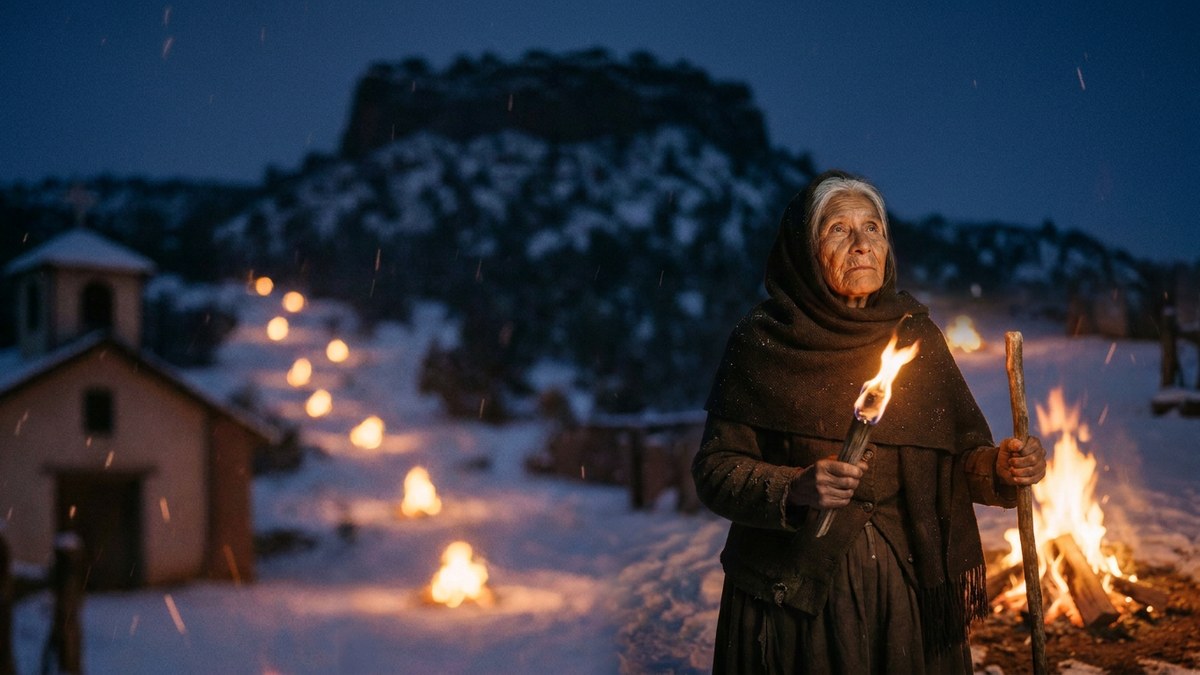
The fires at the top of the mesa were dying one by one in the new snow, and the line of light was shrinking down the hill toward the village like a candle burning down.
"Feed them," said Tomasa.
"With what?" Ramón said. "There's no more wood, Abuela. Everybody's given everything."
Tomasa turned around and went back up the plaza into her own house.
She came out again with a chair.
It was a heavy, carved pine chair, black with age. Her husband had made it the year they married, in 1823, and she had sat in it every evening of her life since. She carried it out into the snow and handed it to her grandson.
"Feed them," she said again.
Ramón looked at the chair in his hands. Then he turned and ran up the hill with it.
And the village went home and came out again.
They brought the benches from beside their doors. They brought the wooden pegs from the walls and the shelves from the kitchens and a broken cart wheel and three old saddle trees and the posts of a corral. Old Anselmo Gallegos brought the wooden cradle all six of his children had slept in, and looked at it once in the snow, and then handed it up the line.
Ben Hatcher stood in the middle of the plaza and watched them do it.
Then he got on his horse and rode for his ranch, and came back with a wagon full of fence posts. They were the posts he had set around the washing spring.
They kept the fires burning.
The young men ran the wood up the mesa all night, in relays, through snow to their knees, and threw it on the dying fires, and blew on the coals, and ran back down for more. The line flickered and wavered in the wind, and shrank, and grew again. But it held. From the top of the mesa to the church door, it held.
At eleven, the bell rang for the Misa de Gallo, the midnight Mass.
Tomasa did not go in. She sat on the bench outside the church door, in the snow, by the first fire, with her shawl over her head and her stick across her knees, and looked up the line of light toward the dark.
Ben Hatcher sat down beside her. He did not ask if he could.
They sat there together, the old woman and the Texan, and did not say anything, because they did not have a word in common.
After a while, Tomasa reached over and put her hand on his arm, and left it there.
At a quarter to one, a boy came down the mesa.
He came walking very slowly, from fire to fire, the way a child walks a fence rail. He stopped at each one to warm his hands. He was carrying a little piñon tree, about two feet tall, by its trunk, and it was dragging in the snow behind him, and he would not let go of it.
Ramón saw him first, from halfway up the hill, and yelled.
Ben Hatcher was off the bench and running before the yell was done. He went up that hill through the snow like a man half his age, and caught the boy up, and the little tree with him, and stood there between two fires holding them both with his face in the boy's wet hair.
The people coming out of the Misa de Gallo stood on the church steps and watched.
Later, in Tomasa's house, wrapped in three blankets by her fire, Danny Hatcher told them what had happened.
He had climbed too far after the best tree, he said, and the snow came, and he could not find the way down. He sat under a rock ledge on the far side of the ridge. He had eaten the last of his bread at four o'clock. He had been very cold, and then not so cold, which he said was strange. He thought he would just go to sleep for a while.
"And then I saw a fire," he said. "Way off. And then another one, under it. And another one. All in a line, going down." He looked up at his father. "I thought it was a road somebody made for me."
Ramón translated that for his grandmother.
Tomasa nodded. She was sitting on a wooden crate, because she had no chair anymore.
"Tell him," she said, "that it was."
The washing spring was never fenced again.
In the spring, Ben Hatcher came up to the plaza with his boy and a mule loaded with lumber, and asked Ramón to help him say something to the old woman. It took the better part of an hour, with Ramón in the middle.
What he said, in the end, was that he had been a carpenter in Texas before he was a rancher. He built her a new chair that summer, out of good pine, carved on the back the way the old one had been. It was not as good as the old one. She said it was better.
And every Christmas Eve after that, as long as Tomasa Archuleta lived, a wagon came up from the old Valdez ranch to the plaza at San Isidro, loaded to the sides with piñon.
> What really happened: Long before paper bags and candles, New Mexicans lit small bonfires of crisscrossed piñon wood, called luminarias, along roads, outside homes and near churches on Christmas Eve, to light the way for the Holy Family and for worshippers walking to midnight Mass, the Misa de Gallo. In northern New Mexico the word luminaria still means these bonfires, while the paper-bag lanterns that came later are called farolitos. A Spanish journal from 1590 describes small fires lit to guide a scout back to camp. Sources: National Park Service; New Mexico History Museum.