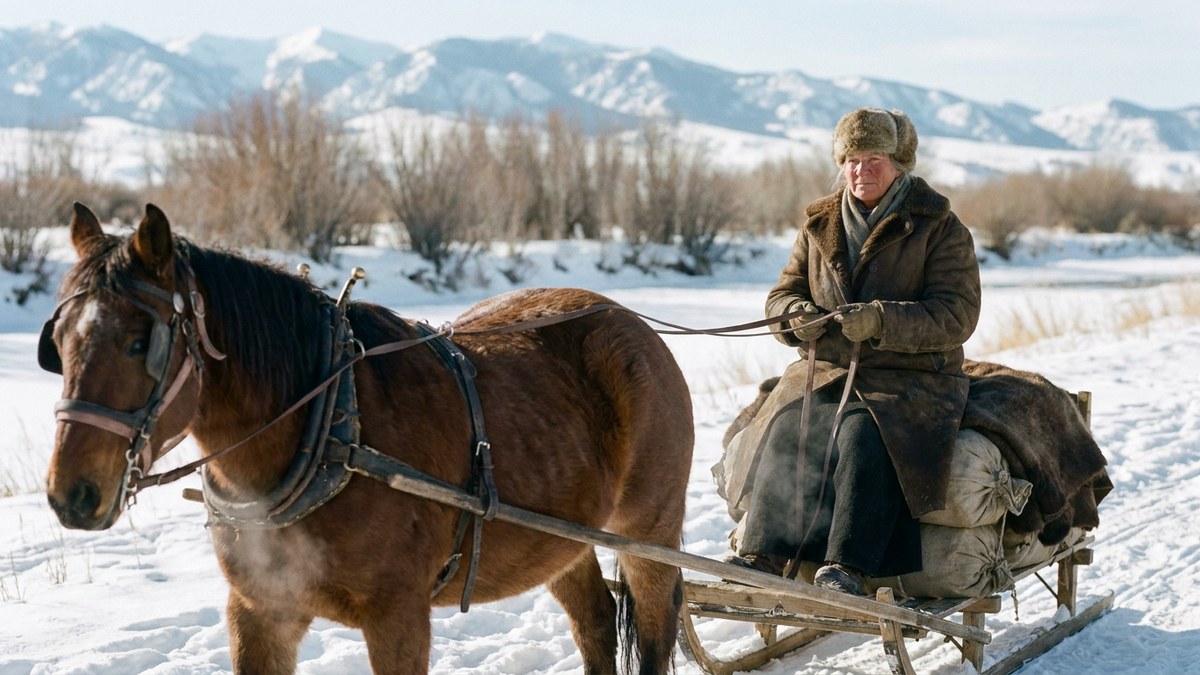
The stage got as far as Esther Galloway's station on December 21, 1886, and the driver said it was not going one mile farther until spring.
He threw the mail sacks down on her kitchen floor and stood by her stove, steaming, with ice in his beard.
"Fifty-one pieces for up the basin," he said. "Christmas letters, mostly. A few parcels. They'll keep."
"Till when?" Esther asked.
"March. April. Whenever God sends a chinook." He held his hands to the stove. "There's two foot of snow on the flat and drifts to a man's chest in every coulee between here and the mountains, Mrs. Galloway. Nobody's getting up that basin for Christmas."
Esther was sixty-four. She had kept the stage station on Arrow Creek in Montana Territory with her husband for nineteen years, and kept it alone since he died, two years ago in the fall.
She fed the stage horses. She fed the passengers. She kept the post office in a pigeonhole cabinet by the kitchen door. Twice a week, when the roads were open, the stage came through and took the mail on up the Judith Basin to the ranches.
When Frank had been sick his last winter, she had driven that route herself. Thirty-one miles, five ranches, two line camps, and the Pratt place at the head of the creek.
"Frank used to say you drive a ground blizzard by your face," she had told the driver once, when he laughed at her for it. "Keep the wind on your left cheek going up the basin and your right coming home. Your eyes will lie to you. Your cheek won't."
He had laughed harder at that.
That night, after the driver had gone to sleep in the bunk room, she sat at the kitchen table and sorted the fifty-one pieces into piles.
The Kesslers. The Dunns. The two young Scotsmen at the Bar Cross line camp. A fat parcel for the McRae children, in brown paper, with a Chicago store's label. A letter for old Sam Tolley in a woman's hand, from Missouri, his sister, who wrote him every Christmas and every Fourth of July.
And at the bottom of the sack, one letter for Cyrus Pratt.
It was a thick, square envelope in a careful round hand. The postmark said Columbus, Ohio. There was something stiff inside it, like a card.
Esther set it on its own pile and looked at it.
Cyrus Pratt ran four thousand head of cattle at the head of Arrow Creek. He was the biggest man in the basin, and he wanted her station.
He did not want the house. He wanted the spring behind it, which never froze, and the forty acres of wild hay meadow along the creek, which Frank had fenced and mowed every August for nineteen years. In a hard winter, hay was worth more than gold.
He had ridden down in October and made his offer at her kitchen table.
"You're an old woman alone, Mrs. Galloway," he had said. "You can't mow that meadow by yourself. You can't run this station. By spring you'll be glad to sell, and by spring I'll be offering half."
"Then I'll wait and see what spring brings," Esther had said.
Pratt had put his hat on. "Spring brings what it always brings," he said. "The strong ones that are left."
On the morning of the twenty-third, she went out to the barn before daylight.
Her old mare, Dolly, was twenty-two years old and as wide as a sofa. Frank's bobsled stood in the corner where he had left it, a low wooden box on two iron runners. Esther pulled it out into the aisle and greased the runners with tallow and backed Dolly into the shafts.
The stage driver came out in his long johns, holding a lantern.
"Mrs. Galloway, what in the name of sense are you doing?"
"Delivering the mail," she said. "It's Christmas."
"You'll die out there."
"I'll be back the night of the twenty-fourth," she said. "There's beans on the stove and coffee in the can. Feed the stage horses at six and four."
She loaded the sacks under a buffalo robe, and a scoop shovel, and a lantern, and a jar of coal oil, and a sack of oats for Dolly. Then she climbed up and took the lines.
The first day was hard and white and beautiful.
The snow had crusted in the cold, and the sled ran on top of it, hissing. She delivered to the Kesslers by ten, and to the Dunns by noon. Mrs. Dunn cried over a letter from her mother and made Esther drink two cups of coffee. At the Bar Cross line camp, the two Scotsmen were so glad of their letters that one of them danced.
She slept at the McRaes', and gave the children their parcel early because she could not stand to watch them look at it.
On the morning of the twenty-fourth, she started up the last nine miles to the Pratt place.
At ten o'clock the wind came up out of the northwest.
It was not snowing. It did not need to snow. The wind picked up the old snow off the flat and drove it along the ground in a solid white wall, waist high, then head high, then higher, until Esther could not see Dolly's ears in front of her.
She turned her face until the wind was on her left cheek, and drove by her cheek.
For an hour, it worked.
Then the sled tipped. Dolly had gone down without warning into a coulee drift up to her chest, and the sled went over sideways behind her, and Esther went with it into the snow. The mail sack burst open. Letters went skittering off across the crust in the wind like white birds.
Esther got to her knees. Dolly was floundering in the drift, blowing hard, snow to her withers.
And somewhere out in the white, going away from her on the wind, was a square envelope from Columbus, Ohio.