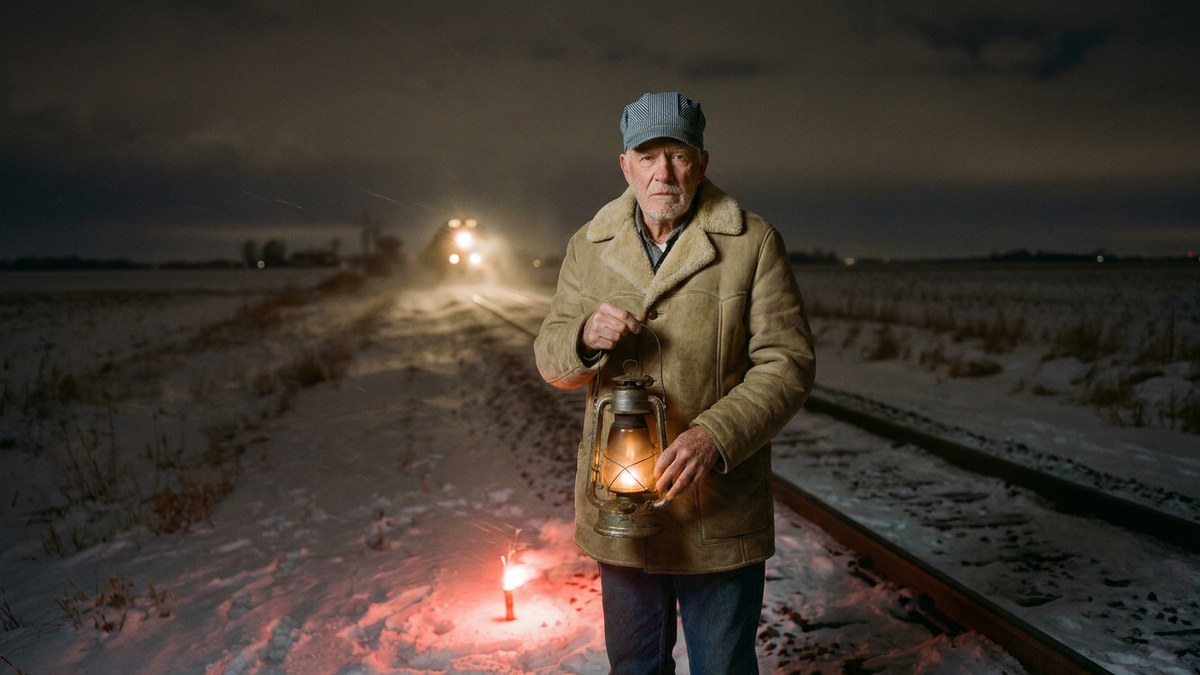
The bus slid off Grange Road at 9:22 on Christmas Eve, and its back end came to rest across the railroad tracks.
Clarence Holt saw it happen from his kitchen window. He was seventy-nine, a widower, and he'd been standing at the sink rinsing his supper plate and watching the snow come sideways across the field when the headlights swung wrong out on the road.
They went into the ditch slow, the way a heavy thing goes. Then they stopped, tilted, with the red taillights sitting right on top of the crossing.
Clarence set down the plate and looked at the clock on the stove.
It said 9:23.
He'd been an engineer for the railroad for thirty-eight years. He'd run freight across Iowa from 1966 until he retired in 2004, coal and grain and cars and containers, in heat that buckled rails and cold that froze the air hoses solid. He'd lived beside this stretch of main line for fifty of those years, and he'd never stopped listening to it.
The eastbound intermodal came through his crossing at 9:40 most nights. Double-stacked containers, a mile and a half long, doing better than fifty miles an hour on the straight. You could set a clock by it in good weather.
In weather like this, it might be a few minutes late. It wouldn't be very late.
Clarence put on his boots.
On the way out, without quite thinking about it, he took his old canvas grip bag off the shelf in the back closet. It still held what it had held on his last run in 2004. Work gloves.
A switch key on a leather strap. A railroad lantern he'd converted to batteries. And six red fusees standing in a coffee can, the long flares every train crew carries.
His late wife, Doris, used to say he'd be buried with that bag. He'd told her that was the plan.
From his front porch, the crossing was a quarter mile down Grange Road. He drove his old Ford pickup down the lane with the wipers going and the snow so thick he could barely see the fence posts.
The bus was a charter coach, white with blue stripes. Its front wheels were deep in the ditch, its nose pointed at the sky, and its back bumper hung square over the near rail. The driver was out in the snow, pushing on the rear corner with his shoulder like he could move twenty tons by himself.
"Get everybody off," Clarence yelled at him. "Off and away from the tracks. Now."
The driver turned. He was young, maybe thirty, with no hat and snow in his eyebrows. "It's just the back end. I can rock it out."
"Son, there's a train due in fifteen minutes."
The young man's face changed.
They got them off. Thirty-one people, a church youth group coming home from a ski trip in Minnesota and four chaperones and a grandmother who'd been riding along to see her grandson.
Teenagers in ski jackets, holding phones, stumbling down the steps into a foot of snow. Clarence herded them up the road to his pickup and told the grandmother to get in the cab where it was warm.
The youth pastor counted heads twice in the headlights and came up with thirty-one both times. A girl in a pink ski hat was crying, and two boys were trying to film the bus with their phones until the pastor took the phones away.
Then Clarence took out his own phone and called 911.
"I need the railroad stopped," he told the dispatcher. "There's a bus fouling the main line at the Grange Road crossing, west of Wexford."
The dispatcher was calm and quick. She said she would contact the railroad. She asked for the crossing number.
"It's on the blue sign," Clarence said. "On the crossing post."
Every railroad crossing in the country had one now. A small blue sign with a phone number and a crossing number, so anybody who saw trouble could call the railroad directly and tell them exactly where.
He walked back down to the tracks with his flashlight.
The blue sign was on the crossbuck post on the far side of the road. It was plastered solid with snow.
He reached up and scraped at it with his glove. The snow came off in a sheet, and under it was a layer of ice, and under the ice he could just make out the numbers, blurred and frozen and impossible to read.
He tried his flashlight. It made the ice glow and the numbers worse.
"Sir," the 911 dispatcher said in his ear. "I've reached the railroad. They're trying to locate the train. Do you have that crossing number?"
"I can't read it. It's iced over."
"They need it to know which train to stop."
"Tell them Grange Road, west of Wexford. Milepost," Clarence said, and stopped.
He'd known that milepost for fifty years. He'd passed it ten thousand times. And in the cold and the wind with the phone pressed to his ear, he couldn't make the number come.
The bus driver came down the road toward him with snow on his shoulders.
"It's coming," the young man said quietly.
Clarence turned toward the west.
Far off across the white fields, where the main line ran straight to the horizon, a single headlight was growing out of the snow. Then he heard it, faint and long, coming down the wind.
Two long blasts, one short, one long. The crossing signal at the next road west.
It was four minutes out. Maybe less.