"Go wake up the trail boss," Opal said. "Tell him I need ten strong kids who aren't afraid of getting dirty, and every bucket in camp."
Madison stared at her. "Mrs. Haney, you can't cook for two hundred people on a wagon."
"Hon," Opal said, "that's what it's for."
The first thing was the fire.
Everything in camp was soaked. The ranch woodpile by the corrals was a sodden heap.
The ground was mud. Rain was still coming down, softer now, steady and cold.
Opal had Garrett and two of the bigger boys stretch the wagon's canvas fly out from the side of the chuck box and tie it off to the trees, so it made a roof twenty feet square. Under it, she had them dig a trench in the mud a foot deep and eight feet long, the way Roy had shown her in 1988, and line the bottom with flat rocks from the creek bank to keep the fire up out of the water.
Then she opened the possum belly.
The firewood inside was bone dry. Oak and hickory, split small, and a coffee can of fat pine kindling on top. She'd refilled it every spring for forty years because Roy said a cook who runs out of dry wood isn't a cook, she's a guest.
She had a fire going in four minutes. In twenty, she had a bed of coals.
The second thing was the sourdough.
Opal's starter was older than the ride. It had come from Roy's grandmother, who'd kept it alive in a crock on a farm near Guthrie through the Dust Bowl. Opal fed it every night of the ride, the way she fed it every night at home, and it rode in its nest of flour sacks in the chuck box where it stayed warm.
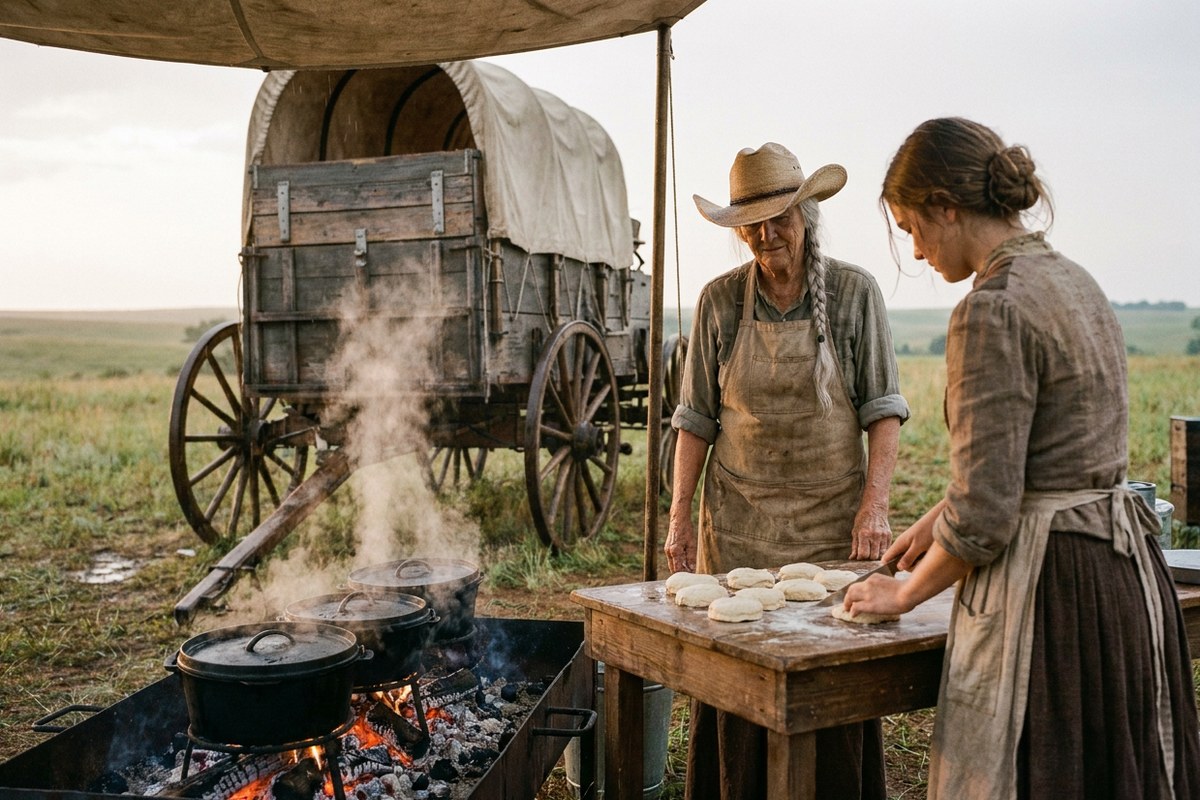
She pulled down the work-table lid on the back of the chuck box and started mixing biscuits in a dishpan. Flour, starter, salt, soda, bacon grease.
Her hands went fast. They'd done this so many times she didn't have to think about it.
Madison stood beside her in her borrowed slicker, watching.
"How many?" she asked.
"Four hundred and fifty, give or take. Two each and some extra for the boys." Opal didn't look up. "You want to help, wash your hands in that bucket and start cutting. Use the rim of that tin cup. Push straight down. Don't twist it."
Madison washed her hands. She started cutting biscuits.
By seven, Opal had eleven Dutch ovens on the coals.
She'd brought fourteen. Roy had collected them at farm sales for thirty years, cast iron with three legs and a flat lid with a rim to hold coals on top. Opal set them in a row along the trench, with shovelfuls of coals under each one and more heaped on the lids.
Four ovens of biscuits. Three of bacon and potatoes, sliced thin with an onion. Two of gravy, made in the bacon grease with flour and canned milk and plenty of pepper.
And her big graniteware coffee pots, three of them, boiling on the rocks at the end of the trench, with a crushed eggshell in each one to settle the grounds the way the trail cooks did it.
The riders smelled it before they saw it.
They came out of the wet camp in ones and twos, then in a crowd. Muddy, soaked, shivering, some of them still in sleeping bags around their shoulders. The trail boss had them line up under the fly.
The kids Opal had put to work handed out tin plates. Madison stood at the end of the line with a ladle, serving gravy, her slicker hood pushed back and flour in her hair.
Opal lifted the lid off the first oven of biscuits with her pot hook.
The steam rolled up into the gray morning. Inside, forty sourdough biscuits sat packed tight, tall and golden brown, the tops cracked open.
Somebody in the line said, "Oh, my Lord."
They ate. All two hundred and twelve. Some of them came back three times.
At noon, with the creek still roaring, Opal put the beans on. Sixty pounds of pintos with slab bacon, in the four biggest ovens, simmering all afternoon.
She made skillet cornbread. She opened the canned peaches and made six Dutch ovens of cobbler with the last of the flour and every bit of sugar in the chuck box.
That night the rain finally stopped. The riders built a fire of their own in the open, and somebody got out a guitar, and two hundred people sat on wet saddle blankets eating beans and cobbler off tin plates under the stars.
The drivers of the two food trucks waded across at sundown, where the water had dropped enough, with their arms full of brisket from their dead freezers. Opal put it in the beans.
Late that night, Madison came and sat on an overturned bucket beside the wagon while Opal scrubbed the ovens with sand from the creek.
She was quiet for a long time.
"I called it rustic," she said finally.
"You did."
"I'm sorry. I've been planning events for nine years. I've never seen anybody do what you did today. Not once." She looked at the row of black iron ovens, steaming in the cold air. "I'd like to put you in the contract. Breakfast and supper, every night, every ride. The trucks can do lunch. And I'll pay you what the trucks charge."
Opal set down an oven and wiped her hands on her apron.
"I'll need help," she said. "I'm seventy-six."
"Whatever you need."
"Then you can start at four tomorrow morning," Opal said. "Wash your hands in the bucket."
At dawn, Madison was there.
The creek had gone down in the night. The sky was clean and pale and cold. Opal had the coals going in the trench, and the Dutch ovens in their long row, and when she lifted the lids one by one, the steam rose straight up into the still air like smoke from a row of chimneys.
Madison stood at the work table cutting biscuits with the rim of a tin cup. Straight down. No twist.