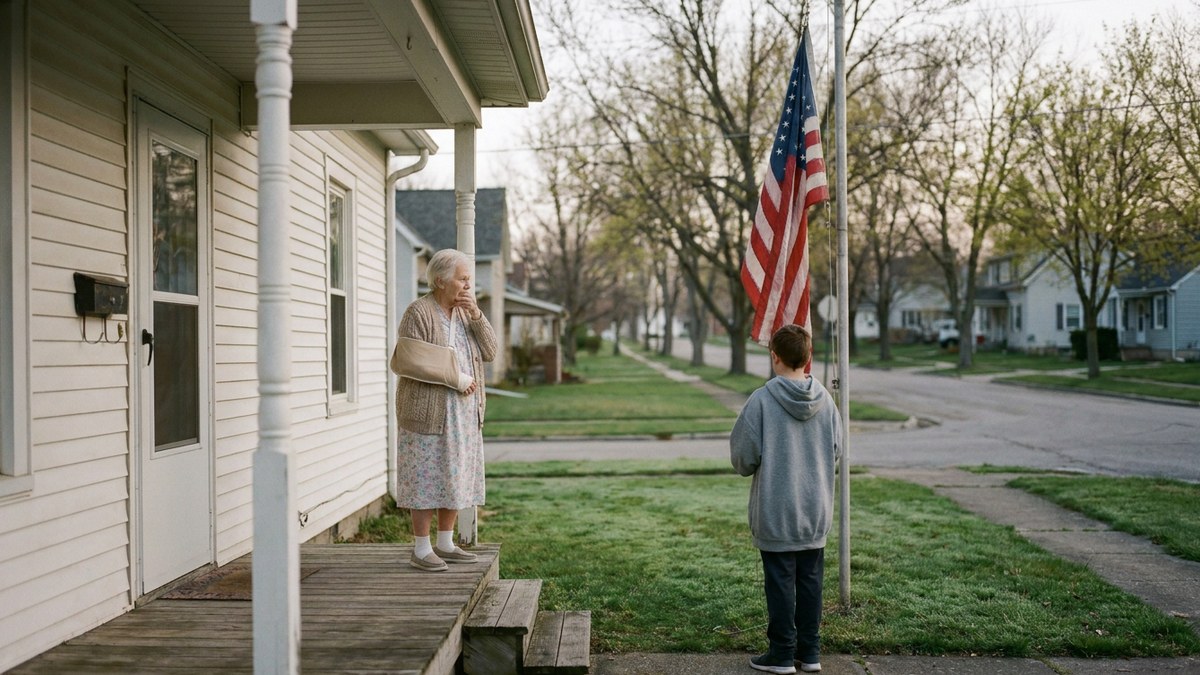
For fifty-one years the flag went up at seven, and this spring Ida Lindahl's shoulder wouldn't let her do it.
She tried on Monday. She stood on the front walk in her housecoat and her garden shoes at five minutes to seven, the way she had every morning since Gordon died, and clipped the flag to the rope on the pole by the porch. Then she took hold of the rope and pulled.
Her right arm went up as far as her chin and stopped. A hot, bright pain went through her shoulder like a nail.
She tried again. Then with her left hand only. The flag climbed four feet up the pole and hung there, crooked, while she held the rope with both hands and her eyes watered.
At last, very carefully, she lowered it back down before it could touch the ground, unclipped it, and sat down on the porch step with the flag folded in her lap.
When she finally went inside, she left it on the porch, folded on the seat of the wicker chair where Gordon used to sit. She couldn't bear to carry it into the house.
Gordon had put up the pole in the spring of 1976.
It was the bicentennial year. Half the houses on Cedar Street had bunting on their porches that summer, and Gordon, who'd come home from the Army in 1968 and didn't talk about it much, had wanted something more permanent.
He dug the hole himself. He set a twenty-foot aluminum pole in a yard of concrete beside the front porch of their little white house in Alder Creek, Michigan, and on the Fourth of July, he raised the flag on it for the first time.
After that, he raised it every morning at seven. He lowered it every evening at sunset.
Rain or shine or snow. He never missed a day that he wasn't in the hospital.
When he got too sick to do it, the last winter, Ida did it for him while he watched from the front window. When he died, in March of 2023, she just kept doing it.
That was what you did. You kept doing it.
Her doctor said it was a torn rotator cuff. Probably from shoveling. Probably it had been coming for years.
"Physical therapy," he said. "Maybe surgery, if that doesn't help. But Ida, no lifting your arm above your shoulder. Not for a good while."
"How long is a good while?"
"Months. Maybe longer, at eighty-one."
So on Tuesday, she didn't try. She stood at the front window at seven with her arm in a sling and looked at the bare pole, and she felt something she hadn't let herself feel since the funeral.
On Wednesday, she didn't even go to the window.
The new people across the street had moved in last fall. A young woman and her boy.
Ida had waved at them a few times and brought over a coffee cake at Thanksgiving, and the young woman had thanked her very kindly. The boy had stood behind his mother's legs and hadn't said a word.
He was eleven or twelve, Ida guessed. Thin, with a buzz cut and a big gray hoodie that hung almost to his knees. He waited for the school bus every morning at the end of Ida's walk, because that was where the bus stopped.
He'd stand there with his hands in his hoodie pocket and his backpack on, looking at his shoes. In seven months, he'd never once said good morning.
Ida had heard from the woman at the post office that the boy's father was in the Army. Deployed overseas since last summer.
The boy had been at the bus stop on Monday morning. Ida remembered that now. He must have seen the whole thing.
The flag hanging crooked halfway up. Her sitting on the step with her face in her good hand.
She'd been too upset to care.
On Wednesday night, she sat at the kitchen table and wrote a note to the Alder Creek VFW. She asked if one of their members might come by and take the flagpole down.
She'd give it to them for the post, she wrote, or for anybody who could use it. She just couldn't look at it bare anymore.
She put a stamp on the envelope and set it by the door to mail in the morning.
Then she went to bed early and cried, which she had not done in a long time.
On Thursday morning, Ida woke at six-thirty, the way she always did.
She lay there for a while listening to the house. Then she got up and put on her housecoat and went to the kitchen to make coffee.
She didn't look out the front window. She'd made up her mind not to.
But the light was coming in through the window over the sink, and when she reached for the coffee can, she saw something on the white siding of the garage next door that stopped her hand.
A shadow. Moving gently back and forth in the early sun.
The shadow of a flag.
Ida went to the front window with her heart pounding.
The flag was flying. At the top of Gordon's pole, full and bright in the morning breeze off the lake, exactly where it belonged.
The clock on the stove said 7:04. The envelope to the VFW was still lying by the front door.
And Ida Lindahl had not raised it.