The wicker chair on the porch was empty. The flag was gone from it.
Ida stood at the front window for a long time, watching it fly. Then she went and sat down at the kitchen table with her coffee, and she didn't mail the letter to the VFW.
She had a pretty good idea who'd done it. She wanted to be sure.
At sunset on Thursday, she sat by the front window with the lights off.
The flag was still flying. The sun went down behind the houses on the other side of Cedar Street, and the sky over the lake went orange and then pink, and Ida waited.
At 8:41, the front door across the street opened, and the boy came out.
He came across the street at a jog, in his big gray hoodie, looking both ways twice. He went straight to the pole and unwound the rope from the cleat. He'd tied it in some kind of a knot, Ida could see from the window, a big lumpy knot that no Boy Scout would have been proud of.
He worked at it for a while. Then he got it loose and started pulling the flag down, hand over hand, too fast.
It came down in a rush and fell into his arms in a heap. One corner of it slid down past his elbow and brushed the grass.
The boy gasped. He actually gasped, out loud. Ida heard it through the window glass.
That was when she opened the front door.
"Not like that, honey," she said gently.
The boy froze. He stood there in the dusk with the flag bunched up against his chest, staring at her like a deer in the road, and for a second, Ida thought he was going to drop it and run.
"I'm sorry," he said. "I'm sorry, ma'am. I didn't mean to. It touched the ground. I'm really sorry."
"It's all right."
"I saw you on Monday. When it wouldn't go up." The words were coming out of him fast now, like he'd been holding them for days. "And then it wasn't up on Tuesday or Wednesday, and I thought, she always does it, every day, I watch from my window. And my dad said before he left, Jonah, you take care of things while I'm gone. And I don't know how to take care of anything. But I figured I could do that."
He stopped, out of breath.
Ida came down the porch steps slowly, holding the rail with her good hand.
"Jonah," she said. "Is that your name?"
He nodded.
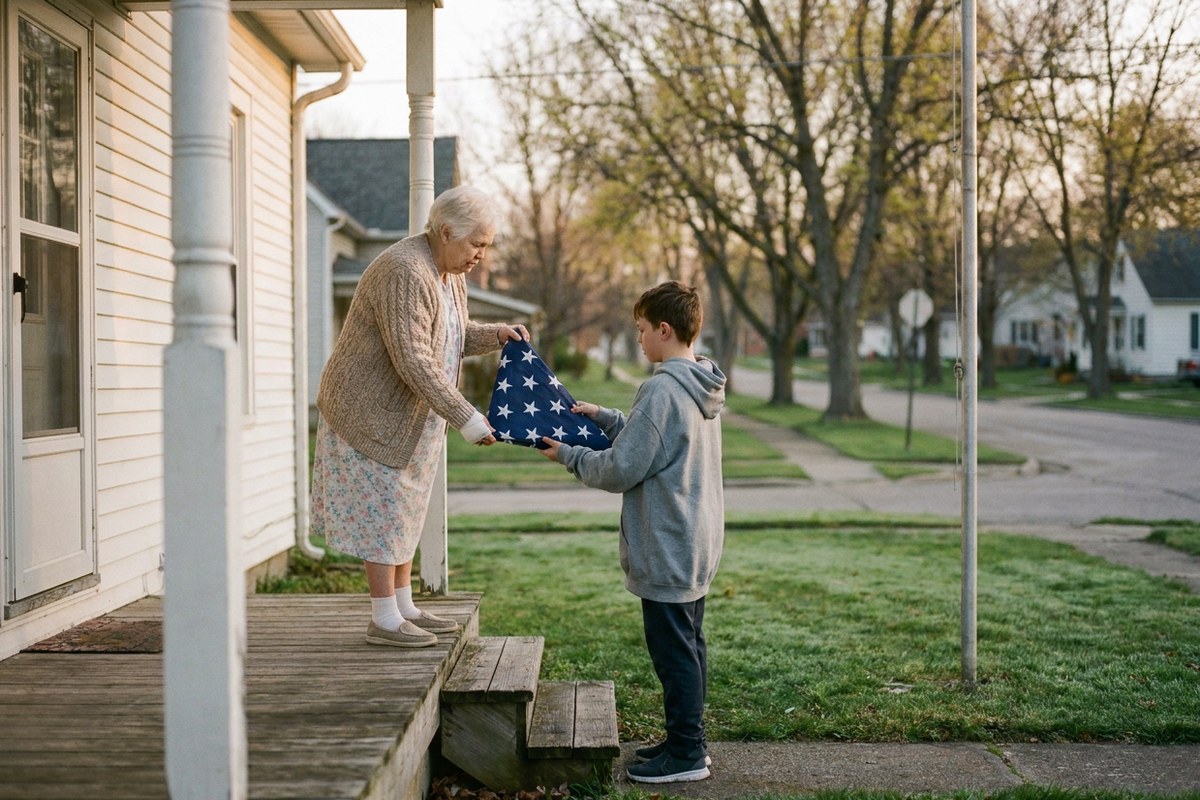
"Well, Jonah. You did take care of it." She held out her good arm. "Come up on the porch, and I'll show you how to fold it. My husband would want you to know it right."
She couldn't do the folding herself, not with one arm. So she told him, step by step, and he did it.
Fold it in half the long way. Then in half again, the long way, with the blue on the outside. Start at the striped end and make a triangle, then another, then another, all the way down.
Thirteen folds, if you do it right. Tuck the last of it into the pocket, so only the blue and the stars show.
Jonah got it on the third try. When he held it up, a neat tight triangle of stars, his ears went red.
"My dad folds them like that," he said. "At the base. I've seen him."
"Then your dad knows what he's doing."
"Is it okay that it touched the ground? I looked it up. It says it's not supposed to."
"It's not supposed to," Ida said. "But it's an accident, and you picked it right up, and you're sorry. That's all anybody ever asked of a person." She smiled. "Gordon dropped it in the snow once, in 1981. He was so upset, he didn't eat his supper."
After that, Jonah came every morning at five to seven.
Ida taught him the rest of it, a little at a time, on the porch steps. Raise it briskly, all the way to the top. Lower it slowly.
Never let it touch anything beneath it. Take it down in the rain, unless it's an all-weather flag, which this one was, but Gordon took it down anyway. Never fly it upside down unless you're in real trouble.
He learned to tie a proper cleat hitch. He learned the date Gordon put up the pole. He learned that Gordon had served in the Army from 1966 to 1968, and had been a mail carrier in Alder Creek for thirty years after that, and had taught half the kids on Cedar Street to ride a bike.
Ida learned things too. That Jonah's dad was a staff sergeant.
That Jonah talked to him on a video call every Sunday, at a strange hour, because of the time difference. That his mother worked nights at the hospital in Saginaw and slept in the mornings, so Jonah got himself up and dressed for school every day and he'd never once been asked if he minded.
He minded, a little. He said so on the porch, one morning in May, and then looked surprised he'd said it.
Ida didn't say anything. She just started baking a coffee cake every Saturday and sending it across the street.
On Memorial Day, the flag went to half-staff.
Jonah had learned how. He raised it briskly to the very top, held it there for one moment, and then lowered it slowly to the middle of the pole, where it would stay until noon. Then it would go back to the top, for the living.
At ten o'clock, the little Alder Creek Memorial Day parade came down Cedar Street. Two fire trucks, the high school band, the Cub Scouts, and the VFW post in their caps, walking slow.
At the front of the parade, carrying the folded flag from Gordon Lindahl's pole on a white pillow, walked an eleven-year-old boy in a borrowed white shirt and a too-big tie. Ida had written the VFW a different letter, in the end.
Ida watched from her porch. And Jonah's mother stood beside her, holding her phone up to the parade, with a staff sergeant in a tan uniform watching from the other side of the world.
That evening at sunset, they took the flag down together on the porch.
The boy lowered it slowly, hand over hand. The old woman caught the end with her good hand so it couldn't touch anything beneath it. Then they stood at the top of the steps, one at each end, and folded it in the last of the light, thirteen folds, until only the stars were showing.