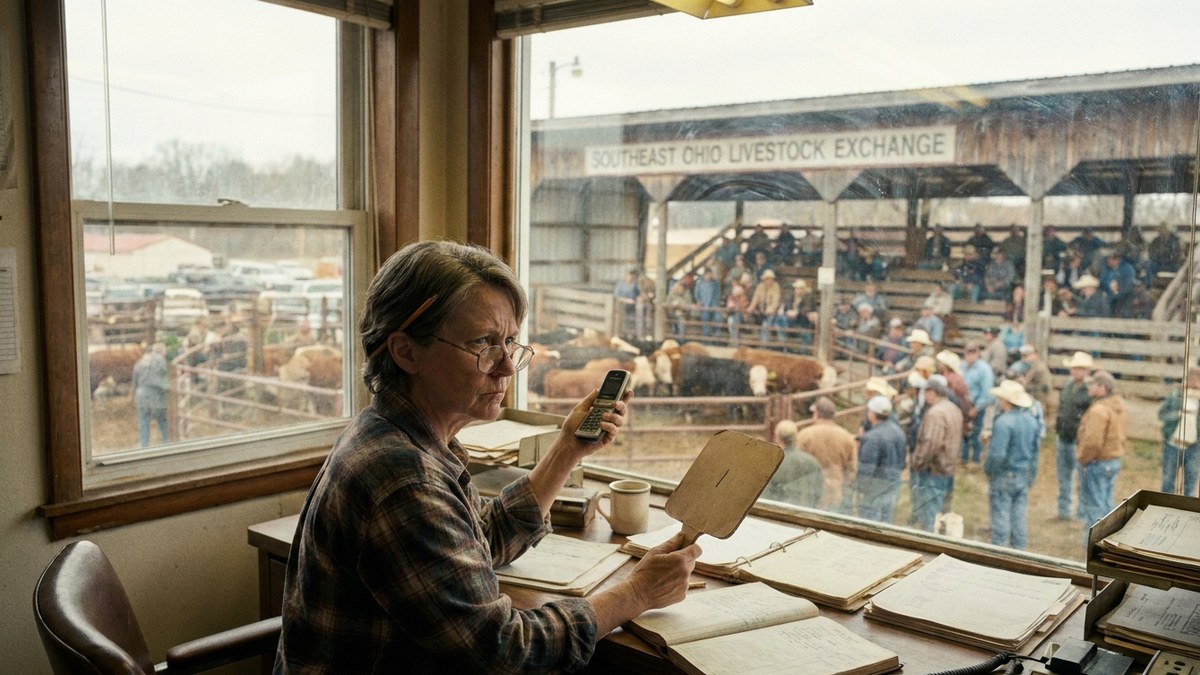
Bidder number 217 had never bought a thing at the Calder County sale barn, and today he was bidding on everything a widow owned.
Bev Truitt noticed it on the fourth lot.
She was at her desk in the office, behind the big window that looked down into the sale ring, with her ledger open and her pencil behind her ear and a cup of coffee going cold at her elbow. She'd sat at that desk for thirty-one years. From that window, she'd watched more cattle sell than there were people in Calder County.
Down in the ring, Ray Dunbar was selling Glen Sayre's cows.
Bev was fifty-eight. She'd started in that office at twenty-seven, back when the barn still ran on carbon paper, and she'd kept every sale book since. She could tell you what a bred heifer brought in March of 1999, and who bought her, and whether his check cleared.
Ray liked to say she was the only thing in the barn that had never once broken down.
Glen Sayre had died in January, at eighty-one, after sixty years of raising good Angus cattle on a hill farm off Lutz Hollow Road. His widow, Loretta, was seventy-nine. She couldn't keep up with sixty cows by herself.
So this was a dispersal sale. The whole herd, plus Glen's equipment, the third Saturday in April.
It was a big crowd. Glen had been well liked, and his cattle were known. Buyers had come from three counties.
Clay Hollister sat in his usual place in the back row with his hat tipped down. Tanner Briggs, the young cattle buyer Clay was teaching, sat beside him.
And Loretta's nephew, Jared Sayre, stood by the ring gate in a new barn coat, watching the board.
Jared was thirty-eight, from Columbus. He'd come down in February to help his aunt "get things organized," and he'd organized the sale himself. He'd called Bev's office fourteen times that week alone. Bev knew it was fourteen, because she wrote every call down on the pad by her phone, the way she had for thirty-one years.
He'd also signed a paper with Loretta, Bev had heard, that gave him ten percent of whatever the sale brought in. As a management fee.
Lot four was a pair, a nine-year-old cow with a heifer calf at her side. Good cattle. Bev would have guessed eighteen hundred dollars for the pair.
The bidding went to eighteen hundred and stopped. Then a hand went up in the top row of the bleachers, on the far side.
Nineteen hundred.
The young farmer who'd bid eighteen hundred frowned and went to nineteen-fifty. The hand in the top row went to two thousand.
The farmer went to twenty-one. The top row went quiet.
"Sold, twenty-one hundred," Ray called. "Buyer number 88."
The young farmer looked unhappy. He'd paid three hundred dollars more than he meant to.
Bev looked at the top row. The bidder was a man of about forty in a gray ball cap and sunglasses, sitting by himself.
He held his card in his lap. She could just make out the number.
217.
She watched him through lot five. And six. And seven.
Every time, the same thing happened. The bidding would slow down near what the cattle were worth. And then 217 would come in and push it up.
Fifty dollars. A hundred.
Two hundred, once. And every time, just before the last bid, he'd drop out and let somebody else have it.
He hadn't bought a single animal. He'd only made them cost more.
Bev pulled out her bidder registration file. The cards were in a gray metal box, in number order. 217 was near the back.
Name: R. Miller.
Address: Belpre, Ohio. And a phone number, written in blue ballpoint, in square, careful printing.
She didn't know any R. Miller from Belpre.
She knew most of the cattle buyers in southeast Ohio, and their wives, and their kids' names. She'd never heard of this one.
Behind her, the new office girl, Kayla, nineteen, was answering the phone and taking checks.
"Kayla, hon," Bev said. "Who registered bidder 217?"
Kayla thought. "Some guy in a gray cap. About nine-thirty. You were at the coffee pot." She shrugged. "He said he was a buyer from down by the river. He was real friendly."
Bev thought about the pens.
Every real buyer walked the pens before a sale. They leaned on the rails and looked at feet and udders and eyes.
Bev had watched them do it all morning from her window. She hadn't seen a gray cap among them once.
Down in the ring, lot twelve was selling. Glen's best cow, a big black eight-year-old with a bull calf. Bev watched the bidding climb to twenty-six hundred.
Then the gray cap went up in the top row. Twenty-seven. Twenty-eight.
Bev looked down at Jared Sayre by the ring gate.
He was watching the board. And as the bid went to twenty-eight hundred, he reached up and touched the brim of his cap, just once, quickly, like a man swatting a fly.
In the top row, 217 dropped out.
Bev sat very still.
Then she took her cell phone out of her purse, and looked at the registration card in her hand, and dialed the number written on it in square, careful printing.
There was a second of silence on the line.
And then, two feet away from her on the corner of her own desk, the office phone began to ring.