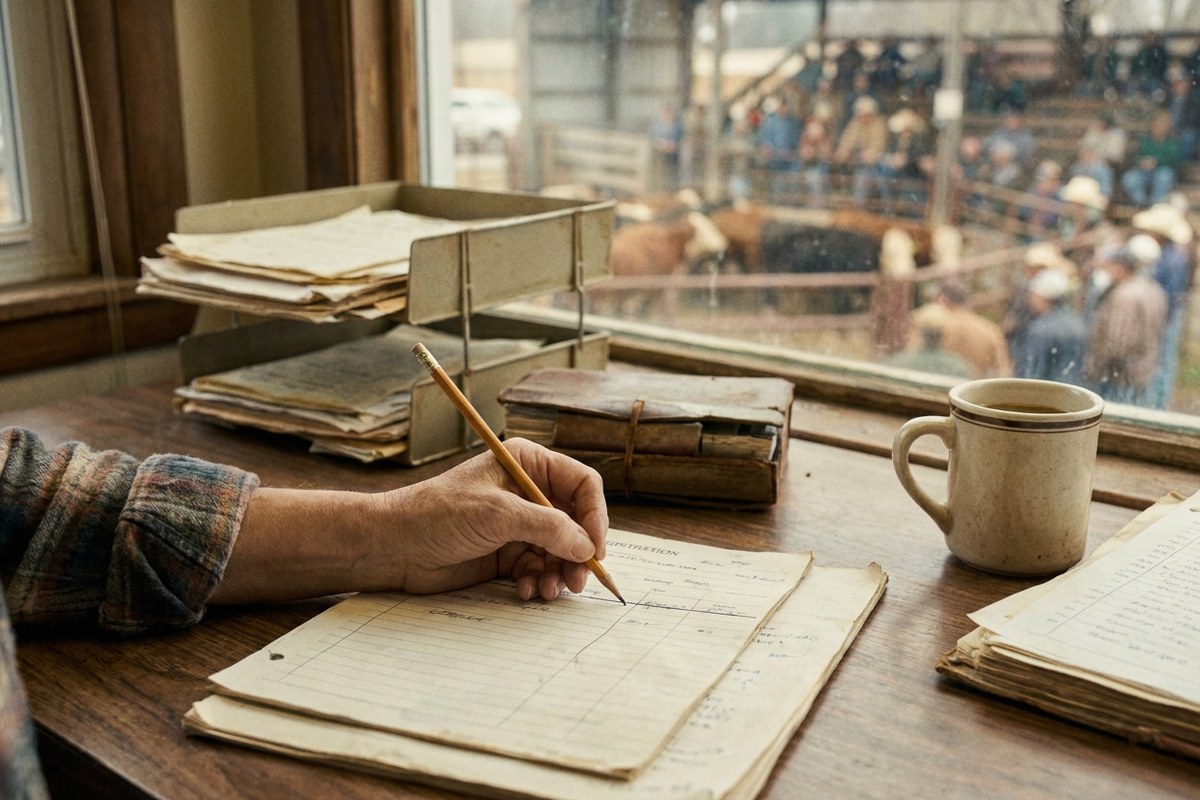
Bev let it ring three times. Then she hung up.
Kayla was staring at her. "Bev? Why'd you call us?"
"I didn't, hon," Bev said. "Bidder 217 did."
She looked down at the ring. At Jared Sayre by the gate, in his new barn coat, watching the board. He'd called that office number fourteen times this week.
He knew it by heart. A man who has to make up a phone number in a hurry writes down the first one that comes into his head.
Bev tore a sheet off her pad and wrote on it in pencil. Then she folded it and handed it to Kayla.
"Take this down to Ray," she said. "Don't run. Hand it to him like it's a lunch order."
Ray Dunbar read the note between lots without changing his face. He'd been calling sales for forty-six years. He'd seen men try to cheat at an auction every way there was, and he'd learned a long time ago that the best way to catch a shill is to let him catch himself.
Lot thirteen came into the ring. A good young cow with a heifer calf.
The bidding climbed to two thousand. It slowed. And the gray cap in the top row went up.
Twenty-one hundred.
Ray looked at the young farmer who'd been bidding against him, and at the farmer's empty hands. Then he looked at the gray cap for a long, slow moment.
"Twenty-one hundred," he said. "I've got twenty-one hundred in the top row. Do I hear twenty-two?" He waited one beat. Then he brought his hand down on the stand. "Sold. Twenty-one hundred dollars. Bidder 217."
In the top row, the man in the gray cap went white.
It was something to see. He stood halfway up, then sat down again.
His mouth opened. He looked toward the ring gate, where Jared Sayre had stopped watching the board and started looking at his boots.
"Mr. Miller," Ray said into the microphone, pleasantly, "the office is right up those stairs. Bev'll take your check."
The man in the gray cap didn't move.
Down in the back row, Clay Hollister pushed his hat up off his eyes and said, loud enough for half the barn to hear, "Well, I'll be."
Bev did it in her office, with the door closed, with Ray standing by the window and Loretta Sayre sitting in the good chair.
The man in the gray cap was named Rodney Miller, it turned out. That part had been true. He was a friend of Jared's from Columbus, and he didn't own a cow or a check that would cover one.
He told them everything inside of five minutes. Jared had offered him two hundred dollars to sit in the top row and run the prices up. Jared would touch his cap when it was time to stop.
Then Jared told the rest.
Credit cards. A car loan. A business in Columbus that had gone under in the fall.
And ten percent of everything his aunt's cattle brought in. Every extra hundred dollars the neighbors paid, he got ten of it.
"I wasn't stealing from Aunt Loretta," he said. He couldn't look at her. "She was getting more money. I thought that was good for her."
"You were stealing from the neighbors, son," Ray said quietly. "Every man who bought one of those cows paid for your friend's bids. It's called shill bidding. It's against the law, and it's the fastest way I know to ruin a sale barn's good name. And it was your uncle's name on those cattle."
Loretta Sayre hadn't said a word. She sat in the good chair with her purse in her lap, very straight, and looked at her nephew.
"Glen would have been so ashamed," she said at last. Not angry. Just tired. "Oh, Jared."
Bev had the sale book open on her desk. She'd been working on it while they talked.
She'd marked every lot where 217 had bid. Fourteen of them. And for each one, she'd found the last honest bid before 217 came in, the last bid from a real buyer, and written it beside the price in pencil.
"The law gives the buyer a choice on this one," she said. "When a seller's side puts in a fake bid, he can walk away from the sale, or he can keep the animal at the last good bid before the fake one came in." She turned the book around so Loretta could see it. "That's fourteen buyers who paid too much. Four thousand three hundred and fifty dollars, all told."
Loretta looked at the numbers for a long time.
"Then they'll get it back," she said. "Every dollar. Today." She turned to her nephew. "And it'll come out of your ten percent, Jared. All of it. Whatever's left over, you can keep, and then you can go home."
Jared nodded without looking up.
"Do you want the sheriff, Loretta?" Ray asked gently.
Loretta was quiet.
"No," she said finally. "I want my husband's cows sold honest. That's all I ever wanted."
They did it right there, before the sale went on. Ray stood at the stand and told the crowd plainly what had happened, without naming anybody.
He said every buyer on those fourteen lots could stop by the office and get the difference back, or give back the animal, their choice. Not one of them gave back a cow.
Then he went on selling Glen Sayre's cattle, honest, to the end.
The last lot sold at four in the afternoon. The prices were good. Not inflated.
Just good, the way Glen's cattle had always been. Loretta Sayre went home with more money than she'd expected, and with every neighbor in the barn stopping to shake her hand on the way out.
When the barn was empty and the lights were off in the ring, Bev sat at her desk and finished the day's books.
She opened the bidder registration sheet to 217. R. Miller.
Belpre, Ohio. A phone number that rang two feet from her elbow.
She took the pencil from behind her ear and drew one straight, neat line through it.